
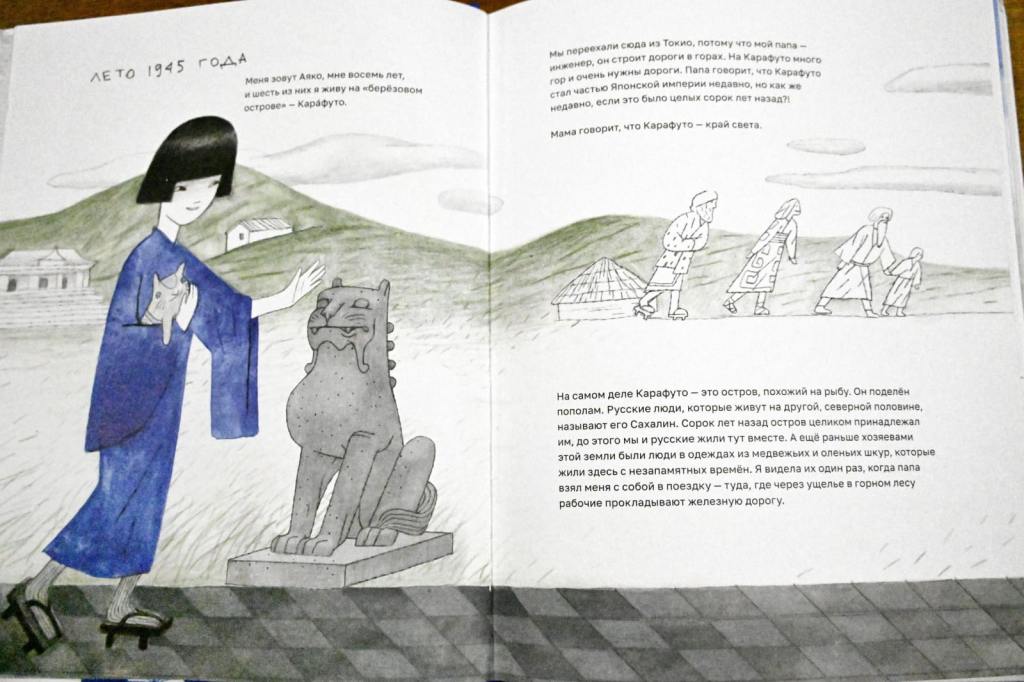
MOSCOW – A children’s book released in Russia last year explores the stories of Japanese civilians who were compelled to depart from Karafuto, situated on the current Russian Far East island of Sakhalin, at the conclusion of World War II, a topic that has garnered little focus within the nation.
Named “Shard of Karafuto,” the book illustrates the friendship between a Japanese and a Russian girl and takes place in Karafuto, the southern region of Sakhalin that Japan controlled until its loss in 1945.
The narrative examines the forced removal of Japanese inhabitants after the Soviet takeover of the island in August of that year.
The writer, Elena Golovanova, resides in Ravenna, northern Italy, and contributes to Russian lifestyle publications. She mentioned that the concept for the book started forming in 2021, when she temporarily returned to Russia.
While exploring a café in the heart of Tyumen, Golovanova spotted a tea bowl exhibited with the label “early 20th-century Japanese ceramics.” She inquired with a café staff member about the presence of a Japanese artifact and was informed that such items were being uncovered on Sakhalin.
Golovanova later discovered that common household objects from the time of Japanese occupation are still being uncovered on the island, and that artists occasionally gather fragments of the pottery and turn them into ornamental items.
Her fascination with Karafuto was deepened by discussions with her friend Miki Homma, who resides in Ravenna and hails from Sapporo in northern Japan.
Homma informed Golovanova that her father left Toyohara, which is now known as Yuzhno-Sakhalinsk on Sakhalin, along with his parents when he was 9 years old during the Soviet invasion, and later returned to Hokkaido.
When Golovanova spoke about the tea cups discovered on Sakhalin, Homma considered her own family’s history. “I believe ours are likely buried somewhere as well,” she remarked.
Unable to stop thinking about the subject, Golovanova chose to produce a picture book. She researched the history of Karafuto through documents and lectures before crafting the narrative.
The story centers on Ayako, an 8-year-old Japanese girl residing in Karafuto during the final days of the war. In the autumn of 1946, Soviet officials instruct her family to leave within 24 hours. With minimal time to get ready and unable to carry most of their possessions, Ayako buries her favorite teacup—adorned with a rabbit—in a forest, wishing she would someday come back to get it.
The narrative then jumps ahead several decades to the autumn of 2025. Ayako’s granddaughter, Fumiko, goes to Sakhalin with her parents. There, she becomes friends with a local Russian girl named Marina.
When the two girls separate, Marina gives Fumiko a necklace crafted from a piece of ceramic she discovered on the beach and had cherished. The fragment features the image of a rabbit.
After coming back home, Fumiko shows the necklace to Ayako. Upon seeing the rabbit, Ayako’s fingers shake as she identifies the design.
The book was released by the St. Petersburg-based publisher Polyandria. In a statement, the publisher characterized the work as depicting individual stories within a larger historical framework, noting that the writing was thoughtfully crafted.
Golovanova mentioned that her family’s background shaped the project.
Her grandmother was sent from Russia to Central Asia in the 1930s under the rule of Joseph Stalin.
Regrettably, refugees continue to be a significant issue in the world, throughout history and today,” Golovanova stated. “I aimed to illustrate this.




 jasdooit
Leave a comment