
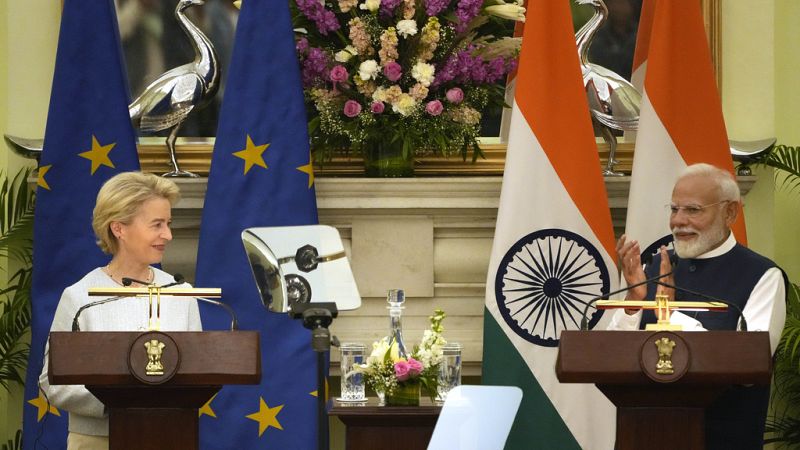
Following several months of rigorous discussions, the European Commission announced on Tuesday a trade agreement with India that significantly lowers tariffs on EU goods, ranging from automobiles to wine, as the global community seeks new markets in the wake of President Donald Trump’s tariff measures.
The statement was issued during a top-level visit by European officials, including Commission President Ursula von der Leyen. Both nations celebrated a “new era in strategic partnerships” as the two seek replacements for the US market.
India is currently encountering a 50% tariff imposed by the Trump administration, which has significantly harmed its exports. Following the recent signing of the Mercosur agreement with Latin American nations, the EU has stated its intention to accelerate its trade plans with new partners.
We accomplished it — we closed the greatest deal of all time,” von der Leyen stated following the announcement. “This is the story of two major entities that have opted for collaboration in a genuine win-win manner. A powerful message that cooperation is the optimal solution to global challenges.
Discussions stretched until the last moment with negotiators convening over the weekend and during the early hours of Monday. The agreement claims it will enhance the “untapped” potential of their merged markets but excluded politically delicate areas like agriculture.
The EU’s influential trade representative, Maroš Šefčovič, who is responsible for negotiations on behalf of the 27 EU member states, stated that Brussels seeks a swift implementation by 2027.
In an interview conducted in Delhi following the announcement of the deal, Šefčovič stated that the India agreement highlights the EU’s updated strategy regarding trade: focusing more on practical outcomes rather than being constrained by political boundaries.
“We restarted discussions with a fresh approach, making it very clear: if this is delicate for you, we can avoid it,” Šefčovič said, referring to the strategy as a turning point.
A victory for European exports aiming to access the Indian market
According to the agreement, the EU plans to double its goods exports to India by 2032 by reducing tariffs on about 96% of its exports to the nation, resulting in annual savings of approximately €4 billion in duties. When fully realized, the agreement establishes a market shared by 2 billion people.
European automakers benefit as Indian customs duties are progressively lowered from 110% to 10% through a quota system. Tariffs in areas such as machinery, chemicals, and pharmaceuticals will also be largely removed.
Wine and alcoholic beverages, major exports for nations such as France, Italy, and Spain, will experience a reduction in tariffs from 150% to approximately 20 to 30%. Tariffs on olive oil will be eliminated, dropping from 40% to nothing.
Following years of conflicts with EU farmers,The Commission stated that certain agricultural products were not included in the agreement, specifically omitting beef, chicken, rice, and sugar.
Regarding India, the agreement maintains the trade conditions for dairy and grain as they are, in accordance with the requests of Indian officials, who considered it a critical issue.
The Commission, representing the EU’s 27 member nations in the negotiations, stated that the agreement features a specific sustainable development section “which strengthens environmental safeguards and tackles climate change.”
The deal does not include geographical indications, anothercontentious zone for negotiators, which will be handled in a separate agreement designed to safeguard EU goods from duplication in the Indian market.
Deal finalized due to pressure from Trump’s tariffs
The timing of the agreement is significant as both parties aim to reduce economic risks posed by Trump’s tariffs.
The EU experienced a tripling of tariffs to 15% last year as part of a disputed agreement, while India is currently facing a 50% tariff policy from Washington.
The administration of Donald Trump imposed an extra 25% tax on India the previous year as a penalty for purchasing Russian oil, a move that India has justified by emphasizing the necessity of affordable energy to support a population of 1.4 billion.
Discussions between the EU and India initially started in 2007 but soon faced challenges.
Discussions were restarted in 2022, with conversations becoming more active last year as both parties aimed to mitigate the effects of Trump’s potential return to the White House.
Following the signing of the agreement during a two-day visit on Tuesday, with the heads of the Commission and the European Council serving as honored guests, the EU stated that the deal demonstrates that “rules-based cooperation” continues to be the favored approach for the union—and an increasing number of partners spanning from Latin America to India.
Prior to the agreement being put into effect, the European Council and the European Parliament must approve it, which could turn into a challenging procedure.
The Commission aims to start putting the agreement into action from January 2027.
This tale has been revised with remarks from Commissioner Šefčovic. View it online and on television.



 jasdooit
Leave a comment