
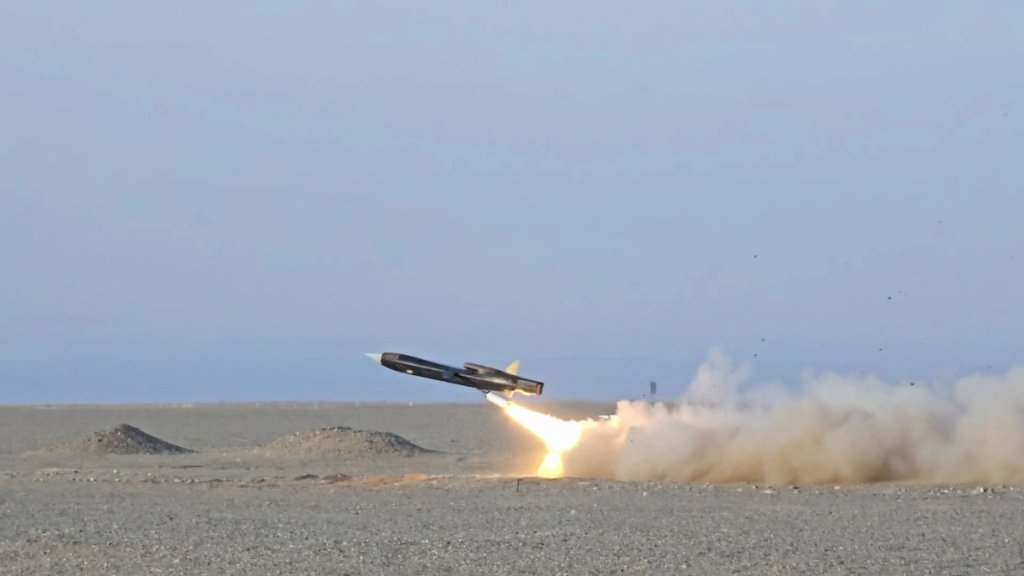
A streamlined tail nozzle developed in Nanjing demonstrates its effectiveness during a high-subsonic speed drone trial.
For the first time globally, Chinese scientists conducted a flight test of advanced thrust technology in a high-speed drone, marking the conclusion of almost 20 years of research led by the principal scientist.
The more lightweight and straightforward aerodynamic thrust vectoring system eliminates the intricate mechanical components found in advanced fighter jets such as the F-35B and Su-37, redirecting engine exhaust to enhance the aircraft’s agility.
Last month, Nanjing University of Aeronautics and Astronautics reported that a group headed by Professor Xu Jinglei achieved success in testing an aerodynamic thrust vectoring nozzle on a drone traveling at high subsonic speeds.
Are you curious about the most significant issues and developments from across the globe? Find the solutions withSCMP Knowledge, our latest platform featuring curated content including explainers, FAQs, analyses, and infographics, presented by our acclaimed team.
In contrast to conventional systems that use bulky, intricate moving parts, the latest system enhances flexibility by employing a light-weight nozzle that has no moving elements.
The trial took place in a desert located in the nation’s northwest, utilizing the CK300 high-subsonic unmanned aerial vehicle (UAV).
The plane measures 3.6 meters (11.8 feet) in length and has a maximum takeoff weight of 140kg (308lbs), a service ceiling of 13,000 meters, and a top speed of 0.9 Mach.
“This successful experiment represents the world’s initial flight test of a high-subsonic medium-to-large unmanned aerial vehicle equipped with an aerodynamic thrust vectoring nozzle,” the university stated.
The technology significantly enhanced the UAV’s agility and successfully minimized its turning radius, with all performance indicators surpassing expectations.
“Crucially, thrust vector control was accomplished merely by replacing the tail nozzle, without [needing] any significant changes to the UAV platform itself.
This highlights the platform’s remarkable compatibility, along with the outstanding integration capabilities of the new aerodynamic vectoring nozzle.
Thrust vector control is an essential technology in contemporary high-agility fighter jets, such as stealth planes. It not only delivers forward propulsion but also creates directional forces for pitch, yaw, and roll. Additionally, it enhances maneuverability and aerial combat effectiveness, allowing for brief takeoff and landing distances.
Current thrust vectoring systems are primarily mechanical and are extensively employed in modern fighter jets like the F-22, F-35B, Su-35, and Su-37.
Although its control logic is simple and sequential, it may be cumbersome, feature excessive components, and exhibit delayed reactions.
The aerodynamic method addresses several of these drawbacks, although it is difficult to implement.
Aerodynamic configurations often involve extracting air from the engine or an external high-pressure supply, which raises engine workload and system intricacy, resulting in reduced thrust and diminished efficiency.
Xu’s group overcame several significant technical obstacles, such as effective deflection across a broad range of angles. During this effort, they obtained over 50 patents, a national defense award, and were acknowledged as the leading entity in this area domestically.
The findings stem from thorough preparation.
In 2013, the group enhanced a current nozzle configuration by incorporating an internal flow channel, allowing for vector thrust without compromising engine performance. This resulted in a 2019 flight test of a drone without a rudder, utilizing the nozzle, as recorded in the Journal of Aerospace Power.
A 2021 patent issued to the group described a short take-off and vertical landing aircraft utilizing an aerodynamic vectoring nozzle. During takeoff, the nozzle directs downward; as velocity and wing lift rise, it slowly adjusts, shifting into horizontal flight.
The university’s 2023 collection of scientific accomplishments focused on vectoring nozzle technology.
It mentioned that in comparison to existing products, this nozzle reduced the number of parts by half, decreased weight by over 20 percent, and enhanced the host aircraft’s top speed by 5 percent and its range by 7 percent.
More Articles from SCMP
This piece was first published in the South China Morning Post (www.scmp.com), a top news outlet covering China and Asia.
Copyright (c) 2026. South China Morning Post Publishers Ltd. All rights reserved.


 jasdooit
Leave a comment