
Although numerous glaciers across the globe are rapidly disappearing, researchers have been puzzled by the fact that certain ones are acting in a completely different manner.
A group of researchers from around the world has identified 3,100 glaciers in the Arctic, High Mountain regionsAsia, and the Andes that are ‘surging’.
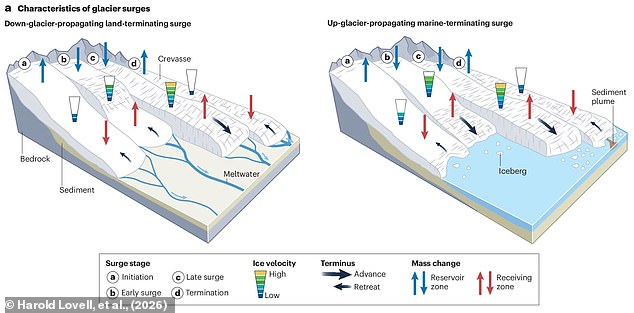
During a surge, a glacier travels significantly quicker than usual, transporting large amounts of ice to the forefront and frequently extending forward.
Although this may seem beneficial, specialists caution that it could be even more “problematic” than the melting of glaciers.
Accelerating causes glaciers to become significantly more susceptible to the impacts ofclimate change, and glaciers that experience surges account for a significant portion of the ice lost in certain areas.
Although this is negative news for the glaciers, the situation is more severe for the individuals residing near them.
Lead author Dr. Harold Lovell, a glaciologist at the University of Portsmouth, states: ‘They accumulate ice like a savings account and then expend it all rapidly, similar to a Black Friday sale.’
However, although they make up only 1 percent of all glaciers globally, they cover nearly one-fifth of the total glacier area, and their actions can lead to significant and occasionally devastating natural disasters impacting thousands of individuals.
In contrast to the majority of glaciers that advance slowly, surging glaciers experience sudden episodes of fast movement that last several years, succeeded by long intervals of inactivity.
Scientists are not completely certain what causes these surges, but studies indicate they are likely connected to the conditions beneath the glacier, where the ice touches the ground.
These glaciers hold large amounts of ice until intense rain or warm temperatures cause water to accumulate under the ice, decreasing resistance and enabling the glacier to move downward.
Even though it may appear for a short time that the glacier is moving forward, the outcomes are typically devastating for the glacier.
Dr. Lovell said to the Daily Mail, “When glaciers move rapidly, they quickly use up all the ice they’ve accumulated over many years. This ice then melts in warmer conditions at lower altitudes, making the glacier highly susceptible.”
There are instances of glaciers ‘surging themselves into extinction’—losing such a significant amount of ice during a surge that they are unable to recover in today’s warmer climate.
Rushing glaciers are also mainly found in a limited number of tightly packed groups in the Arctic, High Mountain Asia, and the Andes, where the ideal combination of temperature and rainfall exists.
The issue is that these rapid increases lead to significant alterations in the environment near the glacier, which can be catastrophic for nearby communities.
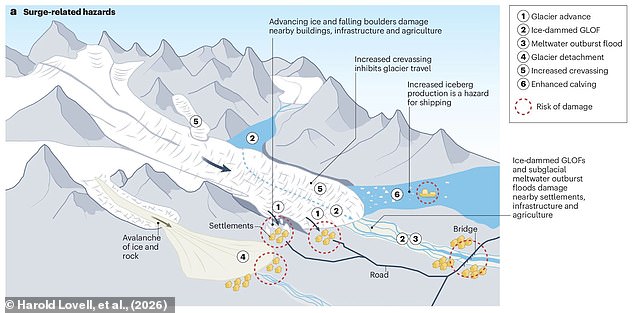
Glaciers moving forward can damage roads, agricultural land, and structures, as well as obstruct rivers, forming lakes that may cause hazardous floods.
During a peak period, water that has accumulated under the glacier can abruptly flow out as a destructive sudden flood.
The swift forward motion also reduces the glacier’s stability, forming a system of extensive cracks that can be dangerous for those crossing the ice.
In severe situations, the glacier could start to fragment, causing dangerous icebergs to break off or detach abruptly in a massive ice and rock landslide.
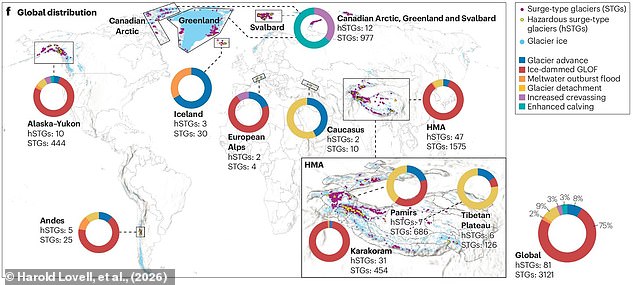
In their study, featured in Nature Reviews Earth & Environment, the scientists pinpointed the 81 glaciers that present the highest risk when they experience rapid movement.
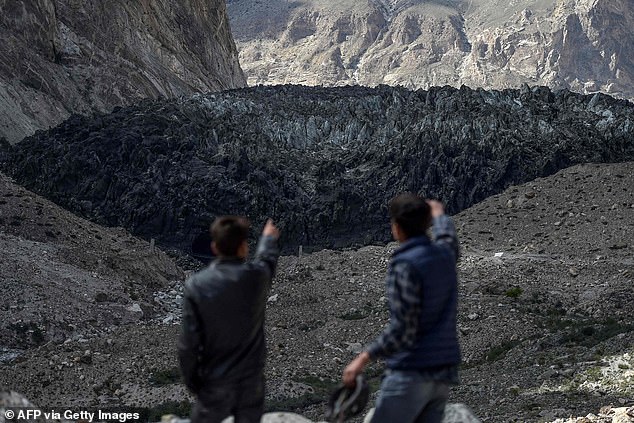
Many of them are located in the Karakoram Mountains, which stretch across China, India, and Pakistan, where inhabited valleys and essential infrastructure lie directly beneath advancing glaciers like the Shisper and Kyagar.
Nevertheless, they are also present across the globe, with significant dangers coming from the Tweedsmuir Glacier in Alaska-Yukon and the Kolka Glacier in the Caucasus.
This danger is exacerbated by the difficulty in forecasting surges, with climate change further reducing their predictability.
In certain regions, glaciers have become so thin that they lack the necessary ice to experience surges, while in other areas, they are currently surging more intensively than before.
Dr. Lovell states: ‘We have managed to assemble the increasing amount of data that demonstrates how global warming is influencing glacier surges, including their locations and frequency.’
This encompasses cases of severe weather, like intense rainfalls or exceptionally hot summers, leading to earlier-than-anticipated spikes, indicating a growing inconsistency in their patterns.
Increases could completely cease in areas such as Iceland, where glaciers are rapidly retreating and finding it difficult to accumulate ice.
However, they may occur more often in certain areas of High Mountain Asia, as well as in the Canadian and Russian Arctic, because of higher temperatures and greater meltwater.
The scientists also propose that such surges might occur in the Antarctic Peninsula, an area where glacial surging has never been observed previously.
Co-author Professor Gwenn Glowers from Simon Fraser University in Canada states: ‘As we begin to gain a more thorough grasp of the processes involved in glacier surges, climate change is altering the guidelines.’
Unusual weather occurrences that were once uncommon even 50 years back may now act as catalysts for sudden increases. Since these increases pose risks in certain areas, it complicates the task of safeguarding at-risk populations.

 jasdooit
Leave a comment