
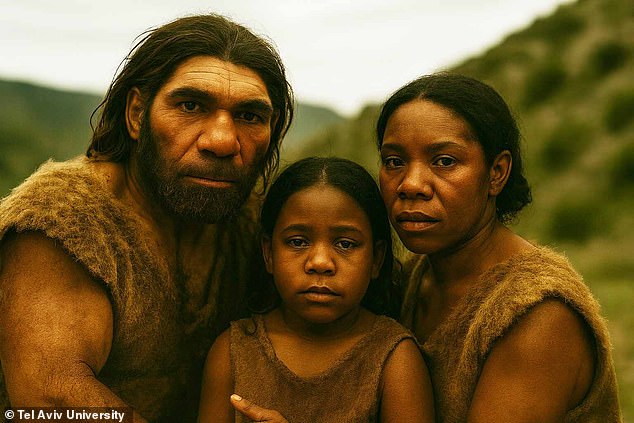
Neanderthal males were short, robust, and strong – and our female predecessors appeared to find them attractive, according to a recent study.
It is a widely recognized truth that early humans and Neanderthals engaged in sexual relations, as numerous individuals today possess parts of Neanderthal genetic material.
But how this private aspect of our development unfolded has remained unclear – until now.
Researchers have found that when these two ancient species interacted, the mating typically involved male Neanderthals and female Homo sapiens.
The discovery enhances our knowledge of interbreeding among these separate groups, which occurred between 45,000 and 50,000 years ago, according to researchers.
Approximately 600,000 years ago, the predecessors of modern humans and their nearest relative, the Neanderthals, separated into two distinct populations,” says Sarah Tishkoff, Professor of Genetics and Biology at the University ofPennsylvania, said.
Our forebears developed in Africa, whereas the predecessors of Neanderthals emerged in and adjusted to living in Eurasia.
However, this division was not meant to last forever.
For their research, the group examined Neanderthal and contemporary human genetic codes.
They discovered that in contemporary humans, Neanderthal genetic influences are exceptionally uncommon on the X chromosome.
Because females have two X chromosomes and males have just one, this implies that very little genetic material from female Neanderthals ever made its way into the human genetic makeup.
Scientists also found that Neanderthals possessed a higher amount of human DNA on their X chromosomes compared to other parts of their genetic material.
This genetic pattern further supports the idea that there was selective mating between Neanderthal males and human females.
The results, featured in the journalScience, question an established belief that natural selection was responsible for eliminating ‘toxic’ Neanderthal genes on the X chromosome.
Across our X chromosomes, there are these gaps in Neanderthal DNA that we refer to as ‘Neanderthal deserts,’ said Dr. Alexander Platt, a senior research scientist at the Tishkoff Lab.
For many years, we simply believed that these deserts arose because specific Neanderthal genes were biologically ‘harmful’ to humans—something that often occurs when species separate—so we thought the genes might have led to health issues and were probably removed by natural selection.
The finding offers a more socially oriented explanation of the genetic information, according to the team.
“Simplest explanation came from mating preferences,” Dr. Platt added.
He mentioned that interbreeding might have been heavily influenced by sexual preferences, “because of the right mix of being more appealing or just less off-putting.”
When questioned about how Neanderthals and humans might have communicated, Dr. Platt responded: “I’m not certain that communication is essential to know what the heart desires. Or to comprehend who is unattractive. Or perhaps even bearable.”
The data also fail to provide any understanding of whose viewpoint was significant on the topic, or which of the involved parties were making the decisions.
He stated: “We were aware that there were multiple instances when the two groups met and mated.”
What we are discovering now is that the process of interbreeding might have been selective, and that men and women did not take part in it in exactly the same manner.
The group mentioned that now the ‘who’ and ‘how’ behind these ancient trusts have been clarified, they are now focusing on the ‘why’.
Recent studies have also uncovered proof that early humans and Neanderthals shared kisses around 50,000 years ago.
For the research, scientists gathered information from scientific publications about contemporary primate species that have been seen engaging in kissing, such as chimpanzees, bonobos, and orangutans.
Experts described kissing as non-aggressive, mouth-to-mouth contact that does not include the exchange of food. By employing a statistical method known as Bayesian modeling to create various evolutionary scenarios, they discovered that Neanderthals probably practiced kissing throughout their existence.
This result contributes to aprevious studywhich found that humans and Neanderthals exchanged oral bacteria through saliva.
Alongside proof of interbreeding, this strongly implies that humans and Neanderthals engaged in kissing during their sexual encounters.
‘Naturally, we assume that the mating was voluntary,’ Paul Pettitt, a professor of archaeology at the University of Durham, had previously stated to the Daily Mail.
But a sorrowful reality of the ancient world might imply that this was not entirely accurate, and perhaps one ‘partner’ had limited options.
Thus, in the chaotic environment of the prehistoric era, mating might have taken place – spontaneously, with minimal thought or purpose. If it was mutual, we can likely conclude there was foreplay – including sensual kissing and cuddling.



 jasdooit
Leave a comment