
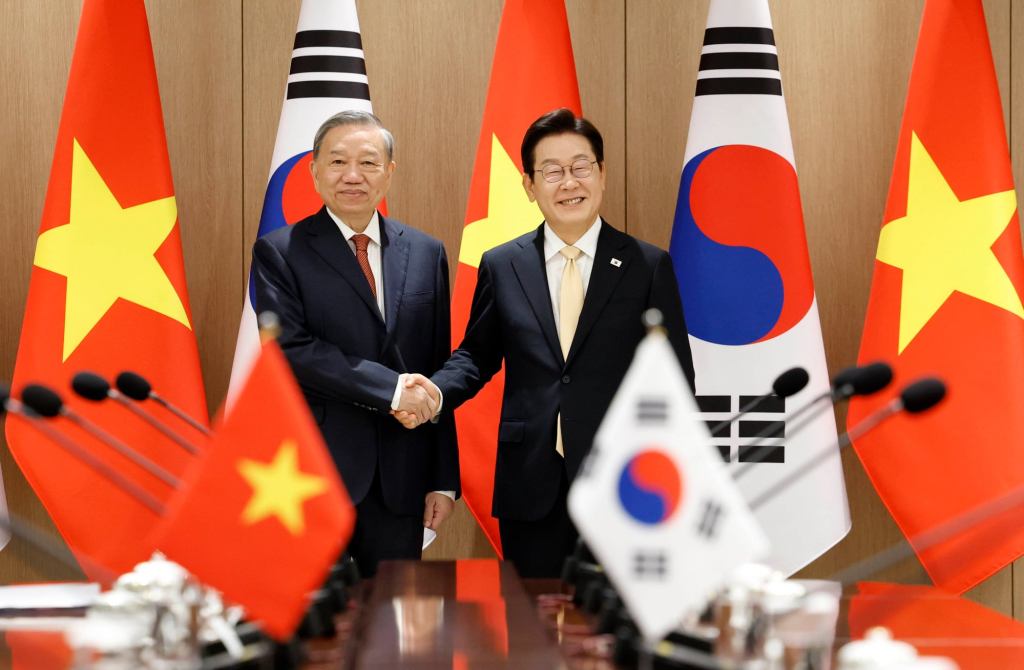
President Lee undertakes a strategic visit to New Delhi and Hanoi, aiming to strengthen economic relationships and supply chain connections amidst the turmoil in the Middle East.
Strengthening strategic alliances and economic relations will be a top priority during the South Korean president’s tenure.Lee Jae MyungHis six-day visit to India and Vietnam, as Seoul aims to enhance collaboration with the Global South during instability in the Middle East.
Lee, who arrived in New Delhi on Sunday, is set to meet the Prime MinisterNarendra Modi, business leaders and Korean expatriates prior to wrapping up theIndiapart of his visit on Tuesday.
National security advisor Wi Sung-rak statedSouth Korea“comprehensively enhance the special strategic relationship and outline a plan for broadening mutually advantageous and strategic collaboration” with India, referring to it as a “crucial ally in extending the range of our practical diplomacy focused on national interests”.
Are you curious about the most significant issues and developments happening globally? Find the solutions withSCMP Knowledge, our latest platform featuring curated content including explainers, FAQs, analyses, and infographics, presented by our acclaimed team.
Kang Jun-young, a professor of international relations at Hankuk University of Foreign Studies, mentioned that increasing global supply chain instability—such as energy security concerns related to the conflicts inIranand Ukraine – along with the growing U.S.-China competition have led Lee to “expand the nation’s diplomatic reach and diversify its trading partners”.
Seoul and Delhi seek to quicken discussions to enhance their Comprehensive Economic Partnership Agreement, aiming to increase two-way trade to US$50 billion by 2030, up from approximately US$27 billion in the previous year.
Besides improving cooperation on regional and global matters, both parties are also anticipated to expand their collaboration in shipbuilding, maritime sectors, finance, artificial intelligence, and defense.
In Vietnam, Lee aims to revitalize bilateral relations, targeting trade of US$150 billion by 2030, up from approximately US$88 billion last year.
His journey to Hanoi takes place eight months following the Vietnamese leaderTo Lam traveled to South Koreaas the initial state guest of the Lee administration.
The two nations seek to enhance partnership in economic security—covering energy, nuclear energy, supply chain stability, and essential minerals—while expanding collaboration in science, technology, climate change, and workforce development.
Cultural interactions and personal connections are also anticipated to expand, showcasing the growing closeness between the two countries.
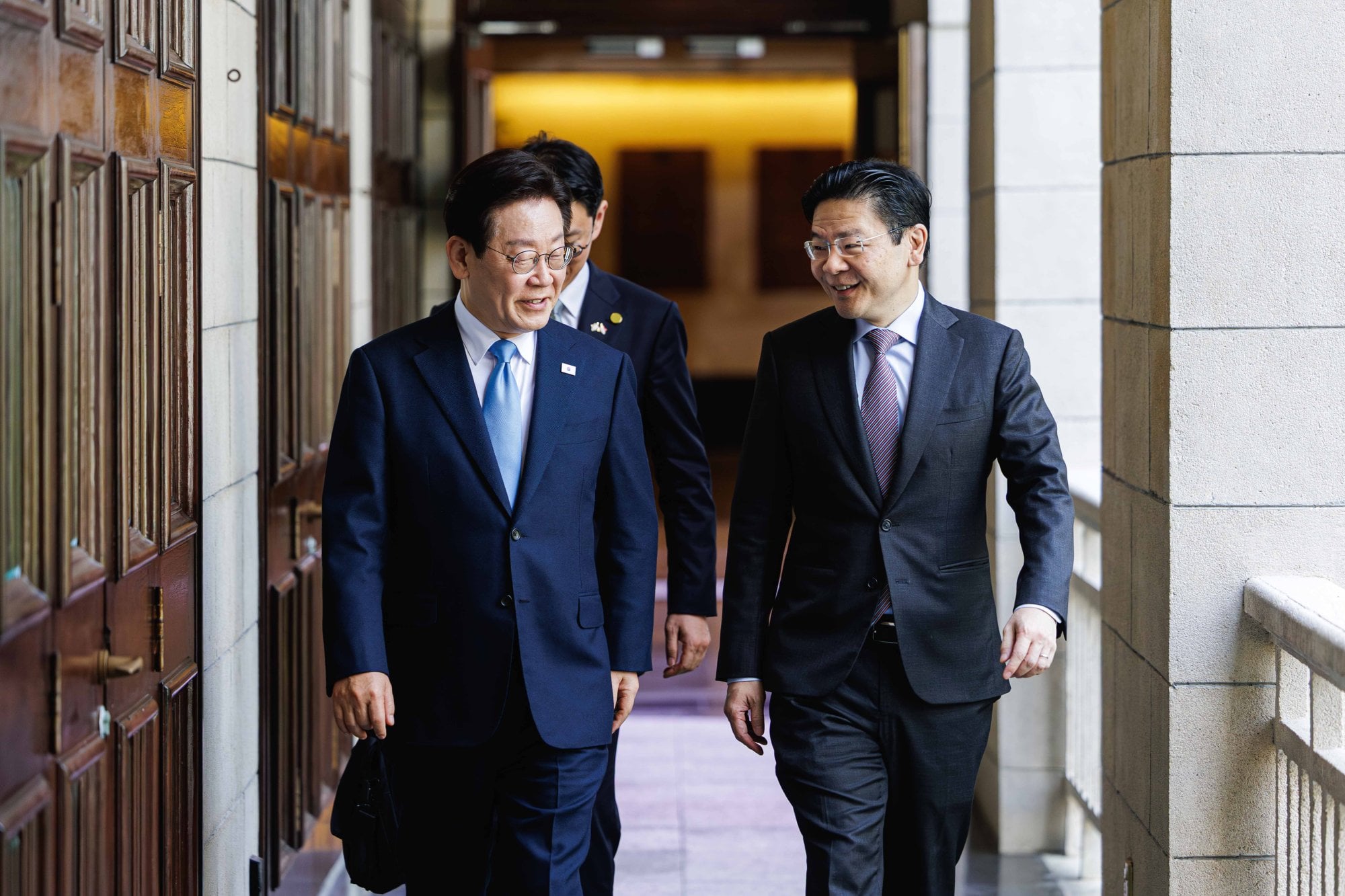
“Lee is adopting a practical approach to diplomacy by engaging with Global South nations, whose influence is growing more significant in maintaining stability within global supply chains,” Kang said, referring to the president’s recent visit toSingaporeand the Philippines, where he aimed to enhance economic collaboration.
He pointed out that Seoul encountered criticism from countries in the Global South for prioritizing natural resources over distributing technology and the wider advantages of economic growth.
“Keeping this critique in mind, South Korea is now adopting more careful, customized methods to address the unique requirements and preferences of each nation,” he stated.
“India is a crucial strategic partner for South Korea in South Asia,” Kang stated, noting that opportunities for bilateral collaboration are robust in manufacturing and strategic sectors.
“In Vietnam, South Korea discovers a collaborator for mutual growth, with major Korean firms maintaining extensive production facilities,” he stated.
South Korea’s total investments in Vietnam surpassed $90 billion by early 2026, mainly fueled by major technology companies like Samsung and LG.
Bilateral trade remains strong, covering areas such as electronics, semiconductors, clean energy, and other high-tech sectors.
Professor Hur Jung from the economics department at Sogang University stated that both India and Vietnam play essential roles in global supply chains.
Delhi also holds a key position in the US-supportedIMECa planned multi-modal transportation corridor connecting India to Europe through the Middle East.
“South Korea seeks to increase its involvement in these alternative shipping routes, which are anticipated to become more significant once the conditions in the Middle East improve,” Hur stated.
He mentioned that Vietnam possesses one of the world’s biggest reserves of rare earth materials, following China — resources vital for South Korea’s semiconductor sector.
“South Korea must expand its sources of rare earth materials as the strategic rivalry between China, its main trading partner, and its long-standing ally, the United States, escalates,” Hur stated.
Vietnam is opening its doors to South Korea’s technology and investments as it aims to shift towards high-tech sectors, mirroring South Korea’s previous development trajectory that was based on export-led growth.
Jung Suk-koo, a former executive editor at the progressive Hankyoreh newspaper, noted that the presence of business leaders—especially the heads of South Korea’s four biggest conglomerates—emphasized the economic emphasis of Lee’s visit.
“It is also significant that leading figures from the banking and financial sectors are included in the delegation, indicating that collaboration might extend to areas like mobile banking,” he stated.
Lee’s trip to India and Vietnam is a component of South Korea’s larger initiative to assist in restoring global supply chains and restructuring manufacturing hubs around the world following the conflict in the Middle East.
More Articles from SCMP
Hong Kong hailed as a ‘global force’ in international rugby following a successful Sevens event
This piece was first published on the South China Morning Post (www.scmp.com), a top news outlet covering China and Asia.
Copyright (c) 2026. South China Morning Post Publishers Ltd. All rights reserved.
 jasdooit
Leave a comment