
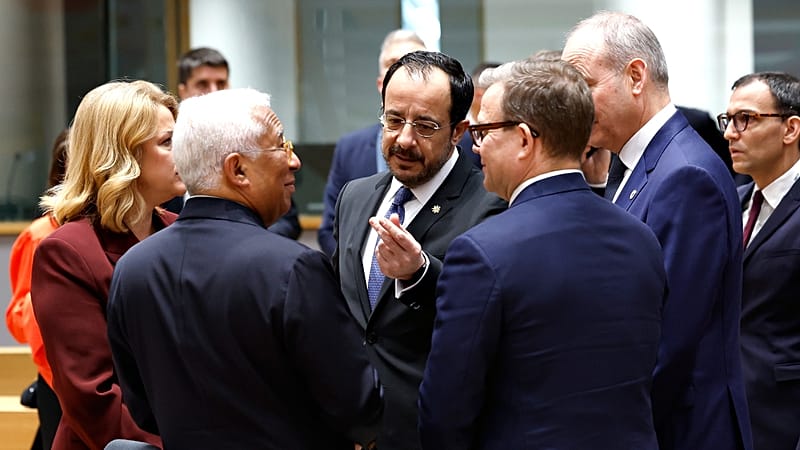
European Union officials have assembled in Cyprus for an informal meeting, which aims to initiate an internal procedure to create a mutual support clause. This clause could, at some point, replace NATO’s Article 5 if the United States decides to leave the alliance, a possibility that former President Donald Trump has frequently mentioned.
The comprehensive invasion of Ukraine by Russia, the conflict in the Middle East, the escalating energy crisis, and the future of the EU’s long-term budget will also be discussed. Nevertheless, no decisions will be taken on Thursday or Friday because the meeting is informal.
As the country holding the rotating EU Council presidency, Cyprus will act as the host.
The gathering will feature one notable absence: Viktor Orbán, the European Council’s longest-serving member, who suffered a clear defeat in the Hungarian elections this month, bringing an end to his 16-year tenure as prime minister.
Orbán, who will step down from his position sometime next month,has decided to skipwhat would have been his final summit. His office states this is because of the transfer of authority.
Most European Union officials are anticipatingturning the pageDuring Orbán’s tenure, marked by ongoing disruption, resistance, and defiance. The Hungarian prime minister’s well-known application of his veto power to hinder EU decisions angered leaders and, on occasion, caused the union to be unable to act at crucial times.
Two of his notable vetoes, regarding the €90 billion loan to Ukraine and the 20th set of sanctions on Russia, were removed earlier on Thursday after Russian oil supplies resumed through the Soviet-era Druzhba pipeline.
Nevertheless, some continue to be engaged, particularly regarding Ukraine’s path toward EU membership.
Ukrainian President Volodymyr Zelenskyy, who had significant conflicts with Orbán, will participate in the leaders’ dinner in Ayia Napa on Thursday evening to advocate for his nation’s application for membership, which is considered a security assurance following the war.
Although Orbán was the main opponent of Ukraine’s entry, other nations are hesitant to advance EU expansion significantly, a controversial issue among citizens. A creative idea to accelerate Kyiv’s progress through a“reversed” methodologywas strongly turned down, with member states requesting viable replacements instead.
Ukraine aims to, at the very least, resume the thematic groups of discussions.
“Certainly, this process demands, as they put it in Europe, consensus, ensuring that every voice across Europe is acknowledged. I believe that in the coming weeks and months, we will witness how events unfold and how the partners will unite,” Zelenskyy stated on Wednesday.
We also strongly hope and are confident that this matter will be settled.
Another topic at the forefront will be the conflict in the Middle East and the closing of the Strait of Hormuz, where Iran and the United States have implemented opposing blockades. Europeans have proposed establishing a multinational force to protect commercial vessels and clear mines from the narrow passage, but the initiative is still in its initial phase and may not come to fruition.
The turmoil in Hormuz has caused energy costs to rise sharply throughout Europe, raising concerns about shortages, poverty, and economic downturn. Leaders will address a series ofnew measures released by the European Commission earlier this week, including social programs, tax cuts, funding for infrastructure, and financial support for eco-friendly technologies.
Leveraging the lessons from the 2022 energy crisis, which significantly raised public debt, the Commission is urging national government to offer specific and short-term support that can be swiftly reduced as prices drop.
A NATO-like protection?
The President of Cyprus, Nikos Christodoulides, aims to utilize the summit to initiate a thorough examination ofArticle 42.7from the EU treaties, which requires mutual support in the event of an armed attack on a member country.
It was utilized just once: by France in 2015.
Cyprus is among the limited number of European Union nations that are not part of NATO, and as a result, it is not entitled to the protections outlined in the alliance’s Article 5. This complex issue emerged during the initial stages of the Iran conflict when a Shahed drone targeted a British military installation on the island.
“We are aware of Article 42.7, but we are uncertain about the consequences if a member state activates this article,” Christodoulides said to AP before the summit.
A high-ranking EU representative stated that the intention is for leaders to have open discussions on Article 42.7, its alignment with NATO, and its real-world application. The EU agreements allow for various forms of support, ranging from economic and diplomatic to military.
During their time in Nicosia, leaders will also address the long-term structure of the EU budget, with the Commission suggesting a total of €2 trillion over seven years, spanning from 2028 to 2034. Many EU nations aim to lower the overall amount, yet they differ on which specific areas should be cut.
The objective in Brussels is to reach a consensus on the updated budget by the end of the year, as significant elections are scheduled in France, Italy, Spain, and Poland in 2027.
 jasdooit
Leave a comment