
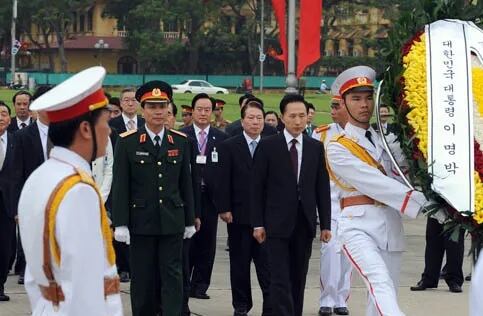
President Lee Jae Myung went back home following a four-day official trip to Vietnam, which began on the 21st. Throughout this visit, the two nations decided to enhance their partnership in semiconductors and batteries in order to secure supply chains and boost cooperation within high-tech industries. Additionally, a deal valued at 480 billion South Korean won for urban railway vehicles in Ho Chi Minh City was also revealed.
Cheong Wa Dae stated, “This visit is meaningful because it occurred at a crucial time when Vietnam, marking the 40th anniversary of its reform and opening-up policy, is progressing toward becoming a developed country under the robust leadership of Party General Secretary and President To Lam.”
The two nations, which had conflicts during the 1960s and 1970s, have made significant progress since they established diplomatic ties in December 1992. The trade between South Korea and Vietnam amounted to roughly 94.5 billion U.S. dollars by 2025. According to information from the Ministry of Trade, Industry and Resources along with the Korea International Trade Association, Vietnam has emerged as one of South Korea’s top three trading partners, after China and the United States. Nevertheless, the 34-year diplomatic relationship has not always been without challenges. Specifically, there was a crisis in 2009 when President Lee Myung-bak’s official visit to Vietnam was almost called off.
Emergency Call While Traveling to Beijing
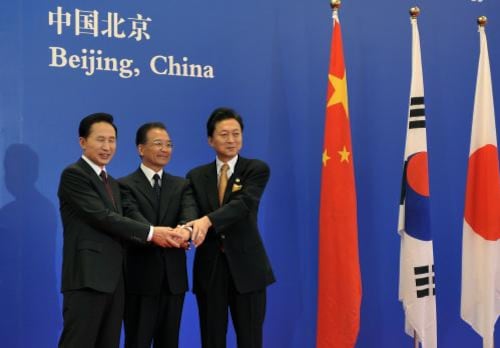
Former Foreign Minister Yoo Myung-hwan detailed the almost-cancelled state visit in his memoir (Oral History), released earlier this year by the Center for Diplomatic History Research at the National Diplomatic Academy. As per the book, Yoo was in Beijing on October 10, 2009, participating in the trilateral meeting involving South Korea, China, and Japan. President Lee Myung-bak had planned to return to South Korea following the summit and then travel to Vietnam on October 21.
While Yoo was sitting at the summit alongside President Lee, Chinese Premier Wen Jiabao, and Japanese Prime Minister Yukio Hatoyama, his phone started ringing. The call came from the South Korean ambassador to Vietnam. Yoo left the meeting room and received an urgent message: “The Vietnamese government has chosen to cancel the president’s state visit planned for ten days later.”
Yoo was taken aback and inquired, “What does this mean?” The ambassador clarified that the Vietnamese government was opposed to a bill being considered in the South Korean National Assembly concerning the handling of Vietnam War victims, which contained terms such as “fighting against communist hostile nations.” Vietnam found these phrases extremely offensive and had consistently asked for changes. Feeling frustrated, they warned of canceling the state visit. Yoo had not been informed about this prior to the ambassador’s call.
Yoo Myung-hwan exclaimed, “Is This a Report?”
Yoo shouted angrily, “How can you refer to this as a report?” Kim Sung-whan, who was the head of the Presidential Office for Foreign Affairs and National Security, renowned for his composed nature, was also extremely upset. Someone present noted, “I had never seen Chief Kim so enraged.”
Yoo assessed the situation as urgent. If the state visit was canceled only 11 days prior to the planned date, it would lead to substantial domestic political criticism and create a damaging mark on diplomatic ties.
Before informing President Lee, Yoo talked about a response strategy with Kim. They decided, “The president will be surprised, so let’s avoid mentioning the cancellation and instead say there is an issue.”
At the trilateral meeting, Yoo informed President Lee: “It appears there is a misinterpretation about the state visit to Vietnam. Some are proposing to delay it. I will go to Vietnam first to resolve this matter.”
Hurried to Vietnam to Offer an Apology, Stating, “I Was Also Not Informed”
Yoo quickly traveled to Vietnam on the 12th following his return from Beijing. He felt that being truthful was the best strategy. During meetings with the Vietnamese foreign minister and prime minister, he expressed his apologies, saying, “As the minister, I was also not aware.” He clearly communicated South Korea’s dedication to revising the controversial statements.
Consequently, the Ministry of Patriots and Veterans Affairs decided to eliminate mentions of the “Vietnam War” from the updated bill titled “Act on the Honorable Treatment and Support of Individuals Who Have Made Outstanding Contributions to the State,” which had been initially passed in September 2009.
The initial bill read, “Vietnam War veterans and Agent Orange victims who helped maintain world peace.” This conflicted with the position of the Vietnamese government, which saw the Vietnam War as a battle to protect the country from the U.S. and its allies. The Vietnamese Embassy in South Korea had asked for changes, but these were not considered prior to President Lee’s visit. It was only after Vietnam warned of canceling the state visit that South Korea agreed to eliminate “Vietnam War” and adjust the wording to “veterans and Agent Orange victims who contributed to maintaining world peace.”
Summit Went Ahead as Planned…A Surprising Change
After Yoo resolved the crisis in Hanoi, the summit went ahead as scheduled. After meeting with President Nguyen Minh Triet, the two leaders pledged brotherhood during a dinner, raising glasses at each table in front of 150 guests. Yoo later remarked, “If the state visit had been called off, I still shudder to think about the condition of South Korea–Vietnam relations.”
Yoo carried out an internal review of the incident. It uncovered structural problems within the Ministry of Foreign Affairs. When the Ministry of Patriots and Veterans Affairs sought input from the ministry regarding the bill, a section chief replied with “no objections” as part of standard procedure. The ministry did not acknowledge Vietnam’s concerns about the matter, leading to the situation worsening.
Yoo said, “If Vietnam had asked for modifications to the bill, the ministry should have worked with relevant parties and the Ministry of Patriots and Veterans Affairs from the start to prevent unnecessary tensions with Vietnam.”
He also stated, “It is evident that there were issues prior to Vietnam informing about the cancellation, but neither the minister nor the head of the Foreign Affairs Presidential Office was made aware. This suggests deeper systemic issues.” He further mentioned, “The ambassador should have brought attention to the matter through a call or a telegram, but there was an absence of urgency.” Yoo recalled the ambassador earlier than usual by six months, taking him responsible.
This marked the first instance where a South Korean president’s state trip was canceled as a result of the Ministry of Foreign Affairs’ oversight. Yoo intentionally incorporated this detail into his memoir, recognizing his own leadership accountability and establishing a warning example.
P.S. “Vietnam Is a Country That Recognizes the Value of Diplomacy”
In his autobiography, Yoo provided a notable assessment of Vietnam and its diplomatic strategy:
Diplomatic ties between South Korea and Vietnam were set up just before Christmas in 1992 in Hanoi. I joined then-Foreign Minister Lee Sang-ok in Hanoi for the formalization of these relations and later headed a media team to Ho Chi Minh City, known as Saigon at that time. Even though Vietnam was economically underdeveloped back then, I was impressed by its energy and dynamism.
During the foreign ministerial discussions in Hanoi, when we attempted to express regret for South Korea’s participation in the Vietnam War, they instructed us not to bring it up. They stressed the importance of looking ahead, arguing that revisiting difficult historical events would not be beneficial.
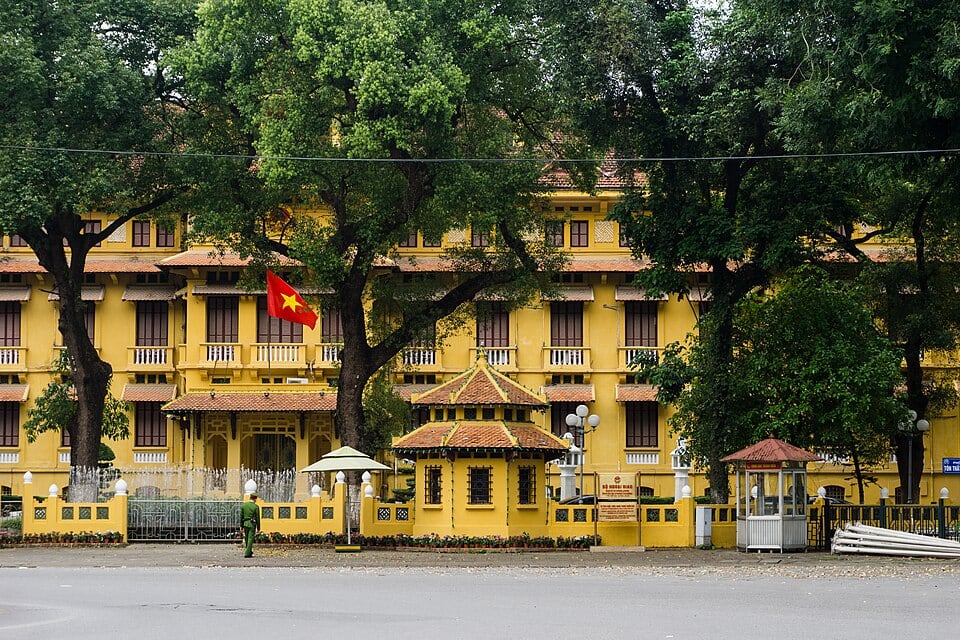
The foreign ministry of Vietnam is located in a separate building close to the presidential palace, not far from the National Assembly. Vietnam has a history where effective diplomacy results in peace, while poor diplomacy leads to conflict—engaging in battles with France, China, and a prolonged war with the U.S. This made me understand that Vietnam has a deep appreciation for the importance of diplomacy.


Leave a Reply