
TOKYO — With the Japanese government easing restrictions on arms exports and boosting defense expenditures, and Prime Minister Sanae Takaichi showing interest in amending the Constitution, the number of individuals participating in demonstrations opposing these measures has risen to tens of thousands. Among those coordinating the events are women who, just a few years ago, had not been engaged in organizing or leading rallies. What is prompting their involvement now?
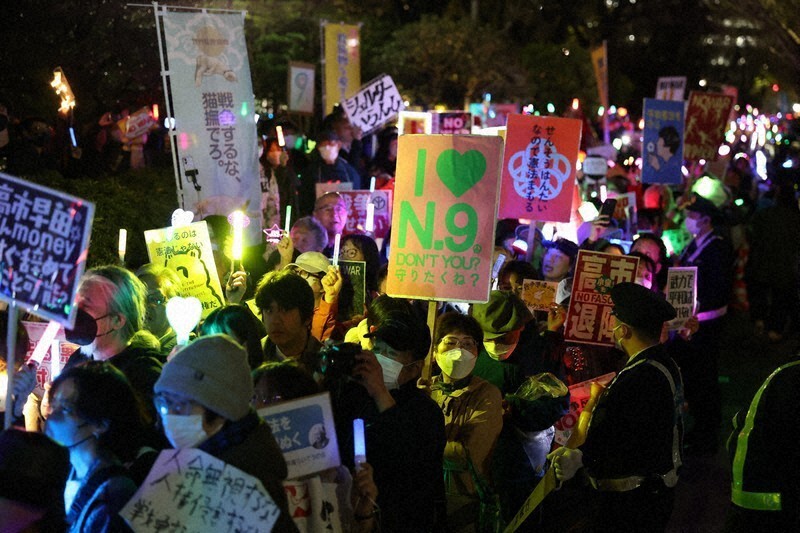
On the evening of April 8, the pavement outside the National Diet Building in Chiyoda Ward, Tokyo, was filled with individuals holding penlights. They were advocating for an end to conflict and opposing changes to the constitution, shouting slogans such as “We might be moving towards war,” and “Exporting weapons jeopardizes peace,” among others.
At the core was “We Want Our Future” (WWOF), a volunteer organization consisting of individuals aged 20 to 40. The movement was sparked by the Takaichi-led Liberal Democratic Party (LDP) securing 316 seats in the February House of Representatives election — a number exceeding the two-thirds majority required to begin the process of amending the constitution. WWOF started collaborating on protests called “Emergency action to protect the peace Constitution” with the civic group “Don’t destroy Article 9 of the Constitution! executive committee.”
Approximately 3,600 individuals attended the initial demonstration on February 27. By the time of the fourth protest on April 8, the number of participants had increased to around 30,000. Organizers stated that synchronized demonstrations took place in 137 additional locations across the country, with media outlets noting that about 2,000 people assembled in front of Osaka Station and approximately 1,400 at Sapporo Station.
A collective known as WWOF, active since 2022, organizes protests and discussion events concerning social issues and politics.
While certain members can utilize over a decade of experience in protest organization when discussing road usage with the police, “newcomers” also participate according to the group’s flexible rule that “those who can do something, do what they can.” For each event, a core group of a dozen or so individuals takes charge, with several dozen others assisting in operations. For the April 8 protest, in addition to the core members, approximately 50 to 60 people contributed to its execution.
The catalyst was the secret fund scandal
A key member, Reina Tashiro, a business owner in her 30s from Tokyo, participated in a demonstration against the government around 2018 concerning the manipulation of official records related to the significantly reduced sale of public land to the nationalist school group Moritomo Gakuen. Nevertheless, she mentioned that she “never expected to be on the organizers’ side” until she became involved with WWOF during the final months of 2023.
She changed her mind following the emergence of the LDP factions’ secret fund scandal, a situation that coincided with increasing prices, which was already a significant concern. She felt a deep connection to a group that was protesting outside the prime minister’s office in the capital, criticizing the LDP’s handling of the issue and calling for the resignation of then Prime Minister Fumio Kishida’s government. She mentioned that the fact that she “happened to be in a position to take action” without affecting her job encouraged her to become involved.
Hanako Chiba, a self-employed woman in her 30s residing in Tokyo, stated she “could no longer remain idle” following Israel’s invasion of the Gaza Strip in the Palestinian territories in October 2023. She participated in a demonstration with a quickly written cardboard sign and later became involved with WWOF.
For both women, staging protests outside the prime minister’s office and the Diet building serves as a peaceful method to bring attention to diverse perspectives and communicate views directly to those in authority, including Takaichi. Tashiro emphasized, “Although the Takaichi administration secured a major win in the election, demonstrations also represent public opinion. (In a democratic nation) there are numerous different voices; a single-minded public opinion is not feasible.”
Speaking about the protests that started in February, Tashiro stated, “I am angry that Prime Minister Takaichi fails to recognize that the Constitution is meant to limit those in power. It was only logical for us to speak out.” She thinks that the peace-promising Article 9 of the Constitution emerged from lessons learned during World War II and has served as a pledge of peace to nations in Asia.
Chiba said, “If the LDP, which fails to draw lessons from the past, is permitted to amend Article 9, then instead of Japan being pulled into conflict (in a scenario endangering its existence), it might once more become a nation able to initiate warfare.”
Feeling of emergency outside of constitutional change
Their worries go beyond changes to the constitution. They are also worried about the update to the “Three Principles on Transfer of Defense Equipment and Technology” along with its operational rules, which were approved by the Cabinet on April 21 — changes that permit Japan to export deadly weapons. They mentioned that they experience a stronger feeling of urgency regarding the fact that Prime Minister Takaichi openly expresses her wish for military expansion, compared to their concerns about constitutional reform.
Following the peak of the Zenkyoto (All-Campus Joint Struggle Committees) student movements between 1968 and 1969, a significant resistance to protests remained in Japan for nearly four decades. Today, demonstrators are still frequently met with indifferent glances.
Chiba, who has studied in South Korea and Taiwan, made a comparison to the large-scale protests in South Korea calling for the president’s resignation, and mentioned: “There are online media outlets that mock demonstrations, and when compared to other Asian countries, I believe Japan’s stance on protests is unique. There is an automatic rejection of views that differ from one’s own, and I think this lack of tolerance is linked to the exclusion of foreigners and discrimination against individuals with disabilities.”
Nevertheless, following the 2011 disasters at the Tokyo Electric Power Co.’s Fukushima Daiichi Nuclear Power Station, anti-nuclear rallies spread throughout the nation, and in 2015, the student organization SEALDs was heavily involved in demonstrations against security-related laws. The concept of “a Japan where people can protest” has been carried on. WWOF intends to keep its activities going. Tashiro stated, “We didn’t aim to cause a commotion. We are progressing through experimentation, while being concerned about our next steps.”
(Japanese original by Mineichiro Yamakoshi, Tokyo City News Department)



Leave a Reply