
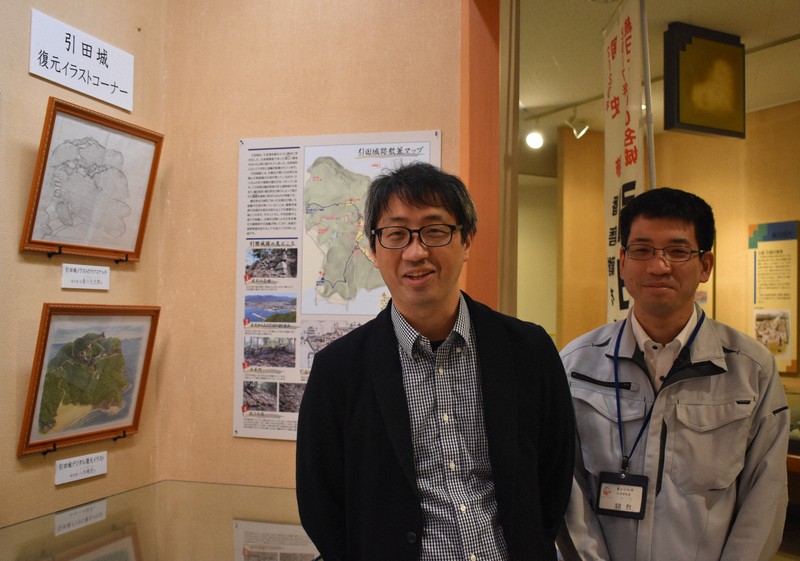
HIGASHIKAGAWA, Kagawa — A digital restoration of the former Hiketa Castle in this city in western Japan has been finished with the help of artificial intelligence (AI), utilizing a basic drawing created by a famous historical artist who passed away before completing the project, enabling people to imagine a location that no longer stands.
Hiketa Castle was constructed in the area that is currently Higashikagawa, Kagawa Prefecture, by Ikoma Chikamasa — a vassal who received control of Sanuki Province from the warlord Toyotomi Hideyoshi during the late Sengoku (Warring States) period, which spanned from 1467 to the late 16th century. The local government first asked an illustration expert to create a visual representation of the old castle, but the specialist passed away before completing more than a preliminary sketch.
Akifumi Yagi, 41, a local resident and licensed Master Web Analytics Consultant, assumed the task and utilized generative AI to restore the image with vibrant colors. The completed artwork along with the original sketch will be exhibited at the city’s Museum of History until the end of March 2027.
The remnants of Hiketa Castle are situated at the eastern boundary of Kagawa Prefecture, close to the border with Tokushima Prefecture. They cover the peak of Mount Shiroyama, which stands 82 meters above sea level and protrudes like a cape to the north of Hiketa Port, historically an important location on the Harimanada Sea. In 1587, Ikoma Chikamasa entered Sanuki and founded Hiketa Castle along with Takamatsu Castle and Marugame Castle. It is thought that Hiketa Castle was abandoned during the early Edo period (1603-1867).
At the castle location, ridgelines were modified to position buildings like the “honmaru” main fortress, the northern “ninomaru” secondary fortress, and a water reservoir in a carefully designed arrangement. Stone walls constructed from naturally occurring, unshaped stones can still be found in approximately 100 areas, spanning roughly 600 meters. The site is recognized as a significant mountain castle that functioned as both a military and economic center, and it was officially listed as a national historic site in 2020.
After the designation, the lifelong learning department of the Higashikagawa Municipal Board of Education aimed to present the complete image of the castle to a broader audience through an illustration, and they commissioned the task to historical artist Gentaro Kagawa in 2024. He visited the location in October of that year to examine the stone walls and other elements, but died from illness in December after completing only a preliminary sketch.
Yoshinori Inokuma, a senior expert in the department, remembered thinking, “If someone else just replaced Kagawa’s work, it would ruin the distinctive aspects of his art. The sketch alone holds significant worth.” At the same time, he believed that “without a full illustrated restoration, it would be challenging to fully express the charm of the castle.”
Approximately six months later, he sought Yagi’s advice to explore any potential solutions. Yagi is a web analyst who assists companies in attaining outcomes through digital marketing and is part of the Tokyo-based Web Analytics Consultants Association. The association has an agreement with Higashikagawa to aid local small and medium-sized businesses by utilizing information and communication technology (ICT), and Yagi had moved there from the Kanto area.
Yagi took on the project after deciding that “Kagawa’s artistic abilities were remarkable” and that “the initial sketch should be shown to the public in its current form.” He designed his own illustration following the same layout as the original draft and devised a technique based on the concept that “digital technology could uncover elements of the castle that could not be expressed through buildings and stone walls alone.”
When creating the final image, Yagi drew upon not only existing remnants but also imaginative sketches from the Taisho period (1912-1926) and a meticulously crafted model of the castle built by local people. He input the image data into an AI system to create the initial illustration, then manually added roads and waterways, and precisely illustrated the stone walls and reservoir.
Inokuma shared his optimism about the project’s influence, stating that “although the location is cherished by locals, including an annual event where elementary students climb the castle ruins, the complete structure is hard to visualize today due to the dense tree coverage.” He added that the illustration would assist people in imagining it and thinking, “This is the type of castle that once stood here.”
(Japanese original by Masahiko Sasaki, Takamatsu Office)



Leave a Reply