
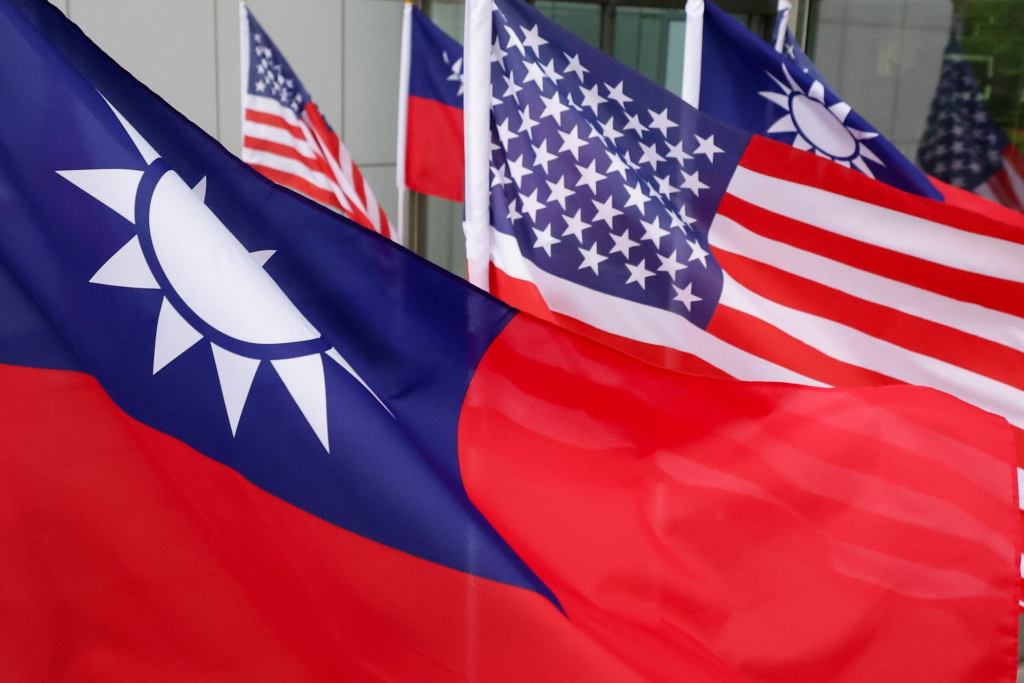
The leader of KMT will put her cross-strait message to the test during meetings with think tanks, Taiwanese expatriates, and possible policymakers in the United States.
Taiwanese opposition leader Cheng Li-wunis getting ready to travel to the United States in June, seeking to utilize the political momentum gained from last month’s meeting with the Communist Party leaderXi Jinping in Beijing.
Cheng, the leader of the primary opposition partyKuomintang, will also test her message regarding the Taiwan Strait in Washington.
In recent media interviews, Cheng has presented a plan that extends beyond conventional party engagement, advocating for what she refers to as “a new roadmap” for stability across the Taiwan Strait — one that she claims is in line with U.S. interests while maintainingTaiwan‘s strategic autonomy.
Are you curious about the most significant issues and developments happening globally? Find the solutions withSCMP Knowledge, our latest platform offering carefully selected content including explainers, FAQs, analyses, and infographics, presented by our acclaimed team.
She is anticipated to remain in the United States for over 10 days during a journey that will involve meetings with policy institutes, overseas Taiwanese communities, and possibly government officials.
Cheng mentioned that the emphasis would be on meaningful strategic discussions instead of formal visits.
At the heart of her argument is a dismissal of what she refers to as the “false dichotomy” between selecting between Beijing and Washington.
“She has stated that Taiwan should not be used as a tool in the rivalry between major powers,” advocating instead for a plan that provides the island with greater flexibility by involving both parties.
Her communication to American audiences is anticipated to highlight that peace between the straits does not conflict with U.S. interests, but rather supports regional stability.
She has presented her strategy as a way to reduce the chances of conflict in the Taiwan Strait—a concern also emphasized by Washington—while steering clear of what she views as increased tension under the current leadership.
The visit comes after Cheng’s highly anticipated trip to mainland China in April,when she met Xi. Several days later, Beijing declared apackage of 10 measuresfocused on enhancing interactions with Taiwan.
Although the measures have not yet been formalized into policy, the appearance of the meeting—the first between the leaders of the two parties in ten years—seems to have benefited Cheng politically.
A new survey conducted by the Taiwanese online news platform My Formosa revealed that over half of the participants felt that greater interactions between the two sides of the strait could contribute to lowering tensions.
Trust in Cheng increased to 31.5 percent, an increase of 7.6 percentage points from March. The findings indicate that Cheng’s efforts on the mainland have appealed to a portion of voters who are looking for a reduction in tensions.
Experts noted that this would enhance Cheng’s confidence before her visit to the United States, although uncertainties persisted regarding how her message would be received in Washington.
“From a local political standpoint, the visit is unlikely to damage her,” remarked Alexander Huang Chieh-cheng, a professor of international relations at Tamkang University in New Taipei City.
Huang mentioned that these journeys were frequently evaluated more based on their perceived impact back home than on their actual content, and noted that robust backing from Taiwanese living abroad could strengthen Cheng’s political influence.
He mentioned that the specifics of her U.S. activities were expected to stay unclear, indicating longstanding agreements regarding interactions between Taipei and Washington.
The trip might also allow Washington to examine Cheng’s strategic placement more carefully.
“US officials and academic experts from policy institutes will be interested in determining if the KMT’s long-standing ‘pro-US, engagement with mainland China’ position remains valid, or if there has been a change,” stated Yen Chen-shen, a researcher at the Institute of International Relations at National Chengchi University in Taipei.
Yen mentioned that Cheng was expected to meet U.S. lawmakers, representatives from the American Institute in Taiwan (AIT), and former officials, with talks anticipated to cover topics such as cross-strait relations, trade, and security matters.
The American Institute in Taiwan was created to manage interactions with Taipei following Washington’s shift in diplomatic recognition to Beijing in 1979.
Beijing considers Taiwan to be a part of China, potentially reunified through force if required. Most nations, including the United States, do not acknowledge Taiwan as a separate country. Nevertheless, Washington opposes any efforts to alter the current situation through military means and remains dedicated to providing Taiwan with defensive armaments.
As per Yen, certain individuals in Washington could attempt to obtain guarantees from Cheng that the KMT would continue its defense obligations, such as purchasing weapons.
Cheng has shown openness regarding defense expenditures, supporting a scaled-down version of the government’s special budget and asserting that choices should be influenced by the details of US military sales.
The Kuomintang has suggested a NT$380 billion (US$12 billion) plan – significantly less than the Democratic Progressive Party administration’s NT$1.25 trillion (US$40 billion) military strategy, which enjoys substantial U.S. support.
Cheng’s visit occurs at a time when worries in Taiwan are growing about avisit of US President Donald Trump to Beijingin May, and the way Taiwan will be addressed.
Yang Yung-ming, who previously served as deputy secretary general of Taiwan’s National Security Council, stated that Cheng’s efforts highlighted more fundamental shifts in the relationship between the United States and China.
He mentioned that Washington’s strategy toward Taiwan could grow more transactional due to Trump’s focus on deals.
“Taiwan faces the risk of becoming involved in larger US-China negotiations,” Yang stated, contending that Cheng’s focus on preventing major-power conflict was an effort to portray Taiwan as an active participant rather than a passive observer.
As tensions in the Taiwan Strait escalate and discussions about Taiwan’s strategic path become more heated, experts also noted that Cheng’s visit to the United States would serve as a crucial examination of whether her cross-strait strategy could extend beyond local supporters and find support in Washington.
More Articles from SCMP
3 fashion films to view following The Devil Wears Prada 2
Style inspired by … J.J. Martin, founder of Milan-based La DoubleJ
This piece was first published in the South China Morning Post (www.scmp.com), a top news outlet covering China and Asia.
Copyright (c) 2026. South China Morning Post Publishers Ltd. All rights reserved.



Leave a Reply