
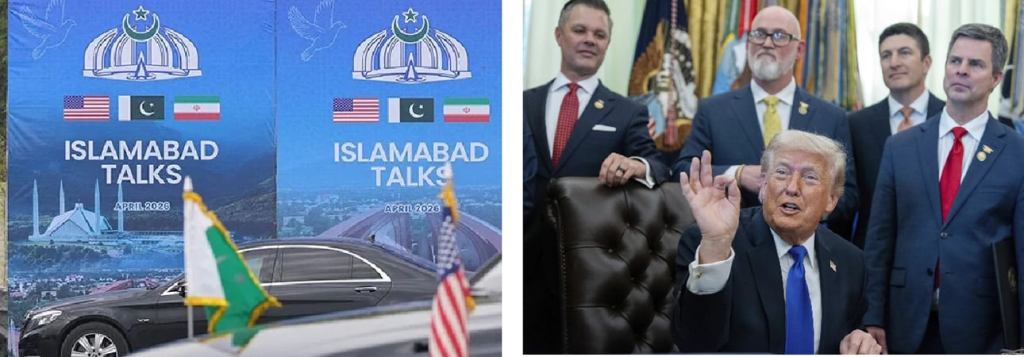
Pakistan, May 2 — Tehran has delivered its most recent suggestion for talks with the United States to Pakistani mediators, according to Iranian state news agency IRNA on Friday, a step that might enhance chances of overcoming a deadlock in attempts to conclude the Iran conflict.
IRNA provided no specific information, but international oil prices, which have increased significantly since Iran imposed a blockade on the Strait of Hormuz, declined following its statement.
The restriction of a crucial maritime route has cut off 20% of global oil and gas supplies, with the US Navy preventing the export of Iranian crude oil. This situation has led to higher energy costs and raised fears of an economic slowdown.
A truce has been in effect since April 8, but news that US President Donald Trump was set to receive updates on proposals for additional military actions aimed at forcing Iran into talks caused global oil prices to rise to a four-year peak on Thursday.
Iran has deployed air defense systems and intends to launch a broad countermeasure in case of an attack, according to two high-ranking Iranian officials who spoke to Reuters under the condition of anonymity. They believe a brief, intense U.S. strike may occur, potentially followed by an Israeli assault.
In the meantime, U.S. President Donald Trump has informed journalists that he is not pleased with Iran’s most recent suggestion for settling the dispute, and that discussions are occurring via telephone, according to Reuters.
“Regarding the negotiation, via telephone. They have (Iran) made progress, but I’m not certain if they will ever reach that point,” he said to reporters.
There is significant conflict; they are experiencing major difficulties in getting along within Iran. The leadership is highly fragmented – it consists of two to three groups, perhaps four.
“It’s a highly fragmented leadership, and to put it that way, they all desire to reach an agreement, yet they’re all in disarray,” Trump added.
Furthermore, Trump stated, “I hold Pakistan in high regard, as well as the field marshal and the prime minister.”
When questioned about his choices concerning Iran, U.S. President Donald Trump stated he faces a decision between seeking an agreement or restarting military attacks.
Currently, we are engaged in talks, but they aren’t making any progress,” he says to journalists. “Do we want to go in and completely destroy them and end this for good, or do we want to attempt to reach an agreement? I mean, those are the choices.
When asked if he wants to restart the strikes, Trump responded, “From a human perspective, I would rather not.”
Trump indicated he would not pursue Congressional approval for military action against Iran under the War Powers Resolution, labeling those who demand it as “unpatriotic,” according to Al Jazeera.
Opposing the necessity of obtaining legal authorization, which mandates that a U.S. president request approval within 60 days of sending troops into action, Trump states, “Many presidents have gone ahead and surpassed it. It has never been enforced.”
Most people believe it is entirely unconstitutional,” Trump said. “Additionally, we had a ceasefire, which provides you with more time. We are in the middle of a significant victory.
I’m not satisfied with Italy, nor with Spain. They seem to think it’s acceptable for Iran to possess a nuclear weapon. Anyone who believes it’s okay for Iran to have a nuclear weapon isn’t very wise.
He warned of removing U.S. forces from Italy and Spain, a day following his statement about considering a reduction in troops stationed in Germany.
Italy’s defense minister, Guido Crosetto, stated he “did not understand” the reasons behind Trump’s threat, with both prime ministers not providing an immediate reaction to the U.S. president’s remarks.
On Thursday, Esmaeil Baghaei, a spokesperson for the Iranian Foreign Ministry, warned that rapid outcomes should not be anticipated from the discussions.
A high-ranking Iranian Revolutionary Guards official stated that any new US attack on Iran, even if it is minor, would lead to “long and difficult strikes” against US positions in the region. Meanwhile, Majid Mousavi, commander of the Aerospace Force, was reported by Iranian media to have said: “We have witnessed what happened to your regional bases, and we will witness the same fate for your warships.”
On Thursday, Trump emphasized again that Iran would not be permitted to possess a nuclear weapon. He also mentioned that the cost of gasoline, a significant issue for his Republican Party ahead of the midterm elections in November, would “plummet rapidly” once the conflict concluded.
Iran claims its nuclear program is exclusively for peaceful use.
Baghaei used social media on Friday to criticize the US for its “aggression” and question Washington’s claim that its strikes against Iran were an act of “self-defence,” as reported by Al Jazeera.
In a post on X, Baghaei points to a US State Department document that supports the war, which mentions: “The United States participated in this conflict at the request of and in the collective self-defence of its Israeli ally, as well as in the exercise of the United States’ own inherent right of self-defence.”
“Defending oneself from what?” Baghaei questions.
Was there an ‘armed attack’ by Iran that could justify ‘self-defence’? Absolutely not!
So this was certainly not ‘self-defence’ – it was an act of aggression against the nation of Iran.
Iran’s Foreign Minister Abbas Araghchi claimed that the “Pentagon is not telling the truth” regarding the financial impact of the conflict, which was initiated by the Trump administration on February 28 in conjunction with Netanyahu, as reported by Al Jazeera.
The ongoing conflict has worsened Iran’s already severe economic issues, potentially leading to disaster following the war. However, it appears capable of enduring the standoff in the Gulf for the time being, even with the US embargo that has severed its energy exports.



Leave a Reply