
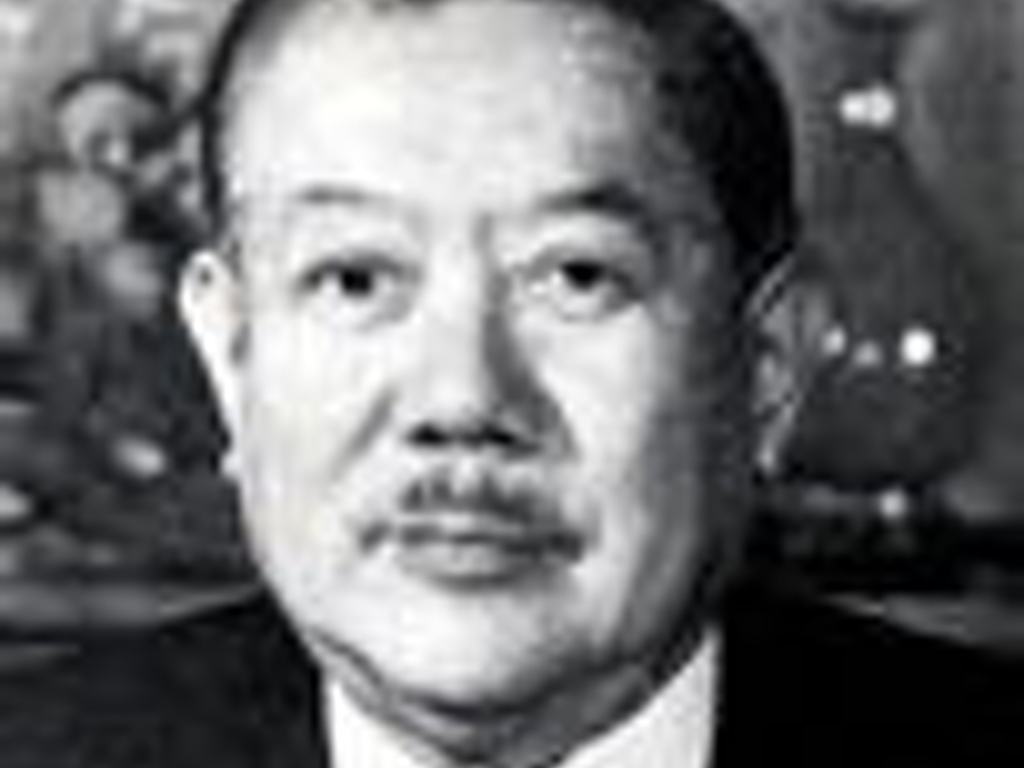
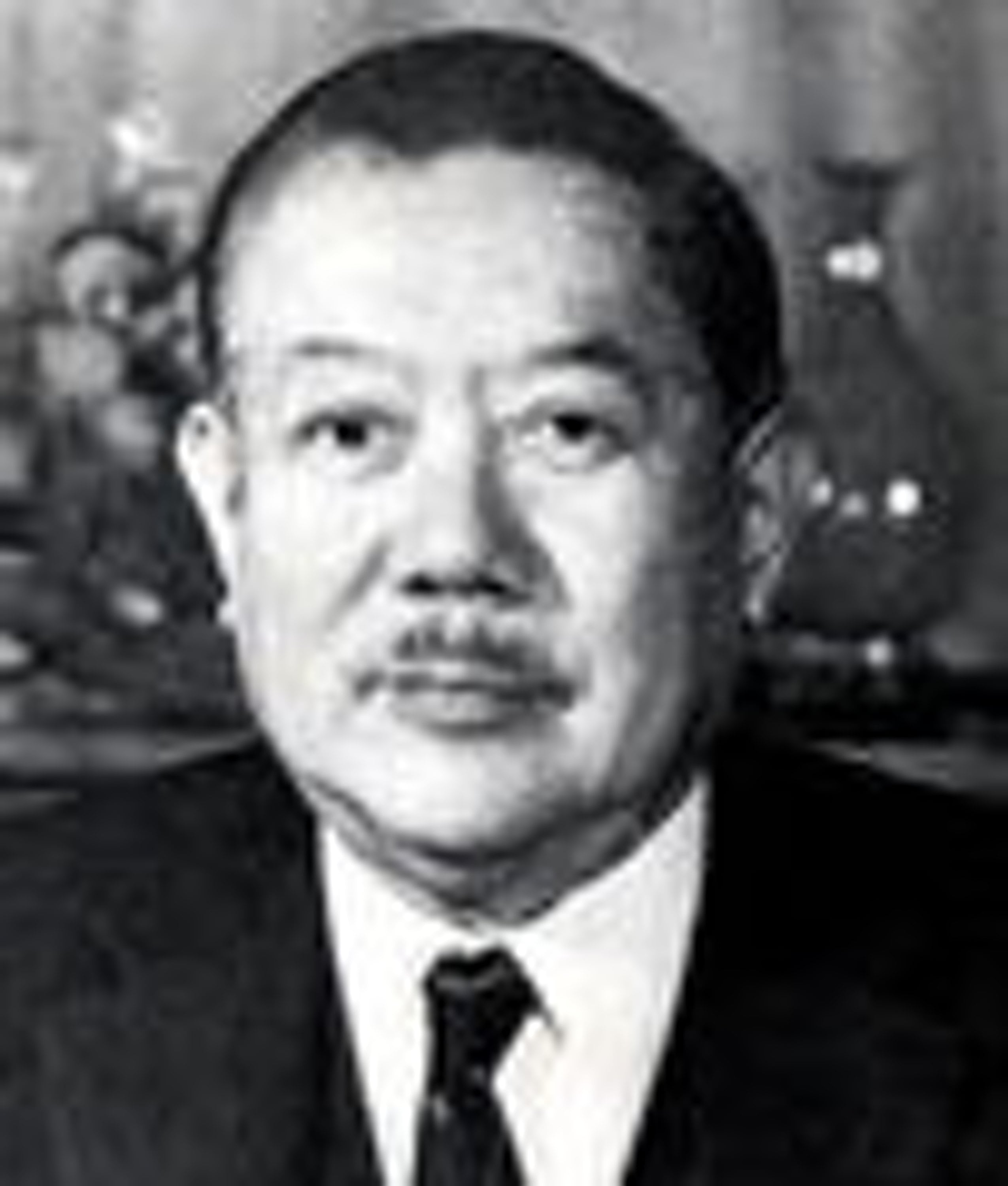
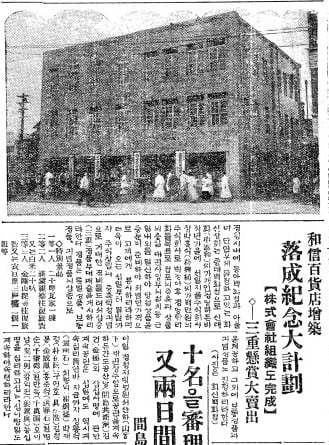
In 1932, the business of Park Heung-sik (1903–1994), a 29-year-old young entrepreneur, was thriving. Having established Seonil Jemu (鮮一紙物), a paper manufacturing company, at the age of 23 in 1926, he acquired Hwasin Sanghoe, a department store located at 2 Jeongmok, Jongno, Seoul (now Jongno 2-ga), just five years later in 1931. In May 1932, he expanded the building and held a commemorative event. The grand prize was a 20-pyeong tile-roofed house.
In July, he purchased and combined Dong-A Department Store, which was a strong competitor located nearby. At that time, the merger of the two biggest Korean-run department stores was seen as a positive change.
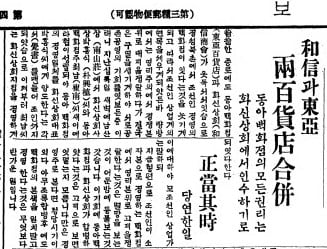
“Even in the bleak landscape of Jongno, the fact that Dong-A Department Store and Hwasin Sanghoe stand prominently shows that there is a department store operated by Koreans in northern Gyeongseong, which has helped boost the image of the Korean business sector. However, the two stores had been vying for customers through a profit-oriented strategy, resulting in conflicts, and they were looking for ways to coexist. On the 16th, an agreement was reached at Namsanjang between Park Heung-sik, president of Hwasin Sanghoe, and Choi Nam, owner of Dong-A Department Store, to transfer full management of Dong-A Department Store to Park Heung-sik, representative of Hwasin Sanghoe, with a written contract being signed (…)
In this context, a source from the Korean business sector stated, “Given the present situation, for a Korean-run department store with limited funds, competing for customers purely on the basis of profit is akin to spotting a lamp in the darkness before collapse. The merger between Dong-A Department Store and Hwasin Sanghoe at this moment is a timely decision for management. Regardless of customer opinions, the fact that the merger preserves the core identity of a department store is most reassuring.” (July 22, 1932, evening edition, page 2)
Hwasin Department Store, which had a capital of 1 million Korean won, occupied a total floor space of 800 pyeong across old and new structures, employed 320 people, and generated daily sales of 17,000 Korean won, “ruled the Jongno commercial area” in 1933. A newspaper from that time stated, “Thanks to the hard work of President Park Heung-sik, the business is progressing quickly.” The sense of pride in being the sole department store in Gyeongseong operated by Koreans was considerable. The newspaper featured Hwasin Department Store as the first entry in its “Introduction of Prominent Businesspeople” series:
“Among the five department stores in Daegu, Hwasin, the sole one operated by Koreans, is prominent in the center of Jongno, controlling the commercial area. It would be significant to present the background and details of Hwasin. The first day of the ‘Introduction of Prominent Businesspeople’ series starts with Hwasin.” (August 30, 1933, page 4)
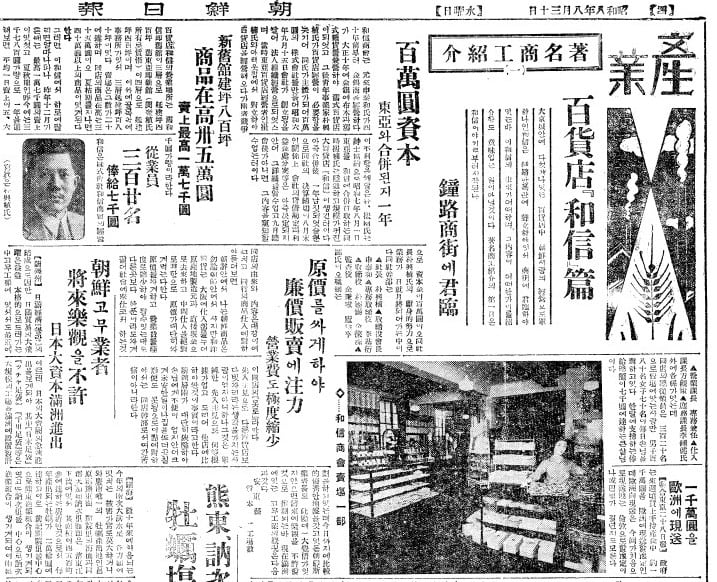
Hwasin competed with Japanese-owned department stores and ranked third in tax payments in 1934, following Mitsukoshi (三越) and Jōjiya (丁子屋) among the five department stores in Gyeongseong. Hirata (平田) and Minakai (三中井) followed.
Park broadened his business operations into wholesale by establishing “chain stores.”
“As a businessman, his intellect is not only sharp but truly exceptional, and his aspirations are remarkable. Rather than being content with Hwasin Department Store alone, he formulated a strategy to broaden his business reach, resulting in the establishment of a chain store system. In other words, Hwasin’s chain stores supply goods in bulk to local merchants. Although some were concerned this might negatively impact small and medium-sized businesses outside Hwasin’s network, it was undeniable that Park Heung-sik’s method embodied advanced capitalist approaches.” (August 5, 1934, evening edition, page 4)
When the Chosun Jungang Ilbo, the third Korean-language newspaper following the Chosun and Dong-A Ilbo, was founded as a joint-stock company in 1934, Park joined as a founding investor along with Lyuh Woon-hyung, Choi Sun-ik, Yoon Hee-jung, Kim Dong-seong, and Hong Bok-sik (April 4, 1934, evening edition, page 2). He also held a position on the board of the Korean Products Encouragement Association with Jo Man-sik, Myeong Je-se, Lee In, Kim Do-yeon, Lee Geuk-ro, Seo Chun, and Hyun Sang-yun.
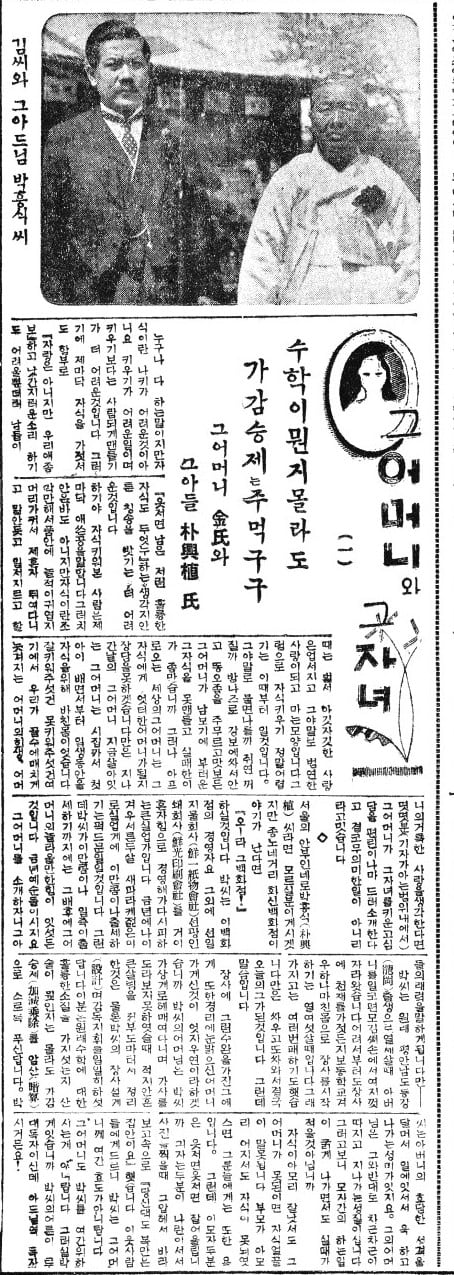
By the time he reached his early thirties, Park had already become one of the leading Korean business figures. “It’s uncommon for someone so young to attain such success in the business field,” remarked contemporary newspapers, which also emphasized his mother, who raised him.
“Bringing up the mother naturally leads to talking about her son’s background—Park was born in Yonggang, South Pyongan Province, and lost his father when he was 13, growing up with his widowed mother, Ms. Kim. Even as a young child, he displayed a talent for business, starting at 16 after completing elementary school. Although he encountered failures, he kept going and became the person he is today. It is not by chance that his mother, who took care of the home and guided his business ideas, had strong financial skills. When Park was busy with business and ignored household responsibilities, his mother not only handled the large household but also supervised and directed his business activities (…)” (June 7, 1934, page 5)
The company kept expanding. In 1935, Hwasin Department Store established a branch in Pyongyang. Although the Jongno location was destroyed by fire the same year, it was reconstructed in 1937 as a six-story structure with a basement, equipped with elevators and escalators. By 1938, Hwasin’s chain of stores had grown to 400 outlets across the country, referred to as “the sole chain management system in East Asia” (January 11, 1938, evening edition, page 2).
On April 24, 1938, “His Majesty Lee (Crown Prince Eun) and Her Majesty Lee Bang-ja” made a visit to Hwasin Department Store. “This marked the first time that Their Majesties examined a commercial establishment run by Koreans” (April 25, 1938, evening edition, page 2).
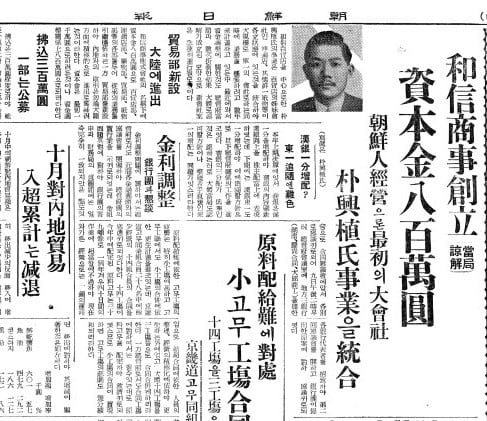
In November 1938, Hwasin Department Store, Seonil Jemu, and other entities combined to establish Hwasin Sangsa, a joint-stock company with a capital of 8 million Korean won, referred to as “the first major company managed by Koreans” (November 10, 1938, evening edition, page 8). During an interview in November 1939, Park stated, “I plan even while sleeping. Business is my entire life” (November 3, 1939, evening edition, page 4).
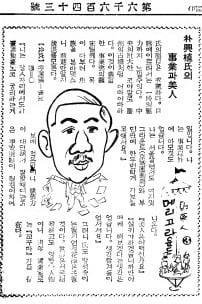
Park aided Korean independence activists and artists. Upon Ahn Chang-ho’s release from prison in February 1935, after being involved with the Shanghai Provisional Government, Park joined others in greeting him at Daejeon Prison. He also backed artists and intellectuals such as violinist and composer Jeong Gyeong-sik, who had returned from 12 years of study in Germany. In 1936, he provided financial support to Son Ki-jeong and Nam Seung-ryong, who secured gold and bronze medals at the Berlin Olympics, as well as to those affected by floods.
He also provided significant funds to Japan’s “National Defense Donations” and was involved in committees that promoted Japanese values, along with individuals such as Yun Chi-ho, Shin Heung-u, Baek Gwan-su, Song Jin-u, Kim Sung-su, Yu Eok-gyeom, and Kim Hwal-ran. In the future, he became part of groups like the National Spirit Mobilization League, the Joseon Situation Countermeasures Research Society, and the Life Improvement Committee.
Following the formation of the South Korean government, he became the first individual detained by the Anti-Traitor Investigation Committee. He was accused of trying to escape to the United States.
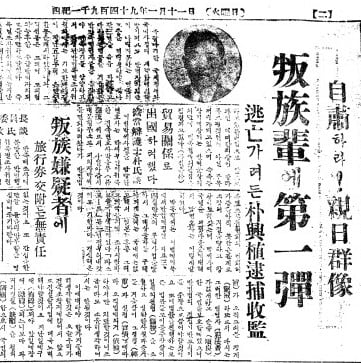
“Kim Sang-don, the vice chairman of the Special Investigation Committee for Anti-Traitor Investigations, commented on the 11th about Park Heung-sik’s arrest: ‘Although there are several high-ranking traitors, Park was arrested first because of worries about his possible escape and interference with the enforcement of the Anti-Traitor Law. There was information that he intended to travel to the U.S. soon (…)’” (January 11, 1949, page 2)
Park was granted bail and eventually found not guilty. He was detained once more shortly after the May 16 coup, facing allegations of illegally acquiring wealth, but was later released.
Hwasin Department Store started to experience a decline in the 1950s because of competition from newly established department stores. Although Park expanded into manufacturing during the 1960s with companies such as Heung Han Chemical Fiber and Hwasin Sony, he did not attain similar achievements. The Hwasin Group faced collapse in 1980 because of financial difficulties. When Park passed away on May 10, 1994, his obituary was published as a single-column announcement.
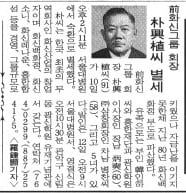
“Park Heung-sik (91), former head of the Hwasin Group, passed away at 2:11 p.m. on the 10th at Seoul National University Hospital following a prolonged illness. Park established Hwasin Industry, South Korea’s first trading company, and grew it into a group that included Hwasin Department Store, Hwasin Sony, Hwasin Renown, and Heung Han Synthetic Fiber. Nevertheless, the company collapsed in 1980 due to its inability to resolve financial challenges.” (May 11, 1994, page 31)


 jasdooit
Leave a comment