
- Click this link to go to the Scotland homepage for the most recent updates and sports information.
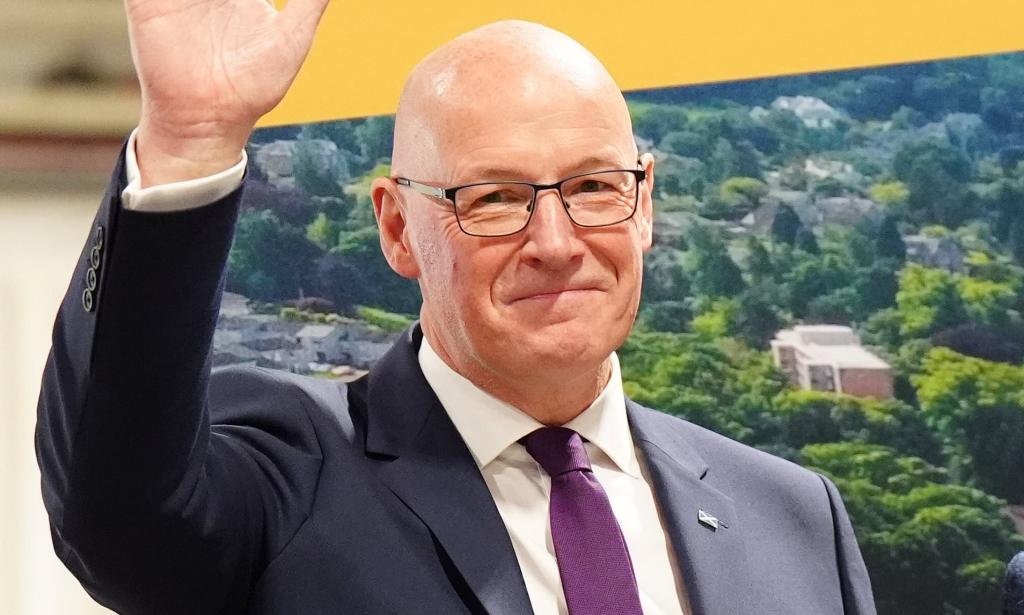
John Swinneyyesterday initiated ANOTHER attempt to conduct a second independence referendum – despite theSNPnot securing a majority and experiencing a loss of 400,000 votes in the Holyrood election.
His party lost six seats and finished with 58 MSPs — seven less than the total needed to secure a majority — as voters in Scotland cast their ballots strategically to remove the nationalists from power.
However, ‘tone-deaf’ Mr Swinney stated yesterday that the SNP and the Greens, who together have 73 MSPs, had obtained a ‘pro-independence mandate’.
He affirmed his intention to proceed with plans for a vote on the first day of parliament following the formation of a new government, aiming to request the ‘section 30 order’ authority from theUK Governmentto permit a vote on Scottish independence to occur.
Last night Conservative leader Kemi Badenochinformed the Mail: ‘John Swinney did not fulfill his own “mandate” for a further independence referendum. He should now cease attempts to dissolve the UK and instead concentrate on lowering excessive taxes and addressing the public services that are collapsing under his leadership.’
‘Swinney devoted the entire Scottish election campaign to arguing that an SNP majority would be the turning point thatKeir Starmercould not be overlooked. However, even though he confidently expected his party to secure an outright victory, he failed to meet his own goal.
Scotland cannot withstand another five years of constitutional disputes. John Swinney must now acknowledge this outcome,put aside his fixation on independence and focus on his regular work.
His decision not to do so is both disheartening and expected.
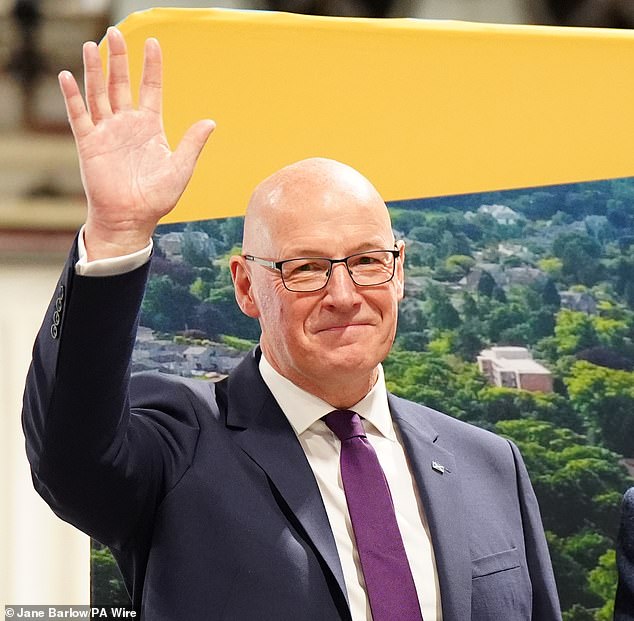
Following the completion of vote counting, the SNP obtained 58 seats, while Reform UK and Labour were tied in second position with 17 each, the Greens secured 15, the Conservatives 12, and the Liberal Democrats 10.
This implies the SNP will have to either operate as a minority government—supported by other parties through a ‘confidence and supply’ deal that might push them towards the left due to the Greens—or form a coalition with one party.
Mr. Swinney stated yesterday that he intends to invite all political parties for discussions, excluding Reform, with talks set to begin next week. He also intensified his efforts to collaborate with Sinn Fein in Northern Ireland and Plaid Cymru in Wales as part of his campaign for separation, asserting that ‘the Celtic fringe is set to take center stage.’
During the election campaign, Mr Swinney mentioned that if the SNP secured a majority, he would schedule a vote in parliament onapproving ‘the creation of a section 30 order to enable Scotland to conduct an independence referendum’’.
When asked yesterday if he intended to proceed with the vote, Mr. Swinney responded: “I definitely plan to continue with my proposals, yes.”
At an event with his new MSP group in Edinburgh yesterday, Mr Swinney stated: ‘There has now been a pro-independence majority for four consecutive elections. This mandate has been overlooked by successive Westminster Prime Ministers, from Labour and Tory, year after year after year.’
I had wished in this election we couldend the deadlock by obtaining the one thing that has successfully secured a vote in the past, which was an SNP majority. Although we have nearly reached that goal, the SNP majority has not yet been achieved.
Nevertheless, this does not alter the fundamental reality that, although there have been numerous efforts to prevent us, this marks the fourth consecutive election where a pro-independence majority has been elected to the new Scottish Parliament. In fact, there are currently more pro-independence MSPs than ever before in the history of the Scottish Parliament.
He stated that Nigel Farage is “racing toward Downing Street” and argued that Holyrood should be “protected from Farage” by granting the authority to conduct a referendum by 2029.
Regarding the first ministers of nationalism in Wales, Northern Ireland, and Scotland, he stated: ‘What people in London tend to describe rather condescendingly as the Celtic periphery is about to step into the spotlight.’
He stated that ‘the people of Scotland clearly desire to have a say regarding their future.’
However, examination of the election outcomesindicates that 40.5 percent of voters supported the pro-independence SNP or Greens in the constituency vote, and 41.2 percent in the regional list.
Scottish Conservative leaderRussell Findlay stated: ‘John Swinney’s deafening resolve to impose yet another unwanted vote on the people of Scotland is nothing short of absurd.’
His teenage fixation on dissolving the UK has been widely dismissed, but rather than acknowledging this reality once more, he is shifting the parameters.
It is deceitful, it creates division, and it shows that this ineffective SNP administration will never reform and will consistently favor secession over any kind of effective leadership.
We stand with diligent Scots who wish to see Parliament concentrate on addressing the cost of living, rather than causing another cycle of constitutional turmoil. John Swinney is in denial. He is entirely deceptive regarding the backing for a referendum, and the public does not desire it.
He charged Mr Swinney with ‘boldly promoting a major falsehood’ by asserting that he has the backing and authority for another referendum, and stated: ‘Although it could be appealing to write him off as an independence-obsessed eccentric, we are aware that he is very serious, which is why we will keep saying ‘no’.’
After all the final results were in, the SNP received 38.2 percent of the constituency vote in Thursday’s elections, with Labour coming in second at 19.2 percent, followed by Reform at 15.8 percent, Conservatives at 11.8 percent, Lib Dems at 11.4 percent, and the Greens at 2.3 percent.
In the regional list, the SNP secured 27.2 percent, followed by Reform with 16.6 percent, Labour at 16.0 percent, the Greens with 14.0 percent, the Conservatives at 11.8 percent, and the Lib Dems with 9.4 percent.
The share of votes for the SNP fell by 9.5 percentage points in the constituency ballot, with a total decrease of 414,000 compared to 2021. It also dropped by 13.2 percentage points in the regional list, where it was 468,000 less than five years ago. Nevertheless, overall voter participation was also reduced, standing at 53.2 percent for the constituency vote this year, down from 63.5 percent in 2021.
At yesterday’s gathering, Mr. Swinney informed reporters that he continues to think it is feasible for a referendum on independence to take place in 2028.
He claimed that he had boosted the SNP’s vote “by approximately 25 percent” over the past two years since taking leadership, and stated that the pro-independence majority “should be acknowledged by the UK Government.”
Alastair Cameron, head of the Scotland in Union campaign group, stated: ‘John Swinney has unsurprisingly utilized his first day following the election outcome to advance his nationalistic agenda.’
However, Scots do not concur, and surveys consistently indicate there are several other issues they consider significantly more crucial.
Nevertheless, no matter how Mr Swinney attempts to interpret the election outcomes, it would be unacceptable to lead us into further constitutional turmoil.
If the SNP is to lead for all over the next five years, it should set aside discussions about the constitution and, for the first time in twenty years, focus on health, education, and the economy.

 jasdooit
Leave a comment