
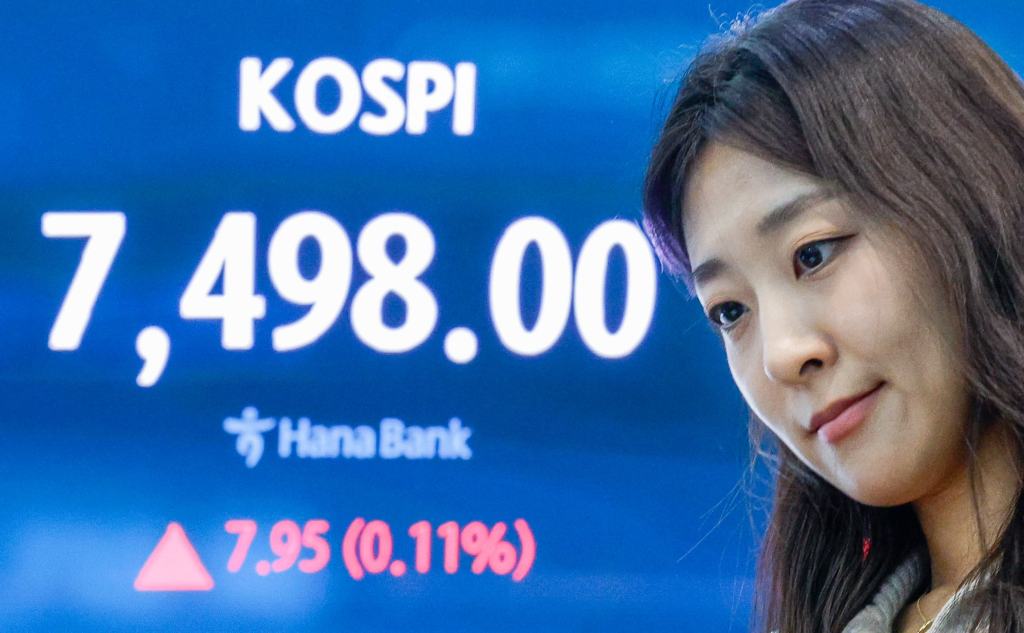
With the KOSPI climbing to the 8,000-point level for the first time ever, a significant flow of money from retail investors is entering the stock market. A combination of disappointment from missing out on top-performing stocks, worry about possible steep drops following recent peaks, and intense trading behavior—ranging from taking loans to invest to uncertainty about when to sell—is shaping the current market environment.
◇A significant amount of money is entering the stock market despite debt investment… ‘Generous’ individual investors are concentrating on major semiconductor stocks
By the 7th, the total amount of personal overdraft loans from five leading commercial banks (KB Kookmin, Shinhan, Hana, Woori, and NH Nonghyup) reached 40.5029 trillion South Korean won. This represented a rise of 715.2 billion South Korean won compared to three days earlier (end of April: 39.7877 trillion South Korean won, according to business days).
The overall balance reached its highest level in three years and four months, since the end of January 2023, while the monthly growth was the biggest in two years and seven months, dating back to October 2023. At the same time, demand deposits, which are seen as emergency funds, dropped by 501.3 billion South Korean won to 696.0511 trillion South Korean won from the end of April, showing the second straight monthly decrease. This indicates that the flow of money into the stock market might have contributed to this pattern.

Furthermore, the involvement of prominent individual investors in the stock market has increased significantly. As per the Korea Exchange, the count of large orders (exceeding 100 million Korean won) placed by individuals in the securities market last month amounted to 1,193,158 instances, marking the highest level in about five years and three months.
This month, as of the 7th, the daily average for large orders reached 83,067 cases, representing a 53% rise from the previous month’s daily average. The majority of the funds were concentrated in major semiconductor stocks: Samsung Electronics had 204,025 orders last month, SK Hynix recorded 142,668, Daewoo Engineering & Construction had 56,143, Samsung SDI received 26,155, Hyundai Motor saw 24,475, and Taihan Cable & Solution had 24,400. As of the 7th this month, the buying pressure continues to be mainly directed towards Samsung Electronics (47,418 cases) and SK Hynix (32,628 cases).
◇Should the Fear of “Being Left Behind” Be Held Responsible? Insights from the COVID-19 Period?
Experts view the presence of individual investors in the stock market as an indicator of their intricate mental condition.

Investors who missed out on the semiconductor boom are feeling a sense of relative deprivation as they observe rising stock values, prompting a last-minute surge into the market and an increase in investment sums and trade volumes. An office worker in his 30s said, “I purchased SK Hynix at 700,000 won and sold it when it fluctuated around 800,000 won, but now it has climbed so high that I can’t keep up, and I regret it. That’s why I took a loan to invest when it went beyond 1 million won.”
On the other hand, investors who purchased big-cap stocks at an early stage and achieved returns exceeding 30% are worried about possible downturns following recent price increases, frequently monitoring stock values. Some are reluctant to sell, worried they might overlook chances, remembering their inactive investments during the COVID-19 crisis.
This nervousness is causing contradictory trading patterns. Individual investors sold a net 5.35 trillion South Korean won on the 4th and 6th—the day before and the day the KOSPI fell below 7,000 points—to lock in gains, but bought approximately 10 trillion South Korean won on the 7th and 8th. Although the KOSPI reached a new high of 7,498 (closing price) on the 8th, trading volume declined by 47% from its peak, prompting doubts about whether a cautious approach is taking hold.
Despite securities firms increasing target prices for Samsung Electronics and SK Hynix to 500,000 won and 300,000 won respectively, and predicting favorable industry conditions, they recommend, “Instead of blindly pursuing profits, thoughtfully develop purchase strategies by taking advantage of short-term market swings.”




 jasdooit
Leave a comment