
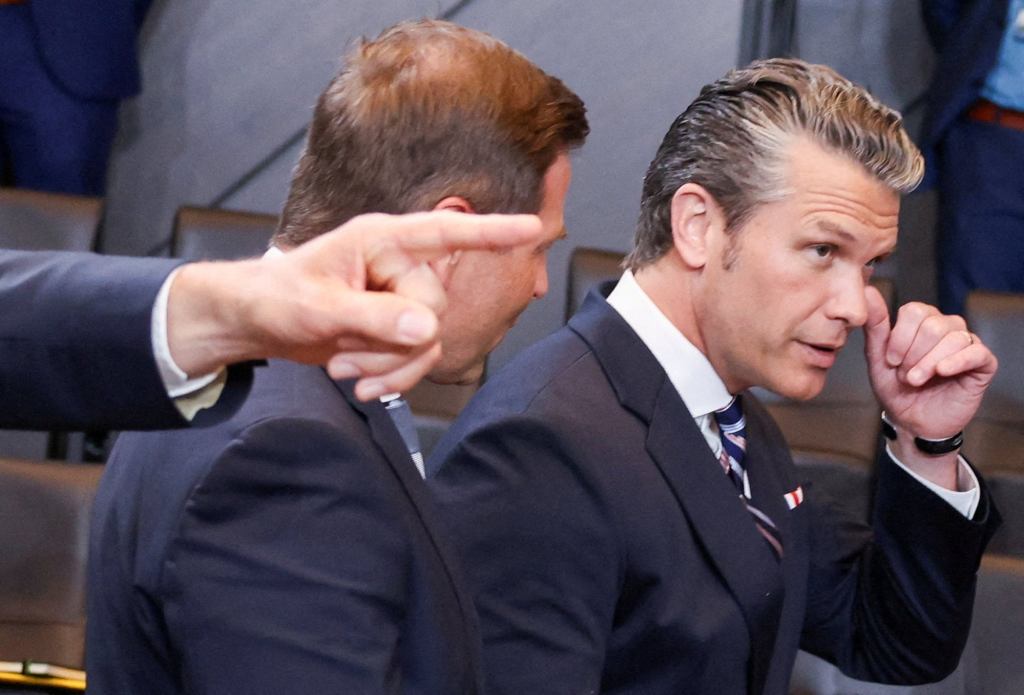
The defense secretary blamed NATO for prioritizing gender equality, climate change, and budget cuts over military funding.
USDefense Secretary Pete Hegseth criticized NATO allies on Thursday, announcing a six-month periodPentagonassessment of U.S. troops in Europe, with the result relying on how quickly Europeans assume control over their own defense.
“This will be an authentic review. It is intended to ensure that NATO is advancing swiftly and irrevocably toward European leadership, preparing to assume primary responsibility for the defense of Europe,” he said to his.Nato counterparts in Brussels.
Hegseth criticized European partners for not offeringUSforces the ability to use bases in Europe to carry out strikes againstIran, calling it “shameful”.
Are you curious about the major issues and developments happening globally? Find the solutions withSCMP Knowledge, our latest platform offering carefully selected content including explainers, FAQs, analyses, and infographics, presented by our acclaimed team.
“These allies, they endanger America’s sons and daughters, our own sons and daughters, by refusing them the consistent access, deployment, and flight rights that should never have been disputed in the first place,” he said.
Hegseth stated that Washington’s contribution to cover NATO’s operational expenses—approximately $790 million in 2026—would be “conditional” on allies meeting their financial targets.
“Where other allies fail to act promptly, our financial contributions will decrease,” he stated.
Grabbing the microphone at the start of the meeting, Hegseth also criticized migration and gender equality initiatives in Europe, comments that echoed those made by the Vice-PresidentJ.D. Vancein February of the previous year, which provoked many Europeans.
“Rather than focusing on tanks, fighter jets, and air defense systems, the emphasis has shifted towards gender equality, climate change, and defense spending cuts. Europe’s borders became more open, welfare systems grew, and defense budgets declined. Along with Europe’s confidence in itself and its civilization,” Hegseth stated.
Hegseth’s statements significantly misrepresented current European policies.
In terms of defense, European allies and Canada have initiated an extraordinary initiative to increase defense expenditures and enlarge their military forces. NATO Secretary GeneralMark Ruttenoted on Thursday that they allocated US$90 billion more for defense in the previous year, representing a 20 percent rise compared to 2024.
Although Europe welcomed significant numbers of migrants and refugees over ten years ago, many nations have since reinforced their border controls.
The Trump administration is seeking to revitalize the 32-nation group to transform it into a “Nato 3.0” that can counter any potential threat, Hegseth stated.
Hegseth’s comments were made a few weeks after theUnited StatesInformed its allies that it would cease providing specific warships and aircraft if any of them were attacked. European allies and Canada are attempting to find ways to fill the void.
The top military leader of NATO, who is American, is developing alternative strategies to protect Europe following the United States’ announcement on June 3 that it would cease providing an aircraft carrier and support vessels, aerial refueling aircraft, and numerous fighter jets, along with other military resources, in times of emergency.
The administration of Donald Trump maintains that it must be prepared to manage two concurrent conflicts and seeks additional military assets available in case a confrontation arises with China in the Indo-Pacific area.
Under NATO’s collective security assurance—Article 5 of its original treaty—the 32 members agree that an attack against one will be seen as an attack against all. It does not require them to offer military assistance, although many probably would.
At its core, the US is reducing the extent of its support if an ally activates Article 5. It possesses Nato’s most significant military forces. It has no plan to remove its nuclear weapons stationed in Europe, which are crucial for Nato’s deterrent strategy.
To emphasize this point, the NATO Nuclear Planning Group released its initial statement in 19 years following its gathering at Thursday’s meeting.
The statement mentioned that the strategic nuclear forces of the Alliance continue to be the ultimate assurance of Allied security and form the basis of NATO’s extended deterrence framework.
The ministers “committed to further improving Nato’s nuclear deterrence role through upgrading Nato’s nuclear assets, boosting its nuclear strategy capabilities, and adjusting to meet its security objectives.”
Additional coverage from Agence France-Presse
More Articles from SCMP
A heartfelt Teochew family film, “Dear You” became an unexpected commercial success in China.
Can China-US agricultural diplomacy avoid conflict stemming from the arrest of an American?
This piece was first published in the South China Morning Post (www.scmp.com), a top news outlet covering China and Asia.
Copyright (c) 2026. South China Morning Post Publishers Ltd. All rights reserved.



Leave a Reply