
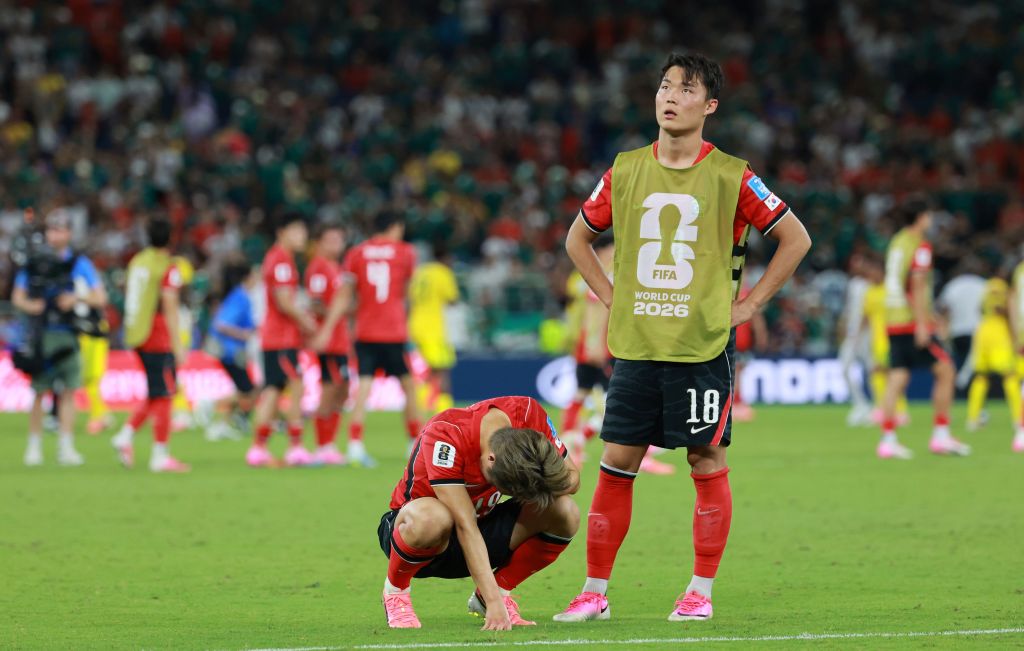
On June 25, during the third group-stage match of the FIFA World Cup in North America, South Korea faced South Africa at Estadio Monterrey in Mexico. Following a weak performance that led to a 0-1 loss, Lee Kang-in was seen sitting on the ground, repeatedly hitting the field in frustration. Although his teammates and coaches tried to comfort him, he remained dejected for a while. After the game, he left the stadium with a somber look, saying, “I am truly sorry to the fans. I will reflect more than anyone else.”
Korean football supporters had high hopes for this FIFA World Cup held in North America. This was due to the main players from Korea’s golden generation of football—striker Son Heung-min, born in 1992, who was once the top scorer in the Premier League, defender Kim Min-jae, born in 1996, currently playing for German giant Bayern Munich, and midfielder Lee Kang-in, born in 2001, from European club Paris Saint-Germain—being crucial to the team’s performance. Nevertheless, they were unable to make a notable contribution under head coach Hong Myung-bo’s disappointing tactical decisions and ended the group stage without making an impression.
Lee Kang-in, the youngest player on the team during the 2022 Qatar World Cup, brought energy to the attack and emerged as the main player in Hong Myung-bo’s squad in this competition. In the opening game against the Czech Republic, he provided an assist for Hwang In-beom’s equalizer and achieved a 100% pass completion rate, exciting the spectators. However, in the following matches against Mexico and South Africa, he found himself without support from his teammates and was unable to make a difference due to tight marking by the opposition. South Africa, in particular, targeted Lee Kang-in’s habit of using his left foot, successfully blocking his passes and crosses.
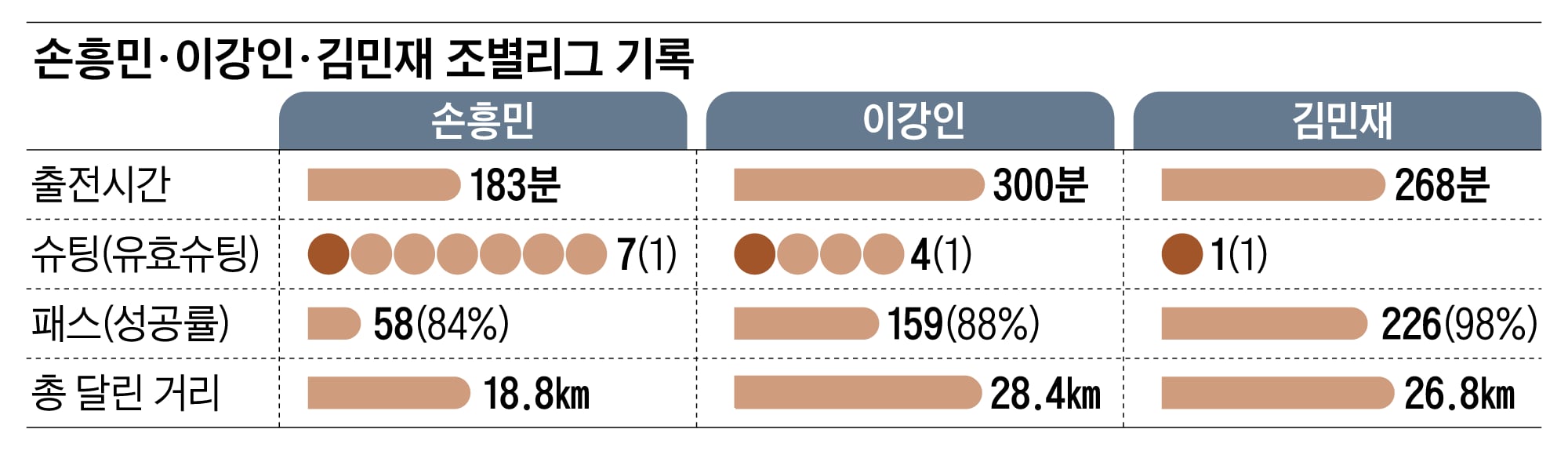
Son Heung-min, frequently considered Asia’s best player, was anticipated to exceed the record of three goals set by Ahn Jung-hwan as the leading Korean scorer in World Cup history, and potentially surpass Honda Keisuke’s (Japan) mark of four goals as the top-scoring Asian player in World Cup history. At 34 years old and nearing the end of his career, this was probably his final World Cup appearance, generating excitement among fans about his “final performance.” Nevertheless, he did not showcase performances that matched his reputation during the group stage.
What was especially disappointing was his inability to show the decisive finishing typically expected from a Premier League top scorer. In the first game against the Czech Republic, he took six shots, but only one hit the target. He didn’t manage a single shot against Mexico, and even in the match against South Africa, where he came on as a substitute in the second half, his only attempt was blocked by an opponent’s foot. Considering that star strikers he faced in Europe—Lionel Messi, Kylian Mbappé, Erling Haaland, Vinícius Júnior, and Mohamed Salah—were performing well in this tournament, his poor form was all the more unfortunate. Son Heung-min lowered his head and said, “I couldn’t contribute much to the team on the field. I have to accept whatever outcome comes.”
“The heart of the defense,” Kim Min-jae also did not demonstrate his typical strong defensive skills. He has regularly played in a four-back formation at his current club, Bayern Munich, and previously at Napoli, but had difficulty adjusting to the three-back setup that head coach Hong Myung-bo used as his primary strategy. Although he successfully limited striker Patrick Siek in the match against the Czech Republic, he was less effective in the games against Mexico and South Africa, allowing several counterattacks to go through the back. To add to his challenges, he was replaced during the South Africa game due to a calf injury in the second half.
Although the trio who were leading Korean football struggled in this World Cup, it’s also difficult to see new stars emerging to replace them. Korean football has typically seen a smooth transition of generations, with new talents shining at the World Cup: Lee Dong-gook (19 in 1998), Park Ji-sung and Lee Chun-soo (21 in 2002), Ki Sung-yueng (21 in 2010), Son Heung-min (22 in 2014), and Lee Kang-in (21 in 2022). However, this time, the team had very few players in their early 20s, with the youngest being 23-year-olds Bae Jun-ho and Jens Castrop. Defenders Lee Han-beom (24) and Lee Tae-seok (24) were given chances but failed to firmly position themselves as future leaders. Jens Castrop, a German-Korean player who attracted attention for his performances in the Bundesliga this season, only played in the second half of the South Africa match, which left him with limited time to demonstrate his skills.


Leave a Reply