
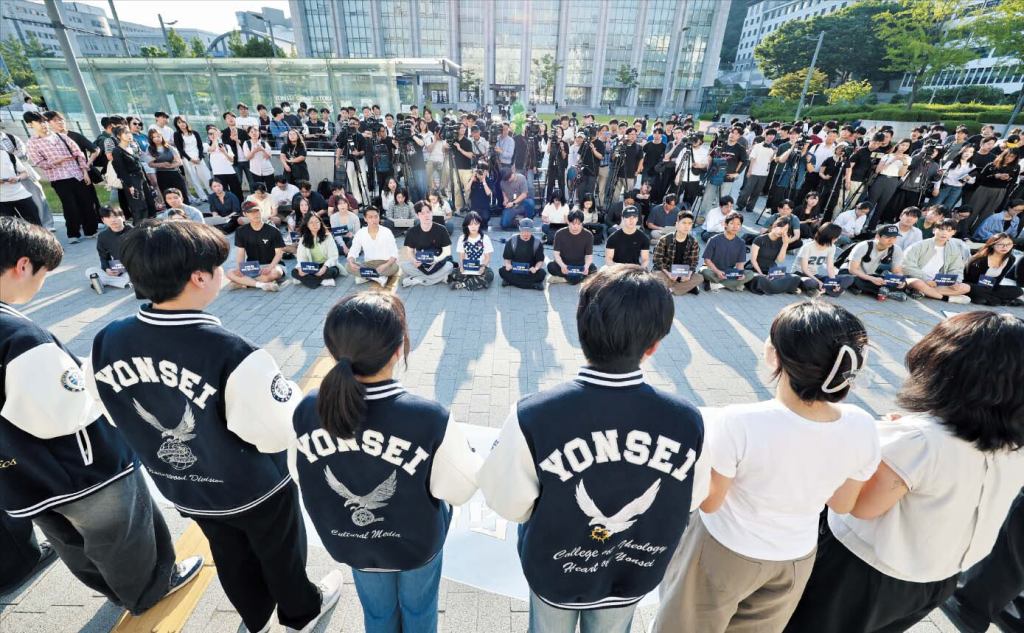
On June 10 at 6 p.m., approximately 20 students assembled at the Acro Plaza on the Gwanak Campus of Seoul National University to express their disapproval of the ballot shortage that occurred during the June 3 local elections. During the gathering, Lee Eui-bin took the microphone to deliver a political statement. However, Lee’s title was not “Student Council President,” but rather “Chairperson of the Joint Meeting of College Student Council Presidents at Seoul National University.” Seoul National University had attempted a re-election in February this year following a lack of candidates in the October 2025 Student Council President election, but once again, no candidates emerged, resulting in the failure to establish a student council. Meanwhile, at the Democracy Plaza on the Seoul Campus of Korea University, Lee Ji-min, who read the political declaration, introduced himself as the “Emergency Response Committee Chairperson.” In Korea University’s March re-election, one candidate ran but had their eligibility revoked by the university’s National Election Commission due to accumulated warnings. With no further candidates, Korea University also failed to form a student council and has been operating under an emergency committee system.
Out of 18 universities across the country that took part in the political statement issued on June 10 criticizing the ballot shortage, five—Seoul National University, Korea University, Yonsei University, Hanyang University, and Sookmyung Women’s University—were unable to establish student councils and signed the declaration through joint college meetings or emergency committees. Similarly, Dongguk University and Kookmin University, which released a declaration on June 5, also do not have student councils. The lack of candidates or low voter participation has prevented the formation of student councils.
Experts point out that the diminished role of student councils in university organizations compared to earlier times is a significant factor. Under authoritarian governments, student councils played a crucial role in driving social change by expressing views on important matters. Many presidents of student councils went on to enter politics, as seen with the 586 group, which emerged as a vital faction in South Korean politics. However, current student councils mainly focus on organizing school festivals, student welfare initiatives, and debates about tuition fee hikes.
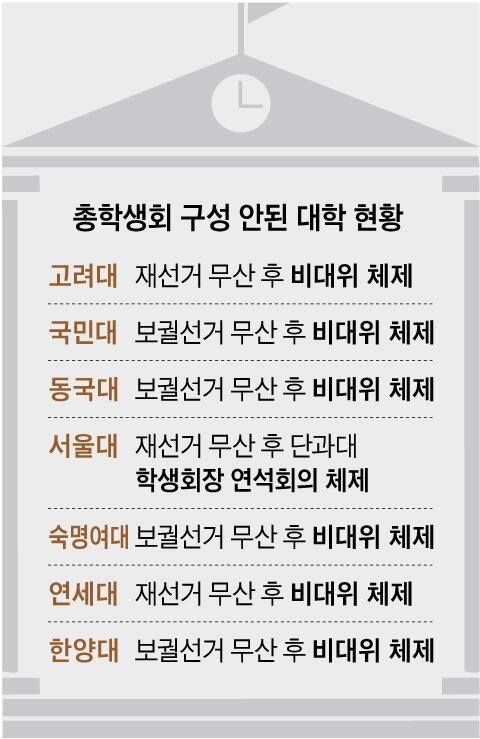
The high expenses involved in running for student council president serve as a major deterrent for students considering candidacy. Lee Ji-min, chairperson of Korea University’s emergency committee, stated, “The cost of creating election headquarters uniforms, posters, signs, and brochures alone averages between 2 million and 3 million Korean won. In some instances, the total expenditure reached approximately 10 million Korean won, which includes meals for dozens of election staff.” Seoul National University, Yonsei University, Korea University, Kookmin University, and Sookmyung Women’s University were unable to elect student council presidents due to a shortage of candidates.
The belief that “student councils do not reflect us” among students is also a contributing factor. A rising feeling exists that student councils are ineffective in tackling youth concerns such as job opportunities, inequality, and gender issues. The erosion of student unity and the rise of a “survival of the fittest” mindset throughout the COVID-19 pandemic are viewed as elements that have led to the decline of student councils.
There is a growing number of election failures caused by low voter participation. Dongguk University, which had no candidates for several years, conducted an election in March with two contenders. Nevertheless, the turnout (43.5%) did not meet the 50% validity requirement, resulting in the ballots not being counted. Similarly, Hanyang University’s 2026 student council election failed to reach the 50% turnout threshold. Kyung Hee University’s Seoul Campus extended voting for two days in April just to surpass the 50% mark. Professor Koo Jeong-woo from the Department of Sociology at Sungkyunkwan University remarked, “Student councils have lost their significance as they no longer reflect students’ voices in society.”



Leave a Reply