
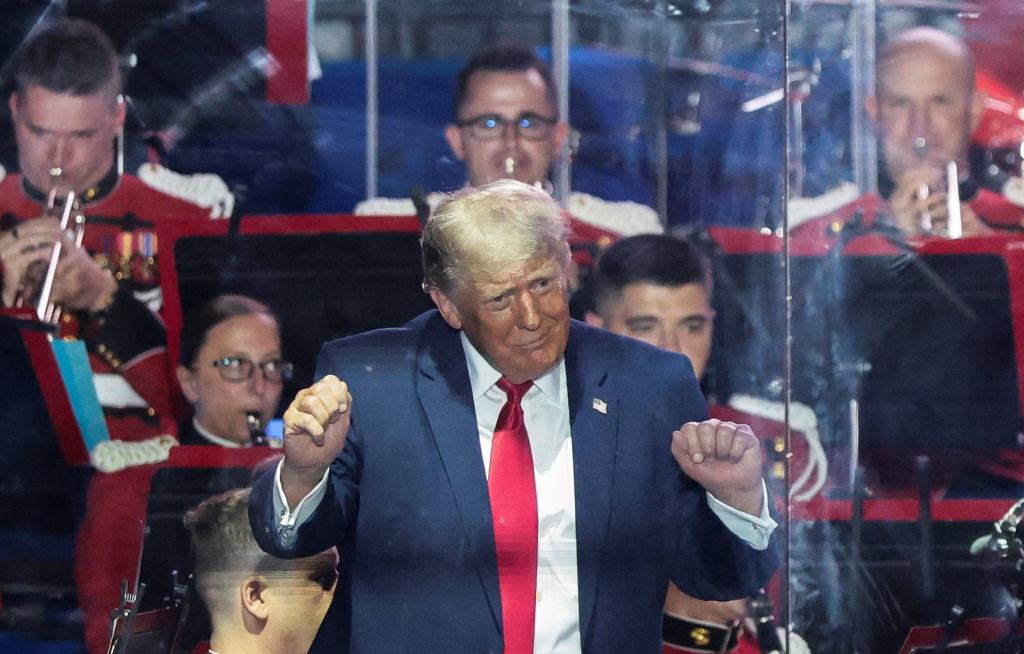
U.S. President Donald Trump has encountered a threefold challenge consisting of war expenses, internal resistance within his party, and withdrawals from his primary supporters after the U.S.-Iran ceasefire memorandum of understanding (MOU). He sought an extra war-related budget surpassing 100 trillion Korean won from Congress, as ongoing conflicts emerged within the Republican Party, and there have been persistent departures among his prominent MAGA (Make America Great Again) supporters.
The White House submitted an urgent supplemental budget of roughly 88 billion dollars (approximately 136 trillion South Korean won) to Congress on the 24th. Out of this, 67.1 billion dollars is designated for the Department of Defense, which will cover expenses related to the conflict in Iran, as well as the procurement of ammunition and equipment.
The budget allocates 21 billion dollars to restock missile and precision-guided weapon reserves that were significantly depleted during the conflict in Iran, 17.3 billion dollars for ongoing military activities, 1.7 billion dollars to enhance combat preparedness, 2.4 billion dollars for drone initiatives, 5.1 billion dollars for cyber and automated technologies, and 12.1 billion dollars for secret projects.
The Department of Defense had previously calculated the direct expenses of the Iran conflict at around 29 billion dollars and shared this information with Congress. Despite Trump’s focus on promoting stability and peace in the Middle East since the ceasefire, he stated, “The war is over,” yet his proposal for an extra defense budget surpassing 100 trillion Korean won right after the agreement has revealed the economic toll of the conflict.
Nevertheless, getting the budget through Congress is anticipated to be difficult. Democrats are against the large increase in military funding, referring to the conflict with Iran as an “unlawful war.” Within the Republican Party itself, there are notable voices opposing the rise in financial spending, indicating substantial challenges ahead.
On the same day, Trump had a direct confrontation with Republican senators during a private lunch at the Capitol. Multiple participants reported that Trump strongly denounced Republican legislators who supported the congressional war powers resolution concerning the conflict with Iran. He was said to have referred to Senator Bill Cassidy as a “madman” during an intense discussion. Following the meeting, Cassidy informed reporters, “The president asked why I opposed the war, and I explained that I raised questions the public needs to be aware of. I won’t be scared off.”
New divisions are appearing within Trump’s previously unshakable base of support. Conservative commentator Tucker Carlson recently mentioned on his podcast, “I backed the Republican Party for 35 years, but I will no longer back it. I won’t vote for a party that doesn’t stay loyal to America.” Former Representative Marjorie Taylor Greene, who was once seen as one of Trump’s most devoted supporters, posted on social media on the 23rd, “It’s not only Tucker who doesn’t support the Republican Party. I’m thoroughly tired of a party that betrays its voters and the country.”
Both individuals have strongly criticized Trump’s conflict with Iran and the broader expansion of military operations abroad. Experts indicate that the widening divide among his supporters, caused by the Iran conflict, is adding to Trump’s political challenges as the November midterm elections approach.




Leave a Reply