
In December 2025, Italy granted over 1.1 gigawatts of solar power capacity through 88 projects in its initial auction that was solely for developments utilizing equipment not made in China.
The average winning bids reached €66.38 ($75.80) per megawatt hour, representing a 17% increase compared to the rate established in a free renewable energy auction conducted in 2025, as reported by data from Italy’s electricity services agency, GSE.
It was a conscious extra cost, incurred to purchase solar equipment from sources outside of China. However, with over 90% ofSolar panels installed in the European Union continue to be imported from China., the auction revealed just how limited Europe’s options truly are.
China continues to manufacture over 80% of the world’s solar equipment, leading all phases of the supply chain, from polysilicon to completed panels. This level of production has provided cost-effective panels globally, yet it has also caused growing concerns among authorities in Brussels and New Delhi regarding their heavy dependence on one provider.
“China is involved in nearly all global solar supply chains,” Ajay Srivastava, founder of the Global Trade Research Initiative, told DW. Even panels manufactured in India or Vietnam, he mentioned, usually depend on Chinese-produced cells, wafers, or polysilicon higher up in the process.
India’s manufacturing push
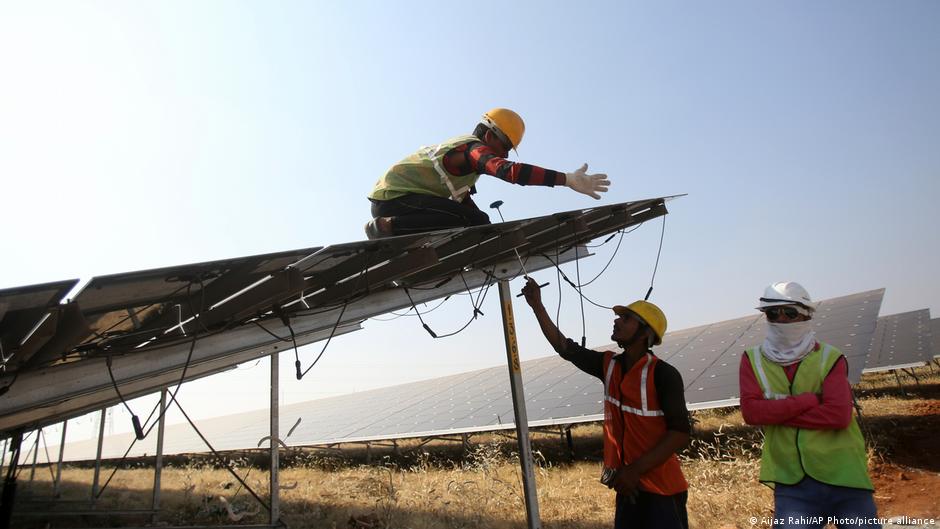
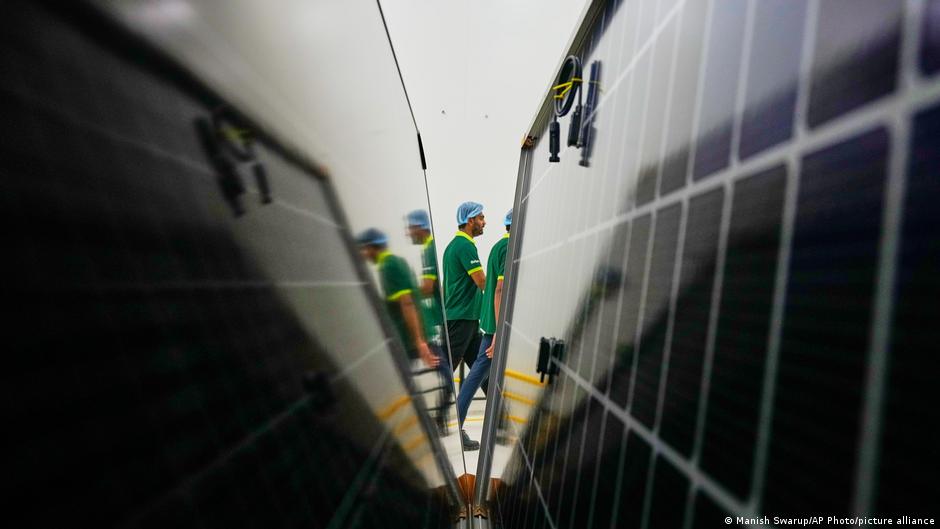
India’s shift from a consumer to a producer has happened quickly, at least in terms of documentation. By early 2026, the nation’s solar photovoltaic (PV) module production capacity had climbed to 172 gigawatts (GW), with cell production nearly tripling to 30 GW.
This change has primarily been driven by policy.
Sanjay Varghese, a top official at the Indian company ReNew, attributed the transformation of the industry almost overnight to the government’s “Make in India” initiative — including tariffs and non-tariff measures like the Approved List of Models and Manufacturers (ALMM), supported by a roughly $2.5 billion Production-Linked Incentive (PLI) program.
Five years back, every solar module installed in India was imported from China,” Varghese mentioned. “However, now, all modules, along with approximately 50% of the cells used in India, are produced domestically.
Varghese is optimistic that the entire supply chain, including modules, cells, wafers, ingots, and polysilicon, as well as metallurgical-grade silicon, will be established domestically within the next five to seven years.
Dries Acke, the CEO of SolarPower Europe, stated that India’s energy capacity has already surpassed its domestic needs. “This clearly indicates that a nation will be seeking avenues for exports,” Acke mentioned.
Where the limits lie
However, experts also warned against exaggerating India’s capability to take over from China.
Jochen Rentsch, who leads technology transfer at the Fraunhofer Institute for Solar Energy Systems, highlighted wafers as the main constraint: approximately 99% of the global photovoltaic wafers are still produced in China. He also cautioned that Chinese producers can sell wafers at prices lower than their production cost, making it “almost impossible” for new companies to compete financially.
Although India has achieved significant self-sufficiency in cells and modules, Rentsch noted, it still relies on China for wafers, polysilicon, and production equipment, indicating that moving towards Indian panels would merely shift some stages of the process rather than remove Europe’s reliance on China.
Varghese recognized the same gap from the industry perspective, pointing out that India still depends on Chinese companies for the equipment and machinery required to produce solar products, and that China remains at the forefront of global solar technology advancement.
Europe’s policy gap
However, Europe’s situation is distinct. Germany, on its own, has established agoal of obtaining 80% of its power from renewable sources by 2030a target that necessitates large amounts of imported clean-energy equipment, much of which remains connected to Chinese supply chains.
As stated by BSW-Solar, the German solar association, domestic module production in Germany has decreased to a minor, specialized market activity, although the country still holds stronger positions in inverters, mounting systems, battery storage, and upstream manufacturing equipment.
Acke suggested that Europe should develop its own version of India’s PLI program, which is an output-focused subsidy, resembling the tax credits provided under the US Inflation Reduction Act, in order to make local production economically feasible.
The EU’s upcoming Industrial Accelerator Act, designed to follow up on the Net Zero Industry Act of 2024, has disappointed supporters such as Acke, as it outlines “Made in Europe” in a way that allows inclusion of free-trade partners instead of mandating actual production within Europe.
To make matters worse, US tariffs on Indian productshave limited export opportunities elsewhere, prompting Indian manufacturers to focus more on Europe. However, Varghese pointed out that anti-dumping and countervailing duties on Indian-made cells and modules in the US have gone beyond 250%, practically shutting that market off for the time being.
However, India’s geographical location provides certain benefits. Rahul Sharan, deputy director and maritime expert at Drewry, an independent shipping research firm, pointed out that India’s western ports effectively link to Europe through the Suez Canal, which could reduce delivery times in comparison to its East Asian competitors.
Nevertheless, he warned that logistics “by itself is unlikely to remove the structural cost benefits that China has developed through size and integration.” Sharan also highlighted the Strait of Malacca — where over 60% of global maritime trade flows — as a long-standing bottleneck whose disruption, whether due to tensions in the South China Sea or U.S.-China competition, could affect solar supply chains well beyond Asia.
A long road ahead
Although specialists debate that, for the time being, India is still the most reliable alternative to China in solar production, it hasn’t fully replaced it yet. Srivastava mentioned that developing real manufacturing expertise requires 10 to 20 years, and initiatives such as India’s PLI often promote assembly rather than comprehensive manufacturing.
He thinks the most practical approach is a unified “China-plus-one” plan, where the US, Europe, India, and other regions develop alternative supply chains, even if it initially increases costs by 10 to 15%. “However, currently, this kind of political and industrial leadership is lacking,” Srivastava stated.
This piece is part of the India-Germany Climate and Energy Journalism Initiative conducted by Clean Energy Wire, backed by Heinrich Böll Stiftung.
Edited by: Karl Sexton
Author: Jyoti Thakur, Leon Kirschgens




 jasdooit
Leave a comment