
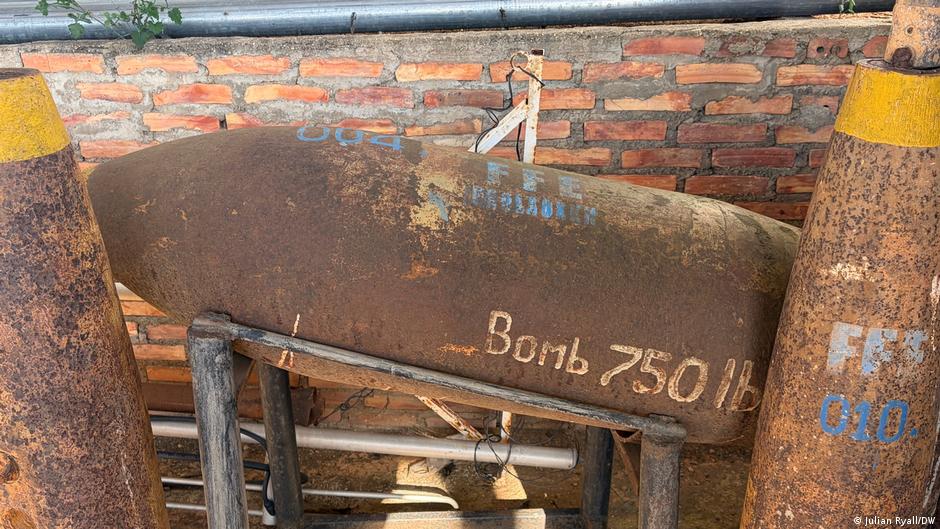
Thong Phet was an 18-year-old beginner monk when the motion of a machete changed his life forever. The blade struck an unexploded bomb he hadn’t seen, causing it to explode.
“A friend brought me to the hospital. I remained aware the entire time. They had to remove my left arm below the elbow, and my right hand was also severely damaged,” he said to DW as he observed a team from theLao National Unexploded Ordnance InitiativeCarefully traverse one of his fields on the edge of the village of Ban Napia, located in northeastern Laos.
In 1973, Xiangkhouang Province faced significant dangers, according to Phet, since the conflict in Vietnam continued, located roughly 100 kilometers (62 miles) to the east.
Although Laos was not officially part of the conflict, North Vietnam set up the “Ho Chi Minh trail” in eastern Laos to transport arms, supplies, and soldiers into South Vietnam.
This, along with the fact that Xiangkhouang Province served as the base for the communist Pathet Lao movement, made it a target for American bombing.
Over 2 million tons of explosive munitions were dropped in Laos from 1964 to 1973, which makes it the country that was hit the hardest with bombs relative to its population. The types of weapons used included incendiary shells, rockets, and 2,000-pound (907-kilogram) bombs, but the item that has created — and still creates — the greatest fear among locals is the cluster bomb.
Cluster bomb threats
Meant to disintegrate in the air, cluster bombsdelivered up to 600 small explosive devices, each no larger than a fist, to poison an area spanning several football fields. It is believed that 270 million of these smaller weapons — referred to locally as “bombies” — were scattered across Laos, yet 30% did not explode. Numerous remain where they landed, decades ago, andkeep presenting a danger to the local population.
I have a clear memory of the bombs falling,” said Phet. “I recall seeing planes approaching and taking shelter in caves nearby with my parents when I was a child.
Now, Phet hopes the unexploded ordnance (UXO) team can ultimately verify that one of his fields is secure.
The undulating fields are dotted with small pieces of red tape that sway in the breeze. Two women wearing UXO Laos uniforms hold a large-loop detector over a section of ordinary grass, but stop when a signal is picked up. They place a marker and proceed along their path.
Behind them, another team member arrives with a smaller metal detector and accurately pinpoints the target. Gently, she digs around the area until the source of the signal is determined.
Occasionally it may be a piece of metal, while at other times it is the remnants of a weapon that detonated ages ago and is now harmless. However, frequently it is a bombie.
Destroying a danger
Every target is meticulously enclosed with sandbags, a minor explosive device, and warning signs featuring a skull and crossbones design. At the conclusion of each workday, an alarm is announced through loudspeakers, echoing through the valley and informing nearby residents about the impending events.
A loud crack echoes, followed by three columns of smoke rising into the sky at the same time from the day’s discoveries.
Within a single week, this team of seven demining experts has rendered 19 bombs and five large-caliber bullets safe, which were found across 10,594 square meters (approximately 114,032 square feet) of farmland.
The region that remains unexplored is extensive. The village spans over 23,000 hectares (approximately 56,834 acres), and earlier search operations have discovered five major explosives and over 6,000 separate bomb fragments.
There is a clear necessity for ongoing efforts, as the village has lost five individuals due to unexploded ordnance. Additionally, there is a danger for the demining teams, with two UXO Lao specialists losing their lives in an explosion in 2002.
Once Phet’s area is confirmed safe, this group will proceed to the next shape outlined with red tape.
‘Obstacle to development’
“UXOs present a major challenge for development in Laos, as they increase costs and slow down progress due to the need for land to be surveyed and cleared to eliminate potential dangers,” stated Martine Therer, the United Nations Development Programme’s representative based in Laos.
In an interview conducted in her office in Vientiane, Therer mentions that Laos is among a small number of countries that have implemented the 18th Sustainable Development Goal, which is “Lives safe from Unexploded Ordnance,” with an emphasis on achieving specific objectives to ensure that unexploded ordnance no longer obstructs human development and poverty alleviation initiatives in rural areas.
If you examine a poverty map, it becomes evident that these regions are largely situated in areas with significant UXO pollution,” Therer stated. “It is evident that the number of casualties has decreased, but there remains a sense of fear within these communities.
“Farmers often endanger their lives while tilling the land, excavating, or clearing vegetation, in a nation where more than 70% of the rural community depends on farming and natural resources for their income,” she noted.
UXO significantly affects income creation and efforts to reduce poverty, as polluted land could otherwise be utilized effectively for farming, industrial growth, tourism, and infrastructure development.
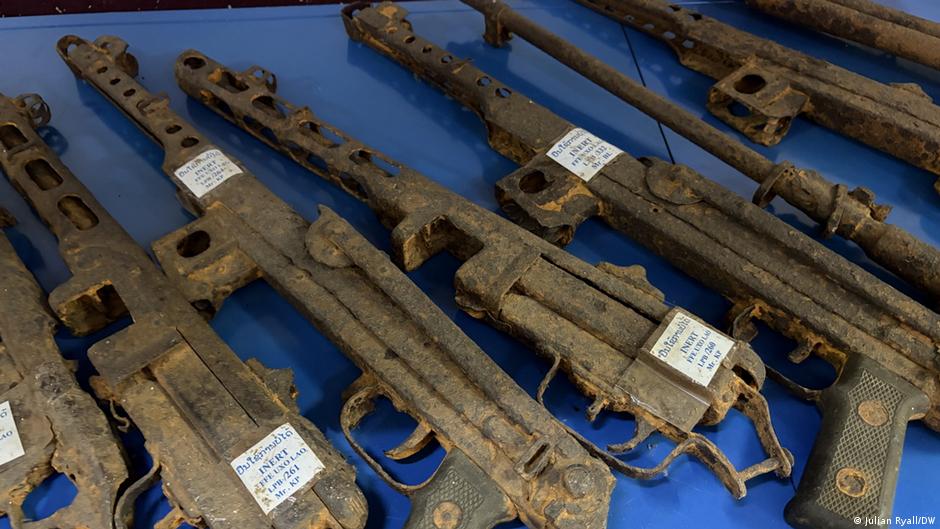
During the 1980s, thousands of people were injured or killed annually due to unexploded ordnance.
Efforts to clear mines and a thorough education initiative in rural areas have significantly lowered the number. For example, in 2015, there were 44 incidents related to unexploded ordnance in Laos, resulting in nine deaths. Five years later, this decreased to 33 incidents and seven fatalities, and by 2025, there were six deaths in 25 detonations.
These figures are minor when compared to deaths from other causes, such as over 900 fatalities on Laos’ roads annually, yet the government here asserts its dedication to spearheading global initiatives to eliminate the danger of unexploded ordnance to civilians.
Laos will organize the four-day Third Review Conference for the Convention on Cluster Munitions in September. First approved in May 2008, 112 countries have officially accepted the treaty. The agreement requires participating nations to refrain from using, creating, manufacturing, or keeping cluster munitions, although notably, the United States, Russia, and China are not among the signatories.
From the beginning, Laos has been a strong supporter of the convention, and I view this meeting as an opportunity for Laos to demonstrate what can be accomplished,” said Therer. “It might appear minor in comparison to the scale of the issue, but they have already made significant progress over the past 30 years, and this is a chance to highlight the entire journey — as well as the work that still lies ahead.
Educating villagers
An essential part of the initiative has consistently involved education, as the residents of Ban Napia recently came together at the local school for a lecture by UXO Lao.
The villagers’ lives have always been affected by the looming presence of explosives, according to Thong Kham, head of the Explosive Ordnance Risk Education team.
Although it’s beneficial to emphasize the main points, the main audience for the presentation consists of young, curious children who explore the nearby fields and woods.

Numerous weapons were dropped near the village between 1964 and 1973, but we believe up to 30% failed to explode,” he stated. “These unexploded devices continue to affect these communities. The people here depend on agriculture, and the presence of UXOs on their land hinders local progress and their daily lives.
A teacher at Kham is utilizing a pointer to demonstrate to the children the various kinds of bombs, rockets, and bullets they could face, as well as the actions they should and should not take.
Never approach a suspicious object and inform an adult right away, she says. Avoid attempting to open any weapon, and use a spade carefully when digging a hole instead of a hoe. Also, never start a fire on the ground in an area that hasn’t been checked for unexploded ordnance, as the heat might trigger a detonation.
The children watch closely and recite the rules in a singsong manner to her. Kham’s team can only wish that they have truly absorbed the lessons.
Edited by: Srinivas Mazumdaru
Author: Julian Ryall (in Ban Napia, Laos)





Leave a Reply