
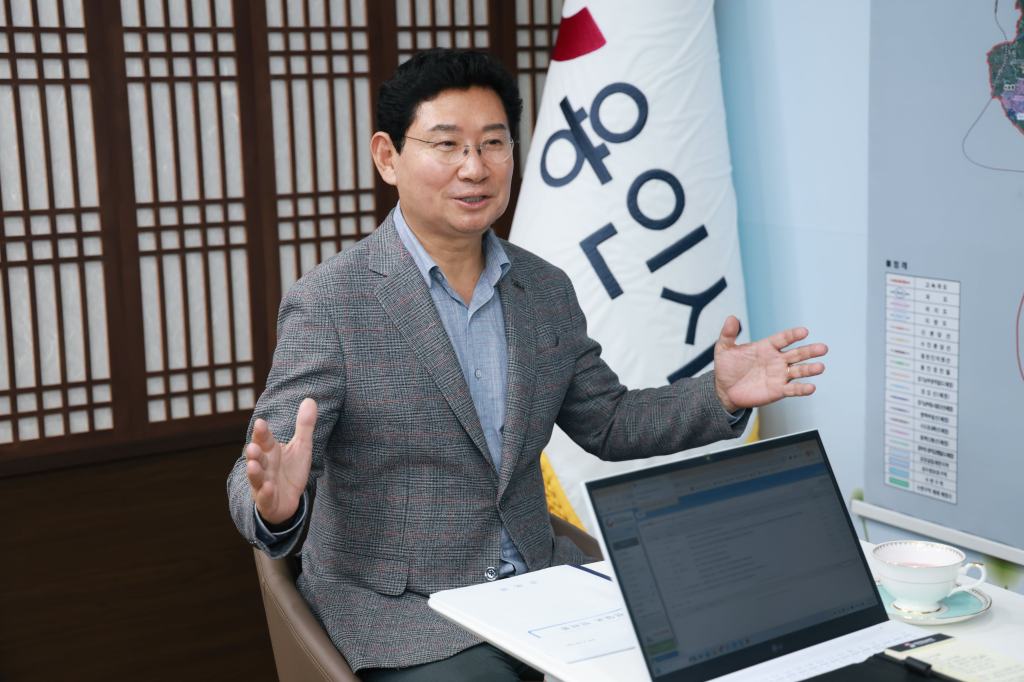
“The word I’ve been repeating every day recently is ‘speed.’ Speed is the most crucial factor,” said Lee Sang-il, 65, the mayor of Yongin in Gyeonggi Province. During an interview with this newspaper on the 15th, he stated, “We will accelerate the development of infrastructure including power, water supply, and transportation networks to enable Samsung and SK semiconductor clusters (industrial areas) to start operating as soon as possible.” Yongin hosts major semiconductor clusters being developed by Samsung Electronics and SK Hynix, creating the world’s largest semiconductor cluster.
Mayor Lee, who previously worked as a journalist, won another term in the June 3 Yongin mayoral election—the first time a mayor has been re-elected in the city’s history. Local analysts stated, “Despite debates about moving the Yongin National Semiconductor Industrial Complex to the Honam area, public opinion supported Mayor Lee.”
– Your initial approval following your inauguration was connected to semiconductors.
During the recent mayoral election, residents continuously called out, ‘Safeguard Yongin’s semiconductor sector until the conclusion.’ My goal is to uphold this commitment. Although the previous administration established the foundation for the semiconductor initiative, the current focus is on quickly finishing it. I intend to make Yongin a worldwide center for the semiconductor industry.
– What is the present condition?
Work on land compensation for the Samsung Electronics National Industrial Complex is currently underway, aiming to start factory operations in 2029. SK Hynix is building its semiconductor manufacturing plant, which is anticipated to begin functioning in February of next year.
– What are the most significant obstacles?
Speeding up the development of the site for the National Industrial Complex and addressing power supply problems are essential. The extended absence of the LH (Korea Land and Housing Corporation) president has postponed the scheduled start of site development projects, potentially causing delays in factory construction timelines. Power availability depends on grid infrastructure, which needs government involvement. Only through strong governmental support can businesses make timely investments.
– The importance of transportation systems is also significant.
Creating a metropolitan transportation system that connects the industrial area, nearby cities, and the capital region is crucial for boosting corporate competitiveness. For this purpose, we have suggested to the government the development of a semiconductor line linking Hwaseong, Yongin, and Icheon, along with the Gyeonggi Southern Metropolitan Railway. We will also work to ensure the successful implementation of projects such as the Yongin-Seongnam Expressway, the Second Yeongdong Connecting Expressway, and the Yongin-Chungju Expressway.
– The administration intends to establish semiconductor manufacturing facilities in the Honam area.
I recognize the importance of balanced national development. Nevertheless, the semiconductor sector depends on the concentration of fabrication plants, R&D centers, and companies that supply materials, components, and equipment to stay competitive. Artificially spreading out these elements would decrease efficiency and result in unnecessary investments. Finishing current projects is the real way to enhance South Korea’s semiconductor competitiveness.
– What is meant by ‘clustering’?
The leading four semiconductor equipment firms globally have already started to converge in Yongin. ASML, a Dutch company at the forefront of the industry, is investing 36 billion South Korean won to set up a technical support center. Tokyo Electron from Japan is constructing an R&D facility, while Applied Materials from the United States recently revealed plans to build an operational site here. Lam Research from the U.S. already has an R&D center in place. This concentration enhances competitive advantage.
– In what way will the additional tax income be spent?
Beginning in 2028, an extra roughly 1 trillion South Korean won in taxes is anticipated each year. This funding will be utilized to transform the Yongin Idong Public Housing District (serving 20,000 households) into a ‘semiconductor-focused new city.’ Additionally, we intend to establish a significant lake park, akin to Suwon’s Gwanggyo Lakeside Park, near Idong Reservoir and Songcheon Stream. A semiconductor hub extends beyond manufacturing facilities; it necessitates a city that attracts global corporations and skilled professionals.
– High schools focusing on semiconductors are becoming more popular.
A high school specializing in semiconductors is set to open in Yongin in March next year, with intentions to transform it into a Meister high school by 2028. It aims to develop specialized personnel for the semiconductor sector.



Leave a Reply