
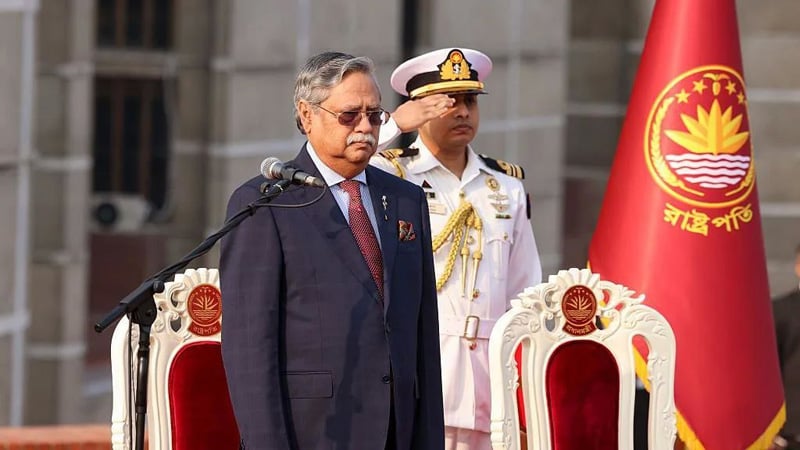
Pakistan, July 25 — President Mohammed Shahabuddin of Bangladesh, who was appointed under the administration of former Prime Minister Sheikh Hasina, stepped down on Friday mid-term due to prolonged political instability in the South Asian nation.
A fresh administration led by Tarique Rahman, the son of former Prime Minister Khaleda Zia and a long-standing opponent of Hasina, took control with a significant win in February following 18 months of temporary governance under Nobel Peace Prize winner Muhammad Yunus. Hasina resigned and went to India in August 2024 after an anti-government campaign that concluded her 15-year leadership.
Hasina strongly condemned the temporary government headed by Yunus.
Shahabuddin handed in his resignation on Friday to Parliament Speaker Hafiz Uddin Ahmad, stating health-related issues. The resignation document was viewed by The Associated Press. The speaker mentioned during a press conference later that day that he had accepted the resignation.
However, local media stated that Shahabuddin was forced to step down due to pressure from the existing government, as he is alleged to have contacted Hasina via phone during his trip to London for medical treatment in May. The AP was unable to independently verify the event.
Shahabuddin was recognized as a loyal supporter of Hasina. After her removal, he encountered significant resistance from a student organization that spearheaded the revolt against Hasina. The demonstrators labeled him as an ally of Hasina and took to the streets calling for his resignation and detention.
A recently established political group, the National Citizen Party, led by student leaders from the uprising, has been actively opposing Shahabuddin for a considerable time.
As per the constitution of Bangladesh, if the president steps down, the Speaker of the Parliament assumes the role temporarily until a new president is chosen by the members of the legislature. The NCP became part of an electoral coalition headed by the Bangladesh Jamaat-e-Islami party, which is the biggest Islamist political group in the nation.
The president serves as the head of state, typically functioning as a symbolic figure, yet holds a constitutional responsibility in times of political emergency. Additionally, the president acts as the supreme leader of Bangladesh’s military forces.
Shahabuddin took office as the 22nd president of Bangladesh on April 24, 2023. Hasina secured a fourth consecutive term in the January 2024 election, which was not participated in by prominent opposition groups such as Rahman’s Bangladesh Nationalist Party and Jamaat-e-Islami.
Shahabuddin’s departure has removed a strong supporter from Hasina’s side. The former prime minister has stated, primarily to Indian media, that she intends to return to Bangladesh in December and appear in court to confront the charges against her.
India declined to transfer Hasina to Bangladesh despite continuous demands from both the government led by Yunus and the present administration.
In November, a special court in Bangladesh handed down a death sentence to Hasina in her absence for authorizing the suppression of an uprising. According to a report by the United Nations, almost 1,400 individuals lost their lives during the crackdown. Hasina rejected the allegations against her while living in exile.




Leave a Reply