
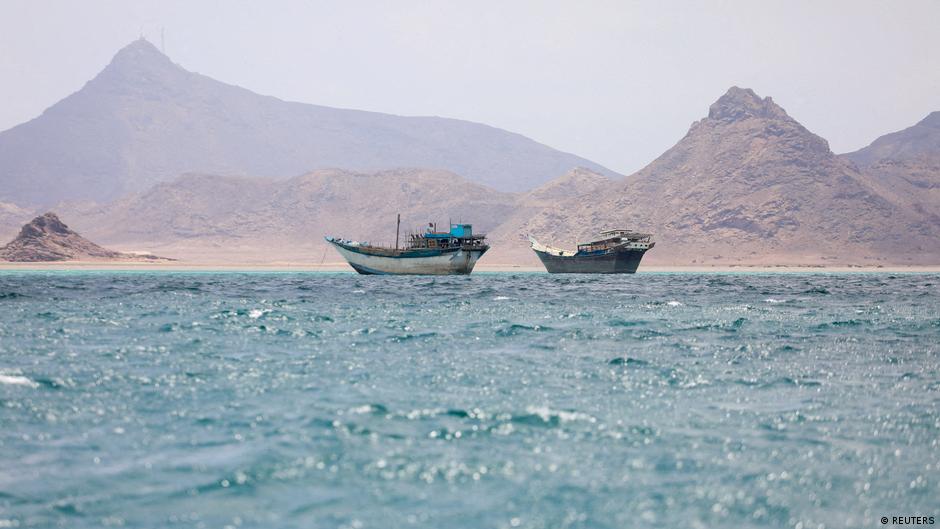
Saudi-led coalition attacks the Houthi-controlled Yemeni port city of Hodeida. The strikes follow reports that Yemen’s Iran-backed Houthi rebels have carried out multiple attacks on Saudi oil tankers as part of their Red Sea blockade. The Houthis assert that the Bab al-Mandeb Strait remains open, stating that the blockade specifically targets Saudi vessels. The EU naval operation ASPIDES has increased the risk level for merchant ships in the Red Sea due to Houthi activities. This occurs amid growing tensions between the US and Iran over control of the Strait of Hormuz, another crucial route for energy exports. Israeli Prime Minister Benjamin Netanyahu promises to respond with full force following deadly clashes in the West Bank. The US continues its strikes against Iran for the 13th night in a row, while Iran claims an IRGC base in northern Iran was targeted.
Keep up with the latest updates on the US conflict with Iran and Middle East news for Friday, July 24:
Fed up with missing our live updates? Click here to add us as a Preferred Source on Google. Next, tap the “Star” or “Preferred” option to ensure DW News remains at the top of your feed.
American troops ‘disable’ a ship that tried to break the blockade around Iranian ports
American forces have “disabled” a commercial ship that tried to bypass the US embargo on Iranian ports, according to military officials who spoke with the Associated Press news organization.
A spokesperson for US Central Command, Tim Hawkins, informed AP that the M/T Lavine was “disabled” in the Gulf of Oman on Friday, following reports that the ship had tried to bypass the US blockade on multiple occasions.
Hawkins stated that the vessel failed to follow US instructions following a warning. Hawkins mentioned that American forces subsequently opened fire on the ship’s engine room.
It’s the second trading ship targeted by theThe US since the military re-imposed its embargoAt Iranian ports on July 14. This comes after the failure of a truce between the US and Iran on July 8.
The US President, Donald Trump, initially implemented a restriction on Iran’s ports in April, which was later suspended after the ceasefire agreement outlined in the US-Iran Memorandum of Understanding in June.
Bahrain triggers alarm bells as reports emerge of an Iranian attack on a US naval base
The Ministry of Interior in Bahrain stated that alarms were being activated late on Friday night.
“Residents and citizens are encouraged to stay calm and go to the closest secure location,” the ministry shared on X.
Bahrain hosts a U.S. military installation called Naval Support Activity Bahrain. The country has often been a target of Iranian attacks since the start of the U.S.-Iran conflict on February 28.
Reports regarding X indicated there were explosions near the facility, and it could have been struck by an Iranian missile. The US military has not provided any statement about the event.
The Saudi-led coalition confirms strikes on Hodeida, but stated it did not target the city’s port.
The coalition led by Saudi Arabia verified strikes on Hodeida in statements reported by the Saudi channel Al-Arabiya.
The alliance, however, stated that it did not attack the city’s harbor and had only focused on “military” locations.
All ports within the governorate continue to be accessible for maritime traffic,” the statement mentioned. “The coalition notes that the destroyed sites were associated with dangers posed to commercial shipping in the Red Sea.
Saudi forces attack Houthi-controlled Hodeida, according to rebel-affiliated media
Saudi Arabia has bombed Hodeida, as reported by media associated with the Houthi rebel group in Yemen.
The Houthis have control over the port city.
“A series of air strikes targeting the telecommunications authority were described as a Saudi aggression,” reported the Houthi-backed Al-Masirah TV channel. Al-Masirah is based in southern Beirut.
Furthermore, the Saudis are said to have attacked Kamaran Island in the Red Sea, which is also under Houthi control.
The attacks follow the Houthis taking credit for assaults on multiple Saudi oil tankers in the Red Sea over the past few days. The Houthis state that they are restricting Saudi ships in the Red Sea.
According to the official SPA news agency of Saudi Arabia, a Saudi ship was attacked once more on Friday, resulting in “some damage to the ship’s hull.”
Trump states that Iranians are becoming ‘very serious’ in talks with the United States.
Receiving inquiries from reporters in the Oval Office, U.S. President Donald Trump stated that Iran is becoming “quite serious” in its talks with the United States.
Trump was questioned regarding reports suggesting the US might soon initiate a major offensive against Iran, the largest operation of the conflict to date.
“No, I haven’t,” Trump responded upon being questioned by reporters about whether he had made a decision to initiate the operation.
“Listen, we are speaking to them at this moment. I believe they are becoming increasingly serious as the days pass,” Trump stated.
Iranian authorities have not responded to inquiries about ongoing discussions with the United States.A truce agreement between the United States and Iran collapsed on July 8..
Trump has consistently stated that Iran was near reaching an agreement.since the beginning of the conflict in late February in the US.
WATCH — US Bombardments Target Iran for Thirteenth Consecutive Night
The US Central Command stated that the strikes were aimed at military assets endangering commercial shipping, whereas Iran has asserted that Washington has introduced sophisticated weaponry into the region.
The United Nations cautioned that the conflict might become uncontrollable, with both parties using more aggressive language and the danger of broader regional escalation increasing.
Trump claims that China and Russia are not supplying weapons to Iran.
On a post shared via Truth Social, U.S. President Donald Trump stated that Chinese and Russian leaders assured him their nations are not supplying arms to Iran, and he expressed his trust in their statements.
President Xi, during our recent meeting in Beijing, China, informed me that he would not, under any circumstances, provide or sell weapons to the Islamic Republic of Iran — and this statement also applied to Chinese companies,” Trump stated. “I believe him, and, in addition, I am doing him significant favors.
“Similarly, President Putin, despite the terrible war in Ukraine (the relationship remains, just like with President Zelenskyy), told me he would not supply weapons to Iran,” Trump said.
Trump stated that China and Russia are not involved in the conflict in Iran, and “if they were, it would be very harmful for them — definitely not in their best interest.”
The Reuters news organization stated this week that U.S. intelligence officials are investigating if Russia is assisting Iran in targeting CIA locations in the Middle East.
In April, CNN reported that US intelligence suggested China is getting ready to send arms to Iran during a truce. China has refuted claims of sending weapons to Iran while the conflict continues.
Houthis on Saudi maritime embargo: ‘There is no closing of Bab al-Mandeb’
The Houthi rebel group from Yemen has refuted claims that it is entirely shutting down the Bab al-Mandeb Strait.
There is no closure of Bab al-Mandeb as some are claiming,” stated Houthi spokesperson Mohammed Abdusalam on X. He mentioned that the group is only implementing a “naval blockade aimed exclusively at Saudi forces.
The Houthis claim that Saudi Arabia is blockading regions in Yemen under their control, and as a result, they have initiated a “naval blockade” against Saudi ships.
The Houthis are a faction supported by Iran and recognized as a terrorist group by the United States, Canada, and various other nations. They have significant control over western and northern Yemen, including the capital city of Sanaa and the Red Sea coastline.
The Bab al-Mandeb Strait connects the Red Sea with the Gulf of Aden and the Indian Ocean. It serves as a crucial route for Saudi Arabia to transport its crude oil.
Concerns over safety in the Strait of Hormuz have led Saudi Arabia to redirect its oil shipments to the western port city of Yanbu, from where the oil is transported through the Bab al-Mandeb Strait.
Oil prices have recently risen temporarily past $100 (approximately €88), marking the first time since May, as a result of the ongoing issues in both the Strait of Hormuz and Bab al-Mandeb.
The Houthis have asserted responsibility for strikes on Saudi oil tankers in the Red Sea over the past few days.
The EU naval mission ASPIDES has increased the danger level in the Bab al-Mandeb Strait for commercial vessels, and mentioned that the potential for further tension is still significant.
United Nations calls for the return of 6,000 seafarers stuck in the Strait of Hormuz
The United Nations has urged nations participating in the conflict in the Middle East to assist in returning approximately 6,000 sailors who are still stuck on vessels in the Strait of Hormuz.
The UN human rights chief, Volker Türk, urged nations to quickly offer consular support to seafarers who are stuck, supply necessary goods, and “ensure safe travel for those stranded at sea to safely leave and go ashore.”
Attacks on civilian ships are unacceptable and need to end. They are safeguarded by international humanitarian law,” said the spokesperson for Türk. “Mariners are still at risk due to ongoing violent attacks in the strait — confronting immediate dangers of death or injury.
The United Nations human rights office stated that 17 maritime workers have been reported deceased since the fighting began in late February.
At least 93 additional sailors, from nine different vessels, were left stranded at sea by their ship operators.
“The seafarers have been abandoned on their vessels, left to manage without provisions, water, fuel, medical assistance, power, or any way to contact their loved ones,” said the spokesperson for Türk.
Netanyahu promises to ‘use full strength’ following deadly confrontations in the West Bank
Four Palestinians were killed by the Israeli military near an Israeli settlement in the occupied West Bank on Friday, with two Israelis also losing their lives in the fighting.
Israeli media outlets and local Palestinian authorities indicated that a group of Israeli settlers, some carrying weapons, arrived at the Palestinian village of Tell, located southwest of Nablus, on Friday morning. The settlers were confronted by villagers who were anxious about a potential assault.
Video of the event, verified by the Israeli military and posted online by the military reporter for Israel’s Army Radio, depicted two armed individuals in regular clothes, along with at least one Israeli soldier, aiming their guns at a group of Palestinians assembled in a field.
“Residents emerged to protect their homes and belongings. Conflicts and physical fights occurred between the locals and the newcomers,” said Walid Zidan, head of the village council in Tell, to the AFP news agency.
Israeli troops were there and joined the settlers in starting to fire … it was the settlers who attacked the village, with the aim of killing, damaging, and setting buildings ablaze.
The Israeli defense forces stated that they have obtained information indicating that Israeli citizens were walking in the region and had been targeted by Palestinians.
In reaction to the event, Israeli Prime Minister Benjamin Netanyahu pledged to “respond with complete strength against the militants and those who plan and support them.”
The Israeli forces later established checkpoints near Tell and Nablus and declared a large-scale operation in the occupied West Bank..
“After the terror attack that occurred earlier today in the region of Tell, IDF troops are getting ready for wide-ranging counterterrorism operations in the area,” the military stated.
Explosions reported near Irbil airport in Iraqi Kurdistan
Explosions were reported near Irbil’s airport in Iraqi Kurdistan on Friday, according to news agencies citing their reporters on site.
The Associated Press reported that its reporter heard at least seven explosions around 9:30 a.m. (0630 GMT) and saw at least four columns of black smoke coming from locations near or within a military base at the city’s airport. The facility is home to U.S. troops in northern Iraq.
An Associated Press reporter noticed drones flying above the city, with air defense systems engaged.
As reported by Reuters, a drone fell close to Irbil International Airport, leading to a brief halt in air traffic.
Irbil serves as the capital city of Iraq’s semi-autonomous Kurdish area.
The US targeted an IRGC base in the north, according to state media.
Iran stated that the US military targeted a Revolutionary Guards (IRGC) facility in the northern province of Gilan, as reported by official media.
“This morning, the headquarters of the IRGC naval forces in Zibakenar was struck by American enemy projectiles, causing damage to some of the equipment within the facility,” stated Ali Bagheri, the province’s deputy governor, as reported by the official IRNA news agency.
He stated, “According to preliminary findings, there have been no accounts of human injuries reported up to now, and the different elements of this event are currently being looked into by the appropriate agencies.”
Iran’s Foreign Minister Abbas Araghchi cautions nations that support U.S. strikes
At the Shanghai Cooperation Organization summit held in Kyrgyzstan, Iran’s Foreign Minister Abbas Araghchi stated that Tehran would take responsibility from any nation supporting the US in an assault on the Islamic Republic.
Any involvement, collaboration, or support in carrying out aggression against Iran will result in international accountability for the involved parties,” Araghchi stated, emphasizing that Iran “retains its right to implement all required actions under the scope of self-defense.
He stated that any origin of aggression directed at Iran would be regarded as a valid target for Iran’s military defenses.
US airstrikes in the southwest region result in at least four fatalities, according to Iran.
An overnight U.S. strike on Khuzestan province in southern Iran resulted in at least four fatalities and multiple injuries, according to Iran’s official IRNA news agency.
The deputy governor of Khuzestan, Valiollah Hayati, stated that the US missile strike targeted regions near the provincial capital, Ahvaz.
“Four of our fellow citizens were killed and five others were injured,” IRNA quoted Hayati as stating.
Bahrain sounds sirens
Bahrain sounded alarms early on Friday, notifying citizens to seek cover due to identified attacks.
The alarms were triggered several hours after the US announced it had initiated a fresh set of attacks on Iran, extending its assault for the 13th night in a row.
The Gulf nations have faced repeated criticism in the last week as the United States and Iran engage in increasing attacks.



 jasdooit
Leave a comment