
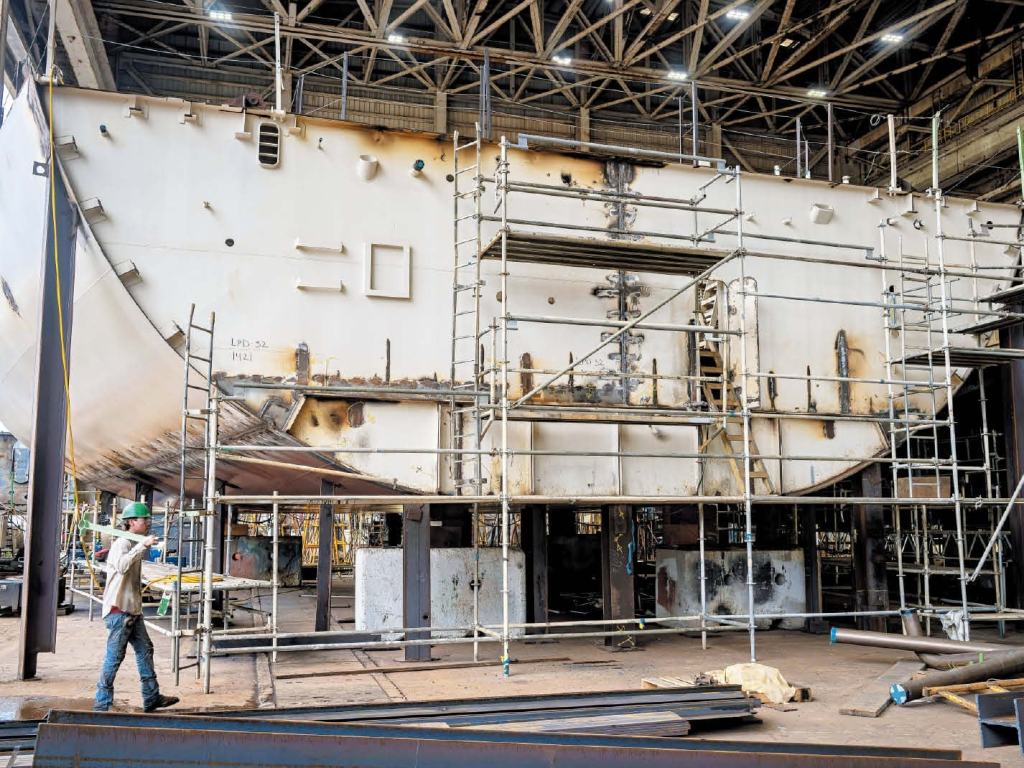
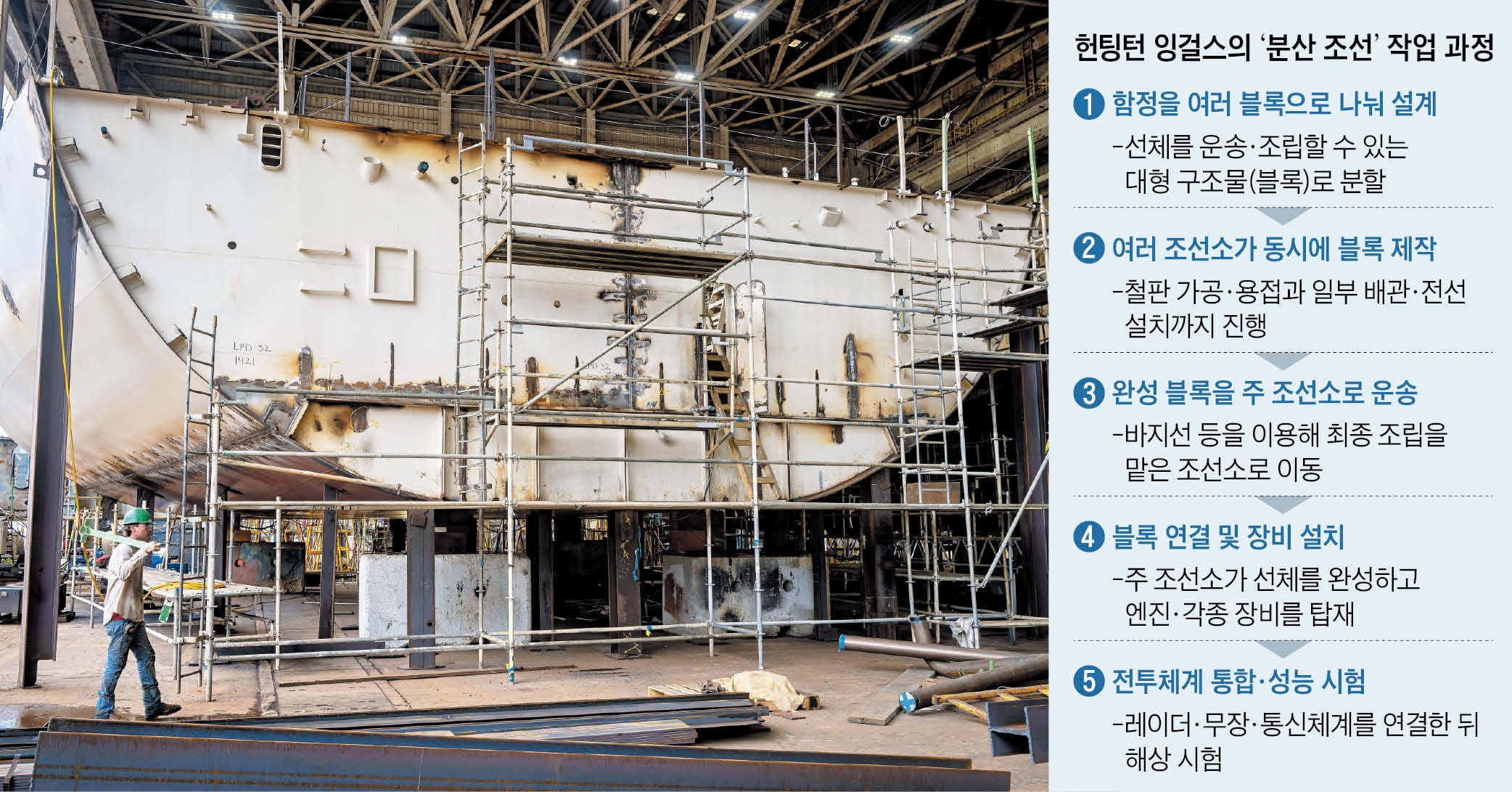
Huntington Ingalls, the leading U.S. military shipbuilder, disclosed on July 27 (local time) that it intends to extend its ‘distributed shipbuilding’ approach—previously used for Aegis destroyers—to transport landing ships, a crucial category of warships. This technique entails several shipyards constructing major hull sections at the same time rather than completing a vessel in one location, with the goal of increasing construction speed and efficiency.
Expectations within the industry are increasing regarding Huntington Ingalls’ growth in distributed shipbuilding. Should Korean shipyards join in the production of U.S. military vessels through the ‘MASGA (Make American Shipbuilding Great Again)’ initiative, they are anticipated to take on initial stages of distributed shipbuilding tasks.
Existing U.S. legislation strongly forbids foreign shipyards from building U.S. military vessels and significant hull components. Nevertheless, should there be legislative changes or presidential exemptions, it is expected that the initial model of Korea-U.S. military shipbuilding collaboration under MASGA will see progress, with Korean shipyards manufacturing hull sections and U.S. shipyards overseeing the final assembly.
◇ U.S. Military Vessels ‘Divided Construction’ Expansion
Dividing a ship into sections, known as blocks, and manufacturing these at different shipyards before assembling them at the main facility is referred to as distributed shipbuilding. This approach enables primary contractors to concentrate on complex assembly tasks, thereby enhancing the overall quality, while concurrent operations help shorten the construction timeline. In contrast to commercial vessels, military ships are subject to strict quality and security requirements, which restrict the use of distributed production. Nevertheless, given the challenges faced by U.S. shipyards, such as labor shortages, outdated infrastructure, and delays in deliveries, engaging with approved external partners is now considered essential and effective.
Huntington Ingalls has delegated the manufacturing of eight sections for the U.S. Marine Corps’ transport landing ship ‘Philadelphia’ to two collaborating firms. This approach builds on previous success with distributed shipbuilding for Aegis destroyers, which feature advanced radar and missile technologies. Aegis destroyers generally weigh about 10,000 tons and are roughly 150 meters long. Transport landing ships are bigger, weighing approximately 25,000 tons and measuring 200 meters in length, which makes their construction more complex—thereby increasing the advantages of using a distributed shipbuilding model.
In May, the U.S. Navy stated its intention to increase the distributed production rate for naval ships from the current 10% to 50% over time. As a result, Austal USA, which has constructed Navy coastal combat vessels and fast transports, recently outsourced hull sections for a Navy support ship designed for towing and recovery operations for the first time in March. Bollinger, a major provider of U.S. Coast Guard cutters, also chose in July to implement distributed methods in the building of an Arctic patrol ship.
Korean shipyards are already getting ready for U.S. distributed shipbuilding. HD Hyundai Heavy Industries entered into an agreement with Huntington Ingalls in October of last year to jointly explore distributed shipbuilding. Samsung Heavy Industries has signed partnership agreements with U.S. shipbuilders Vigor Marine Group and General Dynamics NASSCO. Hanwha Ocean, which acquired Philly Shipyard, collaborated with defense company L3Harris in April to create a distributed supply chain.
◇ Exporting ‘Shipyard Operations’ as Well
Businesses are also independently pushing forward with MASGA-related initiatives. HD Korea Shipbuilding & Offshore Engineering entered into a shipyard modernization agreement with U.S. mid-sized shipbuilder Fraser Industries on July 30. This action is considered as ‘standardizing’ Korea’s shipyard operational system, extending beyond the acquisition of military vessel contracts. Fraser Industries manages a shipyard that has been in operation for 130 years, located along Lake Superior, one of the U.S. Great Lakes. HD Hyundai aims to share knowledge regarding shipyard design, automated facilities, procedures, and quality control, as well as AI-driven production systems. The objective is to upgrade old U.S. shipyards into automated, technologically advanced sites. The company plans to extend this project to modernize additional U.S. shipyards.



 jasdooit
Leave a comment