
On the afternoon of the 30th, at an outdoor foot bath located within an apartment complex in Mapo-gu, Seoul, approximately 10 children were deeply involved in water-related activities, using water guns to spray each other. Nearby, at a playground in another apartment complex, children dressed in waterproof diapers were eagerly running through fountains that sprayed water from the ground.
As the summer temperature rises, apartment complexes and playgrounds are more frequently setting up water play areas. Nevertheless, residents are becoming worried about infectious diseases such as hand, foot, and mouth disease and enteritis. Kim, a 42-year-old homemaker living in an apartment in Mapo-gu with a 9-year-old and a 4-year-old, mentioned, “I don’t allow my children to enter public water play areas like the Han River Swimming Pool or the fountains in the apartment grounds because of concerns about the water’s cleanliness.” Online discussions in mother forums also include stories like, “My child played in a water play area for an hour and immediately got enteritis.”
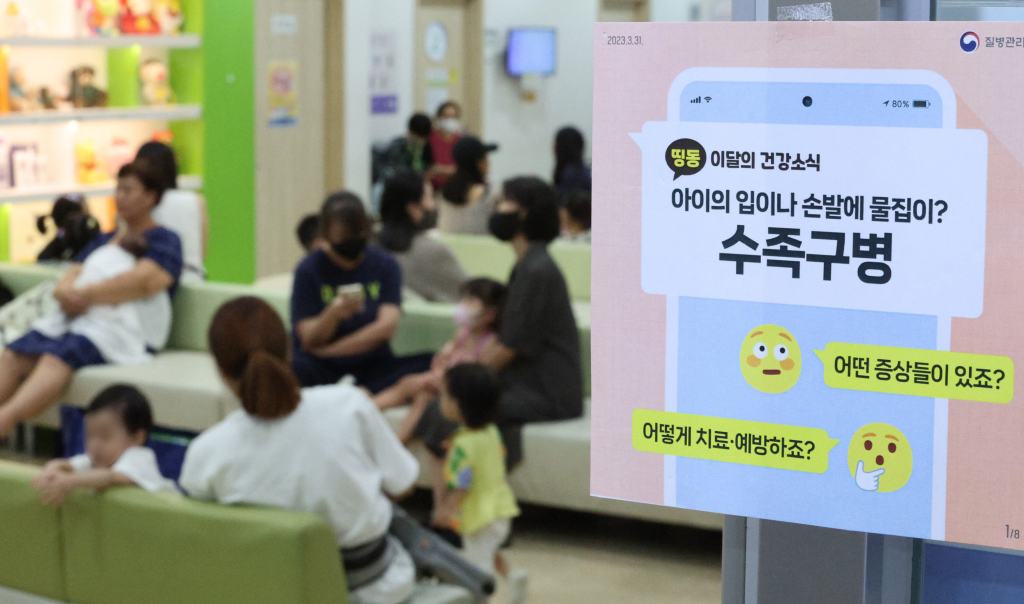
A contagious viral condition, hand, foot, and mouth disease mainly impacts children below the age of five. It can be transmitted via direct contact with an infected individual’s fluids or through objects that have been tainted.
Starting around May, as the temperature increased, the number of infants and young children affected by the illness has been increasing steadily. According to the Korea Disease Control and Prevention Agency, between the 19th and 25th, the outpatient treatment rate for hand, foot, and mouth disease among children aged 0–6 was 48.3 per 1,000 outpatients, representing a 10.27% rise from the previous week (43.8). This rate, which was 1.1 per 1,000 outpatients in late April, has shown a continuous upward trend for 12 weeks in a row.
According to the enforcement regulations of the Water Environment Conservation Act, the legal inspection parameters for water play facilities such as those in apartment complexes include hydrogen ion concentration, turbidity, E. coli, and free residual chlorine. Operators are required to perform water quality tests at least once every 15 days throughout the operational period and must clean tanks, change water, filter, and disinfect. Nevertheless, enterovirus, which is responsible for hand, foot, and mouth disease, is not part of the standard testing requirements.
In contrast to apartment water play areas, temporary inflatable pools that are leased for short periods are categorized as “other amusement facilities” according to the Tourism Promotion Act. These structures are typically maintained using cleaning agents. They usually function on weekends only and are then taken down, and because they frequently don’t need to report to officials, they end up being overlooked in terms of water quality checks.


 jasdooit
Leave a comment