
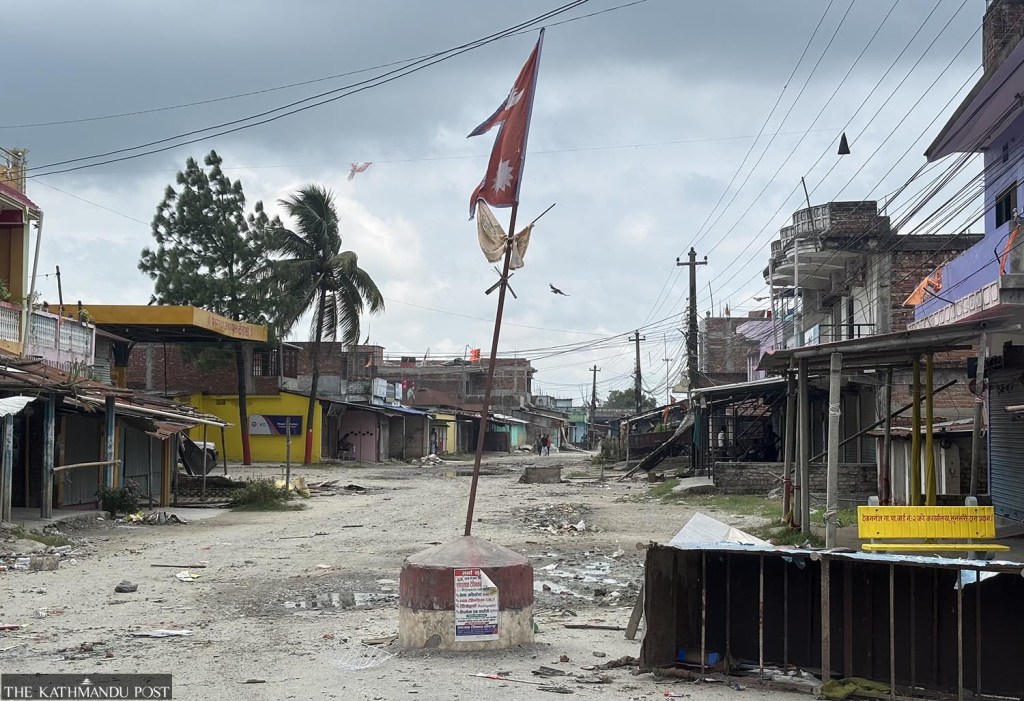
Kaptanganj (Sunsari), Aug. 3 – Om Prakash Mehta was already in bed around 9 pm on the evening of July 26. However, as conflicts escalated at the Kaptanganj Chowk, located 700 meters from his house, he viewed videos on social media showing his own friends at the location and chose to go there too. His father, Krishnadev, attempted to prevent him, but he paid no attention.
Around 10 pm, Krishnadev called his 31-year-old son and instructed him to return immediately. “I’ll be there shortly,” Om Prakash replied before hanging up. At that moment, gunshots rang out at the chowk. Shortly after, Krishnadev got a call from a friend of his son. “Om Prakash has been shot,” he was informed.
When Krishnadev reached the chowk, Om Prakash had already been loaded into an ambulance and transported to the Neuro Hospital in Biratnagar. Those present informed him that it wasn’t too severe and that he would make a recovery.
Krishnadev dressed himself and went to the hospital, located approximately 25 kilometers to the east. At that time, Om Prakash was already on a ventilator. The following day, his family and neighbors informed him that the treatment was progressing well and advised him to return home and look after his wife.
As Krishnadev was heading back to Kaptanganj, reports about Om Prakash’s passing started circulating on social media. His nephew, who was at the wheel, shared the news during their journey.
“Immediately after hearing it, I passed out,” Krishnadev remembered. The last time he saw Om Prakash was when he left his bed that night, disregarding his request to remain.
Across the settlement, west of Om Prakash’s home and roughly 100 meters south of Kaptanganj Chowk, resides 72-year-old Mohammad Tahir Miyan.
On the afternoon of July 27, one day following the start of tensions in the town, a curfew was already in effect in Kaptanganj. Around midday, an agitated group of young men carrying bottles filled with gasoline approached Tahir’s residence. “They started pouring gasoline and set the house ablaze,” he recounted.
People inside the house were able to flee, but two homes—owned by his oldest and third son—and a stack of straw were destroyed by fire.
We have always lived like brothers,” Tahir said, trying to understand what had just occurred in the past 24 hours. Kaptanganj, situated in Dewanganj Rural Municipality approximately one kilometer south of the Indian border, had no record of Hindu-Muslim conflict. Om Prakash was killed during police gunfire. Tahir’s home was destroyed by an angry crowd. The joint story of these two families from different communities—Hindu and Muslim—is straightforward: “Nothing like this had ever happened here.
The conflict that started there ultimately resulted in three fatalities. Jay Prakash Mehta, 21, who was also from Kaptanganj, passed away four days later after being treated for a gunshot wound. Ganesh Yadav, 15, from Golbazar in Siraha, died on July 30. Witnesses claim he was killed during police gunfire. However, in an interview with Kantipur, Home Minister Sudan Gurung denied that the police shot Yadav.
Reports from Kantipur, along with interviews involving over a dozen individuals and an analysis of past records, indicate that the violence in Kaptanganj occurred within a broader context of underlying religious tensions in certain areas of Madhesh. In recent years, local conflicts, the spread of information through social media, political activism, and ongoing institutional shortcomings have all played a role in intensifying the situation. This incident, however, has resulted in fatalities.
The Armed Police Force, Nepal’s border security and riot control unit, had warned about the potential for increasing communal violence approximately three years back, particularly in the Madhesh area. A high-ranking APF official who is aware of the report mentioned to Kantipur last week that the force had consistently informed the political leaders about the dangers arising from escalating communal divisions, yet its suggestions were mostly overlooked.
The episode also emphasizes shortcomings across various levels – local officials who overlooked initial warning signals, security forces that intervened only after violence had already occurred, and political figures who largely stayed away from the situation until there were casualties resulting from the conflict.
Kathmandu, nevertheless, mostly stayed inactive amid the violence that occurred in Kaptanganj, with its initial reaction restricted to the reassignment of police and administrative personnel. A curfew was imposed at 7 am on July 27.
In the following days, demonstrations spread across Sunsari, then expanded to Morang, and later reached Siraha, Saptari, and Dhanusha. Security forces were sent in significant numbers as local officials enforced curfews, but demonstrators continued to challenge these restrictions. As demands increased for Prime Minister Balendra Shah to speak to the country and for Home Minister Gurung to visit the location of the incident, both leaders came under fire for their handling of the situation. Neither showed up in Parliament; Shah conveyed his sorrow over the violent confrontations through social media, while Gurung stayed in Kathmandu. Shah also missed an all-party meeting convened by his party’s leader Rabi Lamichhane to address the escalation of violence in Madhesh.
Dewanganj Rural Municipality, one of the 12 local administrative units in the Sunsari district, is situated approximately 25 kilometers south of Inaruwa, the district’s main center. As per the 2021 census, the municipality is home to less than 40,000 residents, with Hindus comprising 86% of the population and Muslims accounting for 14%. This area, where Maithili and Magahi are commonly spoken, relies heavily on farming. Almost two-thirds of families use firewood or cow dung cakes for cooking, while only 10% of households utilize liquefied petroleum gas (LPG). A significant number of young individuals have moved to countries in the Gulf or Malaysia, resulting in a higher proportion of elderly individuals, women, and teenagers remaining in the villages.
The people who appeared on the streets after the night of July 26 were mostly teenagers and young who had only recently entered adulthood. Elderly and responsible members of both communities remain bewildered with what happened.
“What caused this to happen all of a sudden?” is the question many are posing as efforts are made to restore normalcy following a week of events.
The conflict that ultimately led to violence on Sunday started approximately a month ago. On June 28, the Muslim community observed Muharram on public land at Naya Hatiya Bazaar in Kaptanganj, having obtained approval from the ward office.
We have been celebrating Muharram for 50 years,” stated 36-year-old Jabir Alam, a merchant of goats and sheep. “In the past, there was a Shiva temple here. Now, a Kali temple has been constructed, one after another. We don’t have a specific location, and we have celebrated wherever the local government allows us.
On the day of Muharram, the Muslim community placed 40-50 religious flags at a public location, alongside Nepal’s national flag. Once the festival concluded, two religious flags and the national flag were left behind, as stated by Jabir, for a subsequent gathering planned after 40 days. The remaining flags were taken down by them personally.
Prior to the subsequent meeting following 40 days, Shrawan had already commenced—the month during which Hindu followers honor Shiva, embark on Bol Bam pilgrimages, and visit temples in significant numbers. Hindu locals asked the ward office to take action in removing the flags located near the Shiva temple.
Approximately ten days prior, following a disagreement regarding the flags, I personally stated – if the flags are causing issues, we will take them down; let’s avoid creating a conflict,” Jabir mentioned. “However, the ward chairman and the rural municipality chairman ignored it.
Shatrughan Prasad Mehta, a former headmaster at the nearby Babuji Basic School, also highlights the same shortcoming by local officials.
The local leader provided land for the Muharram celebrations,” he said. “However, when our boys asked him not to leave the flags there, he ignored their request.
On July 26, as reported by Manoj Kumar Pokharel, the local representative of the human rights group INSEC, a group of young people took down the flags that had been previously put up and substituted them with fresh flags featuring pictures of Hanuman.
That night, Hindu youths preparing for the Bol Bam pilgrimage the following day, gathered near the Shiva temple. They were playing songs on loudspeakers, including “Jai Shri Ram” and “Bol Bam ka Nara Hai, Baba Ek Sahara Hai.”
They intended to journey approximately 40 kilometers northwest to the Koshi Barrage to gather sacred water and then return to present it at the Shiva temple. A loudspeaker mounted on a vehicle that was oriented north was directed southward, where the Muslim neighborhood starts roughly 100 meters away.
As per individuals from the Hindu community, Muslim youth visited the location to protest the playing of those songs. Members of the Muslim community, on the other hand, assert that the songs were broadcast through loudspeakers at a high volume near the Muslim neighborhood situated south of the Shiva temple, and that 8 to 10 motorcycles bearing Indian license plates repeatedly drove along the road, causing them fear.
Soon, conflicts intensified, leading to a verbal argument that then turned into a physical fight. There is no one definitive version of what occurred afterward.
Individuals from the Hindu community claim that Muslim youth, who were more numerous than their Hindu counterparts, initiated physical attacks on them. When they were retaliated against, the Muslim youths reported the incident to the police. Members of the Muslim community state that they did not assault anyone but contacted the police upon realizing the conflict had the potential to intensify.
According to information obtained during their field study, Pokharel from INSEC mentioned that the boys from the Hindu community were less in number. “At first, they were attacked,” he stated. “Later, some of them exaggerated the event and requested assistance from the village.”
By that time, the police had already arrived. “Once the police instructed them to depart, the Muslim youths went back home. However, the Hindu youths refused to leave, claiming they had been assaulted and seeking retribution,” Pokharel mentioned. “They attempted to head toward the Muslim neighborhood, which led to a confrontation with the police trying to prevent them.”
The details provided by Jabir align closely with Pokharel’s narrative.
The police stopped us in our own neighborhood, and after that we didn’t go anywhere. The police prevented them from coming here from the north. During the pushing and shoving, they had a confrontation with the police,” he said. “There was no conflict between Hindus and Muslims. There was a clash between them and the police. Not a single person from the Muslim side was hurt. There are only 50-60 Muslim families here, while they are in the hundreds. How can we survive by fighting them here?
Although the event in Kaptanganj was unprecedented, an examination of past records indicates that the nearby area has experienced a history of conflicts related to religious issues.
As per INSEC data, seven such events have been documented in Sunsari alone – three in 2024, two in 2025, and two up to now in 2026. Open-source reports indicate that these occurrences have taken place from Sunsari moving west through the Madhesh regions up to Nepalgunj.
Kantipur has documented at least 17 such events in the Terai region over an eight-year span, from 2018/19 up to the present. As this list includes only media-reported cases, it reflects the lowest possible count. These occurrences took place across districts stretching from Banke in the west, through Parsa in the center, to Sunsari in the east. All these areas are Terai-Madhesh regions that share a border with India.
The reasons behind these events also seem to be alike. Approximately two-thirds of the 17 incidents (11 cases) were linked to conflicts occurring during religious processions and idol immersions held during festivals, such as those for Durga, Lakshmi, Saraswati, and Krishna Janmashtami; processions for Ram Navami and Hanuman Jayanti; and Chhath and Kalash processions. In several of these instances, authorities had to enforce curfews.
In recent years, social media has emerged as a strong platform that quickly magnifies and spreads local conflicts. Whether it was an inappropriate Facebook post from a Hindu youth in Nepalgunj or a derogatory remark about Hinduism made by a Muslim youth in Rajbiraj – neither of which Kantipur is referencing or elaborating on – the frustration that typically starts online has begun to overflow into the streets.
Chandrakishore, a journalist and writer who frequently covers the Madhesh region, thinks that increased social media usage has contributed to the quick spread of conflicts.
The individual who was killed in Kaptanganj had already gone to sleep. Upon hearing an accusation or rumor via social media, he rushed out of the house,” he stated. “These days, videos are posted instantly on social media. YouTubers stream everything, leaving no time for distinguishing between what is good or bad, right or wrong.
Incidents that were intentionally designed to offend and incite another community have also come to light. Last year, around the time of the election in Birgunj, law enforcement detained three individuals who were found with a pig’s head and homemade explosives, which were reportedly meant to be thrown into a mosque. In Gaur, a conflict arose when loudspeakers were used during a Hindu wedding procession while religious prayers were taking place.
Nepal’s third-largest religious community consists of Muslims. As per the 2021 census, they constitute 5.1 percent of the population. The majority reside in the Terai regions.
The 2023 report on religious freedom issued by the U.S. Department of State highlighted concerns raised by Muslim leaders who claimed they encountered pressure from both government representatives and the Hindu population.
Dinesh Shrestha, head of the Biratnagar branch of the North-South Collectives, a think-tank based in Madhesh, claims that these conflicts that have recently come to light are not one-off events that happened unexpectedly or by coincidence.
It seems there is a coordinated attempt to heighten religious tensions in Nepal,” he stated, without specifying who he thought were behind inciting these conflicts. “Whether it’s events that occurred in other areas previously or the recent Kaptanganj incident – all of these are part of that initiative.
Jayaprakash Prasad Gupta, a former minister and the writer of the book “Madhesh: Saamajik Samrachana ra Bibhed,” highlights the impact from neighboring India.
Previously, Bihar’s governments were influenced by caste systems. Now, there is BJP’s Hindu-majority oriented politics,” he said. “Nepal has also been experiencing polarization under its direct influence.
Chandrakishore notes that four patterns observed in rising religious tensions over recent years are evident in the Kaptanganj incident.
The first trend is the stance adopted by members of the same community in other areas when an event takes place in one location. “If a typical incident occurs in Malangwa, a demonstration quickly emerges in Bhairahawa. Previously, these issues would remain local; they didn’t extend to other places,” he mentioned.
The second trend involves the implicit rivalry observed in public religious events in recent years. “If someone sets up one microphone, I must set up four; if he breaks two swords, I have to break four; if he drives 25 motorcycles, I must drive 50,” he said.
The third trend, he mentions, involves standing in front of a different community’s place of worship and loudly proclaiming one’s own group’s slogans as a direct confrontation.
The fourth trend concerns the manner in which these conflicts are handled. In the past, political figures were at the forefront of gatherings designed to ease social tensions. However, he notes that this area has now been taken over by representatives who assert their authority based on religious identity.
Quickly, a person came forward as a Muslim leader, while another started going to meetings as a Hindu leader,” he stated. “If they had stayed within political parties, they could have been regular party members. But now they have turned into leaders.
Ram Rijan Yadav, formerly involved with the Janata Samajbadi Party led by Upendra Yadav, claims he has directly observed how religious politics from outside the region has started affecting the Madhesh area. Four years ago, the Rashtriya Swayamsevak Sangh (RSS) had already established an organization within their party. “The ‘Yadav boys’ who were members of our party committees had already aligned themselves with the Rashtriya Swayamsevak Sangh (RSS),” he stated.
The increasing religious division is also evident in the symbols that have emerged throughout the public environment.
At Kaptanganj Chowk and along the path heading west towards Biratnagar, Itahari, Inaruwa, and into Madhesh, the same picture is seen over and over again — on banners, at road junctions, outside stores, on rooftops, and on power poles.
The picture shows Hanuman. However, it is not the conventional representation of the god; instead, it portrays an angry version of Hanuman. The high-contrast image, with saffron and black hues and a tense expression, is also seen as stickers on motorcycles and vehicles.
“The Hanuman I grew up with was calm,” said Yadav. “In the past two or four years, I’ve begun to see depictions of an angry Hanuman everywhere in Madhesh. The Bajrang Dal and Hindu nationalist groups have encouraged this portrayal,” Yadav stated.
The picture does not originate from Nepal’s conventional religious imagery. As per accounts in Indian media, the ‘angry Hanuman’ image was developed in 2015 by graphic artist Karan Acharya, based in Kerala. It is reported that Acharya created it for a temple’s Ganesh Chaturthi celebration after friends requested him to design a Hanuman with “a unique look.”
The image featuring saffron and black soon gained popularity throughout India and later was also seen in Nepal.
From a cultural and religious perspective, Hanuman’s image is serene. What we have come to understand is that Hanuman symbolizes wisdom, moral values, and humility,” Chandrakishore stated. “However, for political reasons, Hanumanji was portrayed as furious.
Five days following the outbreak of violence, conditions in Madhesh started to slowly return to normal after the Prime Minister Balendra Shah’s speech to the country, RSP leader Rabi Lamichhane’s extended meetings, the Home Minister’s visit to the area, discussions with affected families, calls from political parties for peace, and ongoing conversations between representatives of various communities at the local level.
However, civil society activists caution that if the growing religious distrust within communities is not tackled, the tension might seem to have eased but could still be present underneath, ready to erupt once more.
The curfew has now been lifted in Kaptanganj. Military armored vehicles that were positioned at crossroads have been removed. However, a feeling of anxiety still remains in the village.
Both Om Prakash and Jay Prakash had departed from their residences upon hearing that conflicts had escalated at Naya Hatiya. As per witness Ramesh Kumar Mehta, the group grew even more restless following Om Prakash’s collapse due to being shot by law enforcement.
“People were fleeing in various directions. At that time, Jay Prakash was also shot within the courtyard of the Shiva temple,” Ramesh mentioned.
Near a modest cabin, approximately 500 meters north of Naya Hatiya, Jay Prakash’s motorized rickshaw has been stationary since the day of the event.
In the room of Om Prakash’s father, the fan has not moved since Krishnadev left that night following his son’s shooting.
Tahir Miyan is now without a residence.



 jasdooit
Leave a comment