
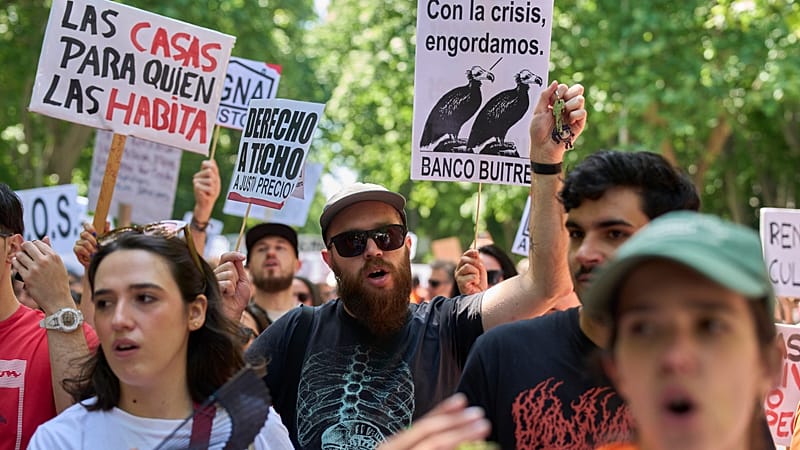
The second-hand housing market shows no indication of cooling down.The average price in Spain reached 3,154 euros per square metre in July, representing a 0.7% increase from the prior month and a 16.2% rise compared to the same period last year, as reported by the Fotocasa Property Index.Transformed into a conventional 80-square-meter apartment, the amount has increased from 217,214 to 252,308 euros within a single year: an additional 35,094 euros for the same property.
The cost of a typical house in Spainhas now surpassed 250,000 euros for the first time,”summarizes María Matos, head of research at Fotocasa, who credits the increase to a limited supply in comparison to demand that continues to be strong despite the financial pressure on households.Matos herself anticipates that the market will enter over the next few months.a stage of “slow return to normal”, as more purchasers enter the marketextent of their financial ability.
Prices increase across all areas
Every one of the 17 autonomous regions experienced an increase in the cost of used homesIn July in comparison to 2025. Fourteen of them experienced rises exceeding 10%:Murcia leads the rankings with 26.2%, followed by Cantabria (20.1%), the Valencian Community (18.1%), Navarre (17%) and La Rioja (16.5%).On the opposite end of the spectrum, the Balearic Islands(6.5%) and Extremadura (7.4%) showed the least significant increases.
In absolute price terms, Madrid continues to be the priciest area, just under 5,500 euros per square metre (5,455 €/m²), surpassing the Balearic Islands (5,401 €/m²) and theBasque Country(3,970 €/m²). Extremadura (1,359 €/m²), Castilla-La Mancha (1,426 €/m²) and Castilla y León (1,806 €/m²)bring up the rear.
Avila and Leon, the largest provincial increases
At provincial level, the rise is nearly universalOut of the 50 provinces examined, 48 experienced price increases, with 29 of them recording a rise of more than 10%.Alongside Murcia (26.2%), two landlocked provinces that seldom appear in real estate news attract attention: Ávila, with 25.3%, and León, at 25.2%. Only Teruel (-8.4%) and Huelva (-2.3%) showed decreases.
Madrid (5,455 €/m²) and the Balearic Islands (5,401 €/m²) once again ranked as the most expensive provinces, followed by Gipuzkoa (4,758 €/m²) and Málaga (4,651 €/m²). Jaén, with 1,117 euros per square metre, continues to be the most affordable province in the country.
Donostia, the priciest provincial capital; Jaén, the most budget-friendly
Among provincial capitals, 46 out of the 47 examined saw an increase in cost, with León city being the top performer.(25.6%), leading Ávila and Ciudad Real, each increasing by 19.8%. The sole capital where prices decreased was Santa Cruz de Tenerife, with a minor drop of -1.3%.
Donostia-San Sebastiánhas established its place asSpain’s priciest regional capital, at 7,120 euros per square metre, leading Madrid (6,624 €/m²), Barcelona (5,304 €/m²) and Palma de Mallorca (5,200 €/m²).
Zooming in on municipalities, 93% of the 404 properties examined by Fotocasa experienced annual price risesand in twenty of them the increase surpassed 30%. Catral (Alicante) leads the list with a 129.7% rise, followed by Bigastro (92.9%) and Narón (62.5%).The priciest towns in Spain continue to be located in specific areasin the Balearic Islands: Santa Eulària des Riu, with a price of 8,494 €/m², and Sant Antoni de Portmany, at 8,266 €/m², whereas Bailén, Mengíbar, and Torredonjimeno, located in Jaén, are the most affordable,all below 800 euros per square meter.
Madrid and Barcelona, progressing at varying paces
The two biggest cities in Spain are following completely distinct paths.In Madrid, an 80-square-metre apartment has risen in price from 485,075 to 529,900 euros within a year, marking an increase of 9.2%, which means purchasers are now paying 44,825 euros more for the same property. In Barcelona, the rise is significantly smaller: 3% over the year, moving from 412,086 to 424,280 euros, an additional 12,194 euros.
By district, Madrid is going through its own surge in the southern part of the city.Villaverde has increased by 29.8%, while Villa de Vallecas has risen by 25.5%, significantly outpacing established neighborhoods like Barrio de Salamanca (2.6%), which continues to be the priciest district, with prices reaching 10,682 euros per square metre.In Barcelona, Gràcia(11.6%) and Nou Barris (11.5%) are the top performers, whereas Ciutat Vella is the only district experiencing a decline, with a drop of -2.7%.
This text was translated using artificial intelligence. Report an issue: [feedback-articles-en@euronews.com].




 jasdooit
Leave a comment