

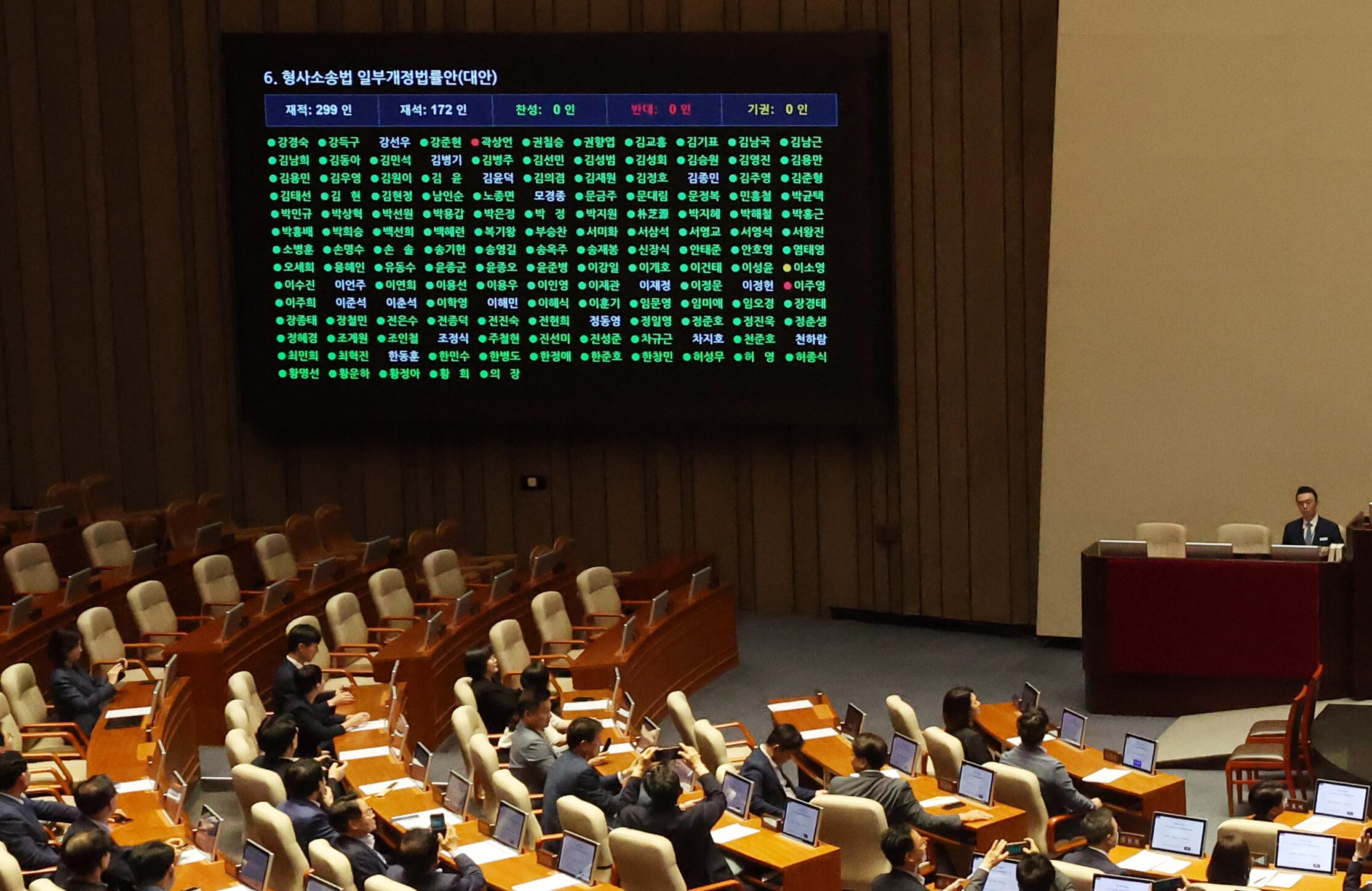
On July 30, 62 legal experts across the country issued a strong warning regarding a proposed change to the Criminal Procedure Act that would entirely remove the prosecution’s power to conduct additional investigations. It is quite rare for legal scholars from both conservative and liberal perspectives—such as the president of the Korean Criminal Procedure Law Association and a former Supreme Court sentencing committee chair—to jointly challenge the ruling party’s legislative initiative. They stated, “The matter of supplementary investigation authority should adhere to legal principles of judicial procedures, not political manipulation,” showing significant worry about the reforms being pushed through based on partisan reasoning.
The main critique from the academic community focuses on the “loss of investigative control systems.” Investigations that involve coercive actions such as arrests, detentions, and searches naturally carry the risk of violating human rights. Excessive investigations can infringe upon the rights of suspects, while hidden or poorly conducted investigations—like those in the Jang Yoon-gi case—violate the rights of victims. Just as courts monitor prosecutors’ decisions to bring charges, police investigations should be supervised by legal professionals: prosecutors. The essential instruments for this are additional investigation powers, prosecutors’ investigative authority, and required case transfers. However, as if mocking the professional ethics of scholars, the Democratic Party enacted the revised bill the following day, removing these oversight mechanisms.
Investigative control plays a crucial role within the prosecution system. Lawyer Kim Jeong-won, who previously served as the head of the Constitutional Court’s secretariat, outlined this history in his book *Chosun, Planting the Constitution*. During Japan’s colonial rule in 1910, Japan implemented police “summary disposition authority” under the pretense of streamlining judicial processes, dealing with two-thirds of all offenses without formal trials. By 1914, administrative detention laws permitted police to detain individuals suspected of being drunk or attempting suicide at their discretion.
Following the liberation, the U.S. military administration eliminated these authoritarian police authorities, requiring that prosecutors examine all applications for warrants. The 1962 Fifth Revised Constitution clearly stated that prosecutors were the only ones authorized to apply for warrants. The Constitutional Court clarified this as intended to “minimize the risk of violations of fundamental rights by stopping non-selective warrant applications from other investigative bodies through legal professionals.”
However, the updated Criminal Procedure Act permits prosecutors to seek warrants solely for cases that have already been submitted by the police. Removing the investigative powers of prosecutors also eliminated their authority to obtain warrants. Similar to the Jang Yoon-gi case, prosecutors will no longer be able to uncover evidence tampering by searching the suspect’s home or vehicle during additional investigations. This may potentially breach the constitutional obligation to safeguard citizens’ lives and property from criminal activities.
The Democratic Party argues that police investigations can be managed through the authority to request warrants, but without additional investigative powers, this is essentially a “powerless lion.” If law enforcement disregards requests for further investigation, there is no way to address it. Calls for punishing or replacing investigators are only advisory and not enforceable. Although seven major offenses, such as sexual assault and domestic violence, necessitate automatic case referrals, if the police decide a case does not fit these categories—as seen in the Jang Yoon-gi case—there is no alternative available.
Former Representative Kim Woong, the writer of *Prosecutors’ Civil War*, predicted the outcome of the updated law: “An individual with intellectual disabilities who is a victim of sexual abuse submits a complaint, but the police classify it as a simple assault. Prosecutors suspect sexual assault and ask for further investigation, but the police disregard their requests. Applications to change investigators are turned down, and video evidence vanishes. Afraid of the case going cold, prosecutors proceed with an indictment based on the police’s classification of simple assault. The disabled person protesting is then arrested for hindering official duties and labeled a ‘malicious complainant.’”
Uncontrolled investigative bodies transform victims into offenders and conceal the truth—a breach of the constitution that lies outside the scope of legislative authority. Even Park Chan-woon, a former leader of the prosecution reform advisory committee and a professor at Han Yang University, remarked, “The amended law must cross the constitutional river.” Rather than quickly fixing the legislation, the Constitutional Court should address it through a constitutional review.



 jasdooit
Leave a comment