
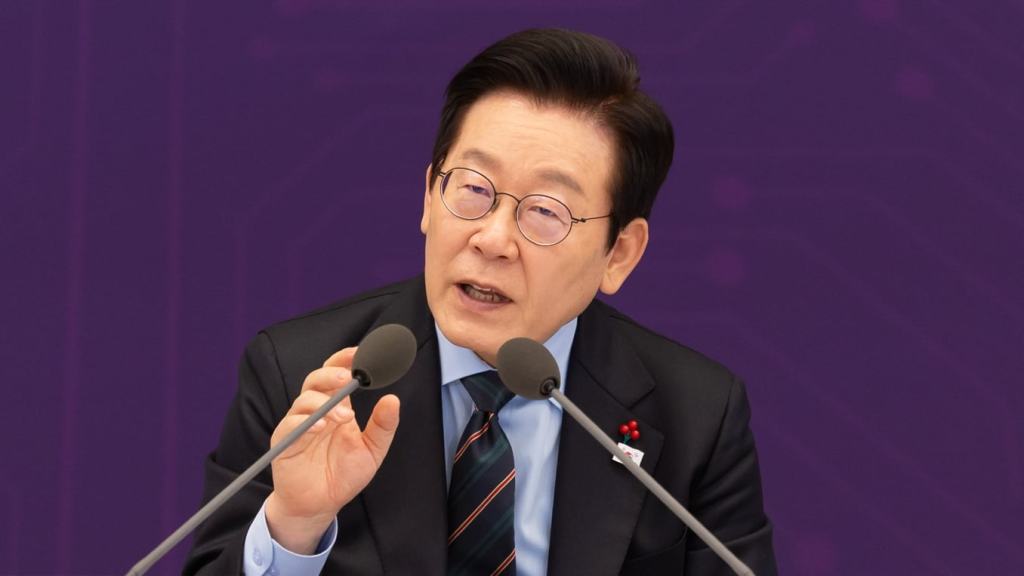
President Lee Jae Myung, four days after unveiling the government’s tax reform plan on the 7th, directed a comprehensive review of the “Individual Comprehensive Asset Management Account (ISA)” and the “Stock Price Suppression Prevention” measures included in the reform. The ISA has come under scrutiny from investors due to its reduced long-term tax-saving benefits, while the Stock Price Suppression Prevention initiative has sparked debate over worries that its very limited eligibility criteria could restrict its effectiveness. Han Jeong-ae, chairperson of the Democratic Party of Korea’s Policy Committee, mentioned during a meeting on the 9th, “As the reform plan is expected to be finalized by late August, we will work with the government to address these issues beforehand.”
The ISA is an “all-in-one account for tax savings” that enables users to handle savings, funds, stocks, and exchange-traded funds (ETFs) within one single account, providing tax benefits of up to 2 million Korean won (4 million Korean won for those with low income) on interest and dividend earnings. By the end of June, there were 9,735,431 accounts with a total investment of 73.3624 trillion Korean won.
Investors expressed disapproval of the reform that limits the ISA’s term to five years. The ISA only taxes net profits following the deduction of losses from various products. At present, there is no cap on the maturity period, enabling indefinite extensions past the required three-year holding period, which allows for the consolidation of gains and losses within a single account for tax advantages. However, mandating settlement every five years would interfere with this consolidation. The reform also suggests eliminating the carryover of unused contribution limits. Presently, if 5 million Korean won is deposited out of the annual 20 million Korean won limit, the remaining 15 million Korean won can be carried over to the next year, allowing a total deposit of 35 million Korean won. According to the new proposal, unused limits would expire, significantly impacting young individuals with low income or self-employed people with inconsistent earnings.
Furthermore, the reform brings in a new “Productive Finance ISA” which allows interest and dividend earnings from local stocks and equity funds to be tax-free. Nevertheless, this does not cover ETFs that invest abroad. An industry expert stated, “This seems to limit investor options, encouraging money to flow into domestic stocks.”
The “Stock Price Suppression Prevention” policy, created to stop major shareholders from deliberately reducing stock prices to minimize inheritance and gift taxes, has been criticized for unclear standards. Initially, a bill proposed by Democratic Party of Korea legislator Lee So-young aimed at roughly 1,200–1,300 listed companies with a price-to-book ratio (PBR) under 0.8x, seen as undervalued. However, the set 0.8x limit faced backlash for being unexplained, prompting suggestions to take into account industry-specific conditions. The government’s updated approach identifies companies that were in the bottom 25% of PBR in the KOSPI or bottom 10% in the KOSDAQ for 12 out of the past 13 half-years (6.5 years) as subjects for review. Although eliminating the fixed threshold, the number of impacted companies decreased substantially to approximately 130.
Concerning updates to the tax reform, Han Jeong-ae mentioned on the 9th, “It might not be necessary to modify the current ISA.” With regard to the Stock Price Suppression Prevention initiative, she noted, “The government’s approach varies from the initial suggestion, meaning further clarification is required regarding the reasons behind these modifications.”


 jasdooit
Leave a comment