
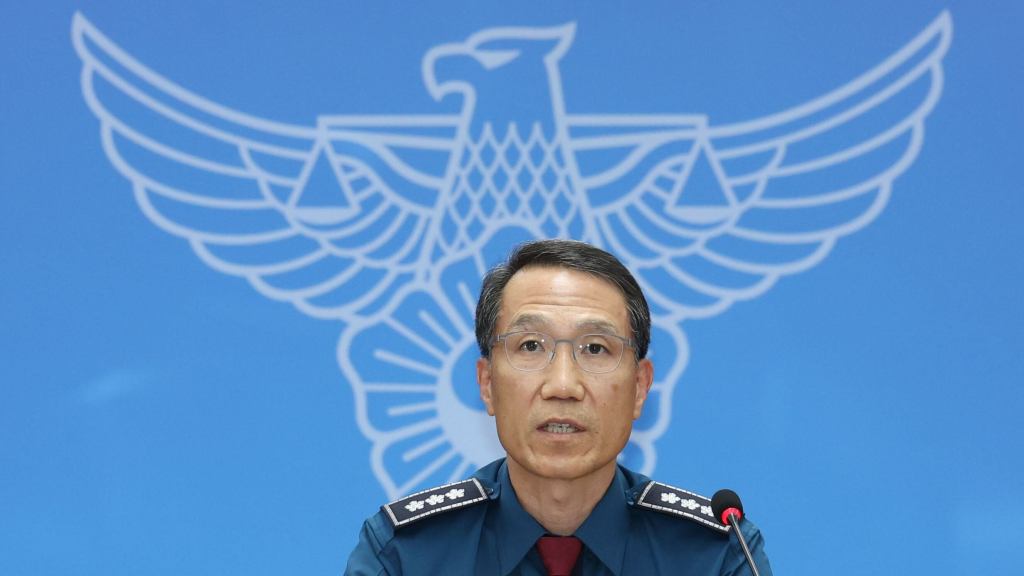

Starting in September, the police will implement a “sangpi system (相避制),” which prohibits officers from directly investigating cases involving their spouses, direct ascendants, or descendants and requires transferring such cases to other jurisdictions.
The National Police Agency convened a session of the “Task Force for Implementing Amendments to the Criminal Procedure Act” on the 7th.
By early September, the police will implement the sangpi system for cases involving officers’ spouses, immediate family members, or relatives. Under this system, officers are not allowed to directly handle such cases and must refer them to other police departments.
An internal unit for investigating corruption will also be established. Earlier this July, Minister of the Interior and Safety Yun Ho-jung stated that the National Police Agency’s National Office of Investigation would set up an internal corruption investigation team to monitor misconduct and corrupt practices by officers, pledging rigorous enforcement based on a zero-tolerance policy.
The police will move and restructure investigative supervision duties to the Human Rights Ombudsman’s Office, aligning with staff changes during the latter part of this year. This move is intended to improve impartiality and equity by shifting oversight responsibilities that were previously managed by the National Office of Investigation.
The task force also reviewed plans to increase the number of investigative staff following the updated Criminal Procedure Act. The police will decrease mobile units and add 881 more investigators, indicating a drop in unlawful and violent gatherings. Additional staff will be obtained through discussions with relevant departments and internal reallocations.
Furthermore, the police revealed the implementation of an “Attorney Proxy Reporting System,” enabling complaints to be submitted via lawyers without revealing the reporter’s identity.
Comprehensive strategies were also developed to enhance the administration and oversight of cases referred by prosecutors, as well as to set up a “Vulnerable Groups Subcommittee” inside the Police Investigation Review Committee.
The police mentioned, “In addition to institutional enhancements, the National Office of Investigation, headed by the Investigation Planning and Coordination Officer, will keep exploring legal changes and process improvements after the updated Criminal Procedure Act, informing everyone via task force meetings.”




 jasdooit
Leave a comment