
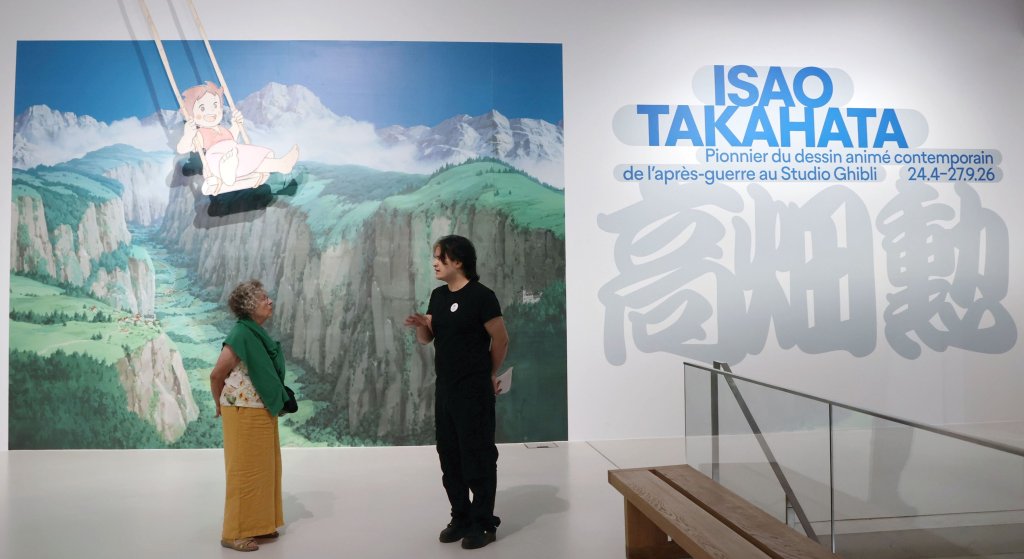
LAUSANNE, Switzerland – A Japanese animated television series centered around a Swiss girl residing in the Alps has unexpectedly become a part of Switzerland’s cultural heritage, as a retrospective exhibition featuring director Isao Takahata attracts visitors keen to rediscover his meticulously designed portrayal of the nation.
The display at Lausanne’s Mudac museum, highlighting Takahata’s professional journey, includes a variety of drawings, animation cels, images, and additional production items. However, the main focus is “Heidi, Girl of the Alps,” the 1974 anime series adapted from the 19th-century children’s book by Swiss writer Johanna Spyri.
The show, helmed by Takahata, gained recognition for its meticulous portrayal of mountainous scenery and country life. Despite being made in Japan, it has deeply connected with viewers in the nation that inspired it.
In June, during a visit, the exhibition hall was filled with guests, such as groups of children on educational outings.
Takahata and his team of creators visited Switzerland, including Maienfeld, the location featured in the original story, to examine the local scenery and customs prior to developing the series.
This kind of study was rare during that period, and the group recorded aspects of country life that were included in the animation.
“It’s quite intriguing for us to grasp how an individual from outside Europe, specifically not from Switzerland, portrays our nation,” remarked Marco Costantini, director of the Museum of Contemporary Design and Applied Arts, known as Mudac.
Typically, a museum asks, ‘What did they create in Japan or the U.S.?’ But here, it’s the reverse — how a Japanese artist perceives Switzerland.
The series did not air on Swiss television channels, as stated by Mudac. Nevertheless, numerous Swiss audiences discovered Heidi through transmissions from nearby nations like France and Germany. Some viewers had no knowledge that the cherished animation originated from Japan.
It was truly impressive to witness how they recreated the Swiss landscapes,” remarked Marc Lukyantsev, a graphic designer in his early 20s from Montreux who attended the exhibition. “It truly resembled Switzerland from a Swiss perspective. It feels authentically Swiss.
Even though Takahata did not create the visuals himself, he was crucial in defining the artistic direction of his movies. The Swiss newspaper Le Temps referred to him as a “complete artist” who could effectively communicate a distinct vision to his production crew.
According to Costantini, Takahata’s focus on realism was key to the series’ charm.
The distinctiveness of Takahata lies in his link to reality, not merely pure imagination,” he stated. “He recorded a great deal to make his films. It wasn’t just fantasy — there was significant effort involved in reconstruction and documentation.
“He resembled an ethnologist or an anthropologist,” Costantini remarked.
Costantini mentioned that Takahata’s portrayal of Switzerland struck a chord because it mirrored an image of the nation that many Swiss individuals already identified with — a perspective influenced by mountains, valleys, and conventional rural living.
“It symbolizes the concept of Switzerland,” he stated.
The display, taking place from April 24 until September 27, also delves into Takahata’s wider impact on animation, such as his work to push the boundaries of the art form beyond just children’s entertainment.
Animation was once seen as something only suitable for children,” Costantini remarked. “But Takahata shifted people’s perspectives. His films were created for children, yet also resonated with adults.
Takahata’s movies frequently addressed topics like peace, environmental issues, and interpersonal connections, expanding the understanding of what animation could convey.
Takahata, who co-established the renowned animation studio Studio Ghibli in 1985 alongside figures such as anime director Hayao Miyazaki, passed away in 2018 at the age of 82.
Almost half a century since Heidi first premiered, the show continues to be a Japanese portrayal of Switzerland that many Swiss audiences see as their own.




 jasdooit
Leave a comment