
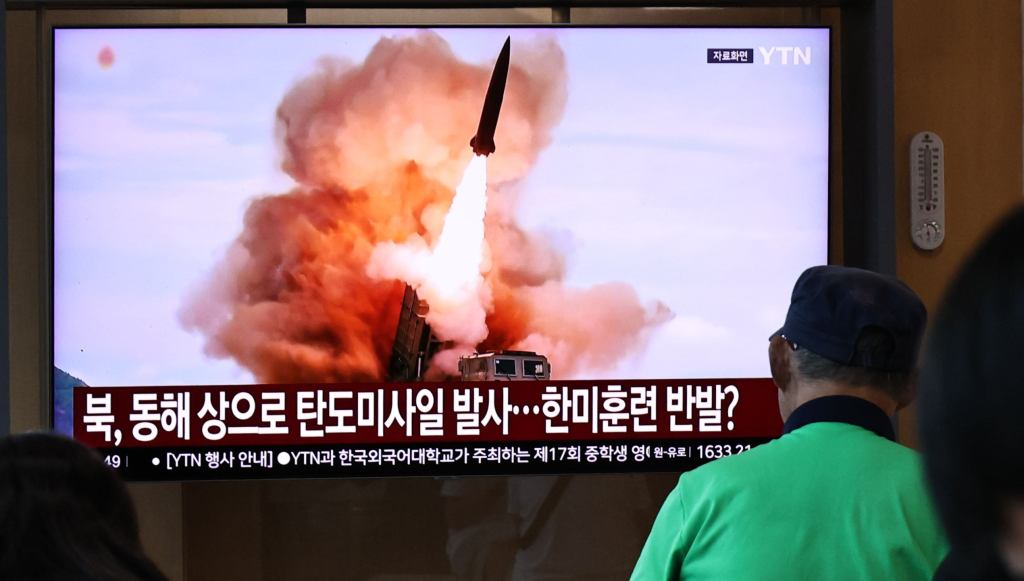
North Korea fired a ballistic missile into the East Sea on the 12th. This is the second act of provocation within six days, coming after a short-range ballistic missile was launched toward the East Sea on the 6th. The National Security Office convened an “emergency security situation review meeting” with various agencies, including the Ministry of National Defense and the Joint Chiefs of Staff (JCS), calling on North Korea to stop its ballistic missile tests, which breach UN Security Council resolutions.
The Joint Chiefs of Staff identified a ballistic missile that was launched from the Wonsan region towards the East Sea around 6 a.m. on the same day. The JCS mentioned, “The missile traveled over 700 km, and South Korea and the U.S. are carrying out an accurate analysis of its characteristics.” Although the maximum range of North Korea’s short-range ballistic missile KN-23 (the North Korean version of the Iskander) is reported to be approximately 700–800 km, the JCS did not clearly categorize this missile as a short-range ballistic missile. It is possible that North Korea decreased the range of a medium-range ballistic missile or conducted a test of a short-range hypersonic missile.
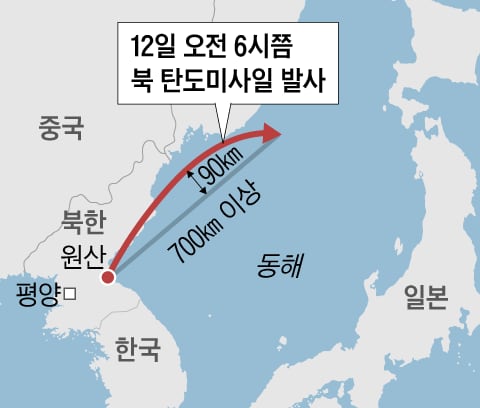
As per Japan’s Ministry of Defense, the missile reached an apogee of 90 km, surpassing the previously known range of 50–60 km for the KN-23. This has led to theories that North Korea may have conducted a test of a hypersonic glide vehicle warhead at high altitude. Hong Min, a senior researcher at the Korea Institute for National Unification, stated, “It is possible that North Korea tested a hypersonic glide vehicle warhead integrated with the KN-23 short-range ballistic missile.”
Yoo Ji-hoon, a researcher at the Korea Institute for Defense Analyses (KIDA), remarked, “This launch might serve as a reliability test for missiles provided to Russia or a performance enhancement test based on problems observed on the battlefield in Ukraine.” As reported by international media, Ukrainian intelligence officials believe North Korea has sent a missile unit consisting of approximately 90 personnel to the frontline in Ukraine this month to operate KN-23-class missiles.
A new act of provocation by North Korea took place before the upcoming South Korea-U.S. joint military exercise known as “Ulchi Freedom Shield” (UFS), which is scheduled to start on the 17th. North Korea has historically responded strongly to the UFS drills, referring to them as “invasion exercises.” On the same day, North Korea released a statement via Jang Kum-chol, the First Vice Minister of Foreign Affairs, criticizing South Korea’s intention to deploy nuclear-powered submarines as a “serious threat to North Korea’s security and maritime sovereignty.”




 jasdooit
Leave a comment