
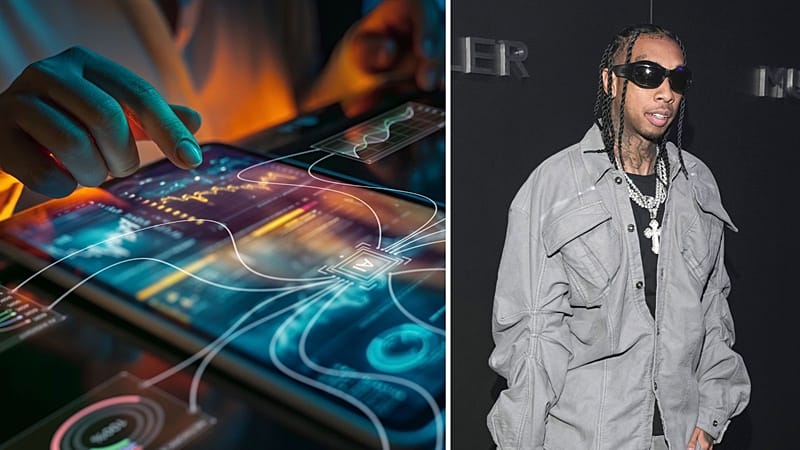
“Cease your tears, it’s a reflection of the current era…”
What do you know about it, Harry Styles? Some indications are worth shedding tears for.
Here’s another that is certain to bring about some emotional reactions: As AI-created music keeps increasing on streaming services, a recent study has shown that nearly 40 percent of new music released worldwide in July 2026 incorporated AI in its production.
That concerning number is from a recent poll bySubmitHub, an online service where users can submit music to playlists and blogs. They examined over a million music tracks and, using their own AI detection tool, SH Labs, discovered that 23.2 percent of them were entirely created by AI.
Furthermore, 15.3 percent were discovered to have incorporated AI-generated audio that had been “altered or refined” by people. This adds up to an impressive 38.5 percent of all music released last month that involved AI in some capacity.
SubmitHub was launched SH Labsearlier this summer to draw attention to a “rising issue of transparency” regarding artificial intelligence in music. Their AI detection tool is being utilized by Bandcamp and Traxsource to identify the application of AI in music, as well as by GEMA, the performance rights organization that recently secureda significant legal case targeting the AI music creation platform Suno.
In a statement, Jason Grishkoff, the founder of SubmitHub, stated: “I believe the way ahead for AI music is transparency. Individuals should have the choice to decide if they wish to interact with music created by artificial intelligence.”
He stated, “Our role is to provide them with sufficient details to enable that decision.”
These latest numbers come after new data fromDeezer, who stated that AI-generated content made up over half of all new daily uploads in June. They also reference a 2025 study that found that97 percent of people “can’t distinguish between authentic and AI-generated music”.
Some groups are beginning to recognize the worries of genuine musicians and music enthusiasts who are troubled by the low-quality AI-generated content being distributed on streaming services.
For example, Bandcamp prohibited all AI-generated music at the beginning of 2026, claiming that they “reserve the right to remove any music if suspected of being AI-created,” while streaming leader Spotify recently announced that it will start addingan “AI Persona” emblem on certain artist profiles, assisting listeners in recognizing when an artist’s music might have been created with the help of artificial intelligence. This program will begin in September.
While artists from Kate Bush to Queen’s Brian Mayhave expressed concerns about the existential challenge AI poses to creators, noting that “the unauthorized use of creative content to train generative AI is a significant and unfair risk to the income of those who produce such works,” yet some artists have adopted a simpler perspective regarding the application of this contentious technology.
Luke Steele from Empire Of The Sun recently acknowledged that he employs AI in his music creation; Boy George mentioned he utilized AI to assist in writing his.strongly pro-Israel reggae song ‘We Will Dance Again’(a situation that ultimately resulted in its removal from Bandcamp due to breaching its AI policies); and one contemporary artist who has drawn the frustration of his colleagues is American rapper Tyga.
The former acknowledged that he utilized AI as a “tool” for his latest (and poorly received) album, ‘$tarface’. Tyga employed AI to create the retro synths on his record, comparing it to the introduction of Auto-Tune.
Nevertheless, the album has faced harsh reviews from critics, withPitchforkrating it with the minimum score of 0/10, referring to ‘$tarface’ as “arrogant, self-satisfied, and disheartening,” and stating that “its presence has made the world a worse place.”
Artists have criticized Tyga – among them Doja Cat, who voiced the sentiments of many music fans when she described him as a “penis for creating an AI album.”
A tangible and metaphorical device for some; a total fraud for others.
In another indication that some content creators are growing more at ease / brazen inembracing AI slop, American record producer and rapper Timbaland has introduced an “A-Pop” project named Stage Zero and signed its first artist, TaTa, whom he refers to as “a living, learning, autonomous music artist created using AI.”
These examples and recent statistics, along with the disturbing “music” generated by AI creationsTilly Norwood, Velvet Sundown and Breaking Rust– who vie with genuine artists for audience attention as well as earnings – indicate that one point is evident. We still haven’t exited the artificial forest yet.




 jasdooit
Leave a comment