
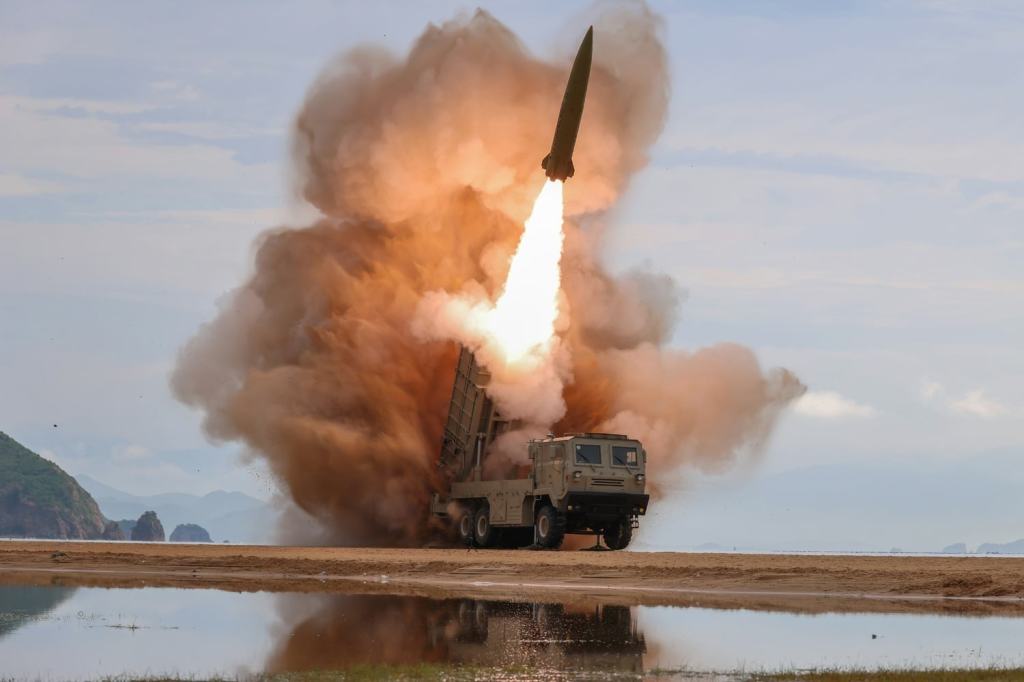
North Korea fired more than 10 short-range ballistic missiles, believed to be 600mm large radar-guided artillery, toward the East Sea on the 20th. This happened as South Korean and U.S. military officials, after U.S. President Donald Trump indicated a desire to hold talks with North Korea, reduced the size of the regular South Korea-U.S. joint training exercise ‘Ulchi Freedom Shield’ (UFS) by half.
The Joint Chiefs of Staff (JCS) reported that they observed North Korea firing more than 10 short-range ballistic missiles from the Pyongyang region towards the East Sea on that day. The missiles traveled roughly 300 km. Defense Minister Ahn Gyu-back disclosed during a session of the National Assembly’s Defense Committee that the ballistic missiles launched by North Korea were the large radar-guided artillery system known as the KN-25. North Korea asserts that the KN-25, which has a range of approximately 400 km, can be fitted with the tactical nuclear warhead ‘Hwasan-31,’ introduced in 2023. The Ministry of National Defense confirmed for the first time on that day that the KN-25 has been stationed in forward areas close to the DMZ, suggesting that North Korea may be capable of conducting tactical nuclear strikes across the Korean Peninsula in case of an emergency.
The launch occurred during the theater-level South Korea-U.S. joint military exercise ‘Ulchi Freedom Shield’ (UFS), taking place from the 17th to the 21st. Nevertheless, some reports indicate that North Korea fired the missiles following the conclusion of Chinese Foreign Minister Wang Yi’s visit to South Korea, which had begun the day before, implying possible attention towards China.
Previously, Kim Yo-jong, the vice chairman of North Korea’s party, expressed in a document titled ‘Position on Major National Issues’ published by the Korean Central News Agency the day before that while the U.S. Forces training, which started on the 17th, was considerably reduced under the leadership of U.S. President Donald Trump, “we find no value in commenting on it and have absolutely no interest.”
Kim Yo-jong remarked, “Cutting back on the size or length of the training does not alter the provocative and hostile character of the military drill.” She further noted, “Despite the strong relationship between the leaders of the two nations (North Korea and the U.S.), we emphasize that our sovereign measures taken to counter threats to our national security are entirely logical, precise, and necessary.”
Park Won-gon, a professor at Ewha Womans University, stated, “This conveys the idea that simply reducing joint exercises, rather than stopping them, is not enough.” He further noted, “By firing ballistic missiles equipped with tactical nuclear warheads, there could also be an indication that future U.S.-North Korea negotiations should recognize North Korea’s nuclear arsenal and start discussions based on that reality.”
This is the third missile test conducted by North Korea this month, after the ones on the 6th and 12th.
Previously, North Korea launched a short-range ballistic missile (SRBM) from the Wonsan region towards the East Sea in the afternoon of the 6th. On the 12th, around 6 a.m., it fired another ballistic missile from the Wonsan area towards the East Sea. During that time, the North Korean missile traveled over 700 km. South Korean military officials mentioned that further analysis is required to determine the type of ballistic missile. North Korea did not reveal information about either launch via state media or other sources.




 jasdooit
Leave a comment