
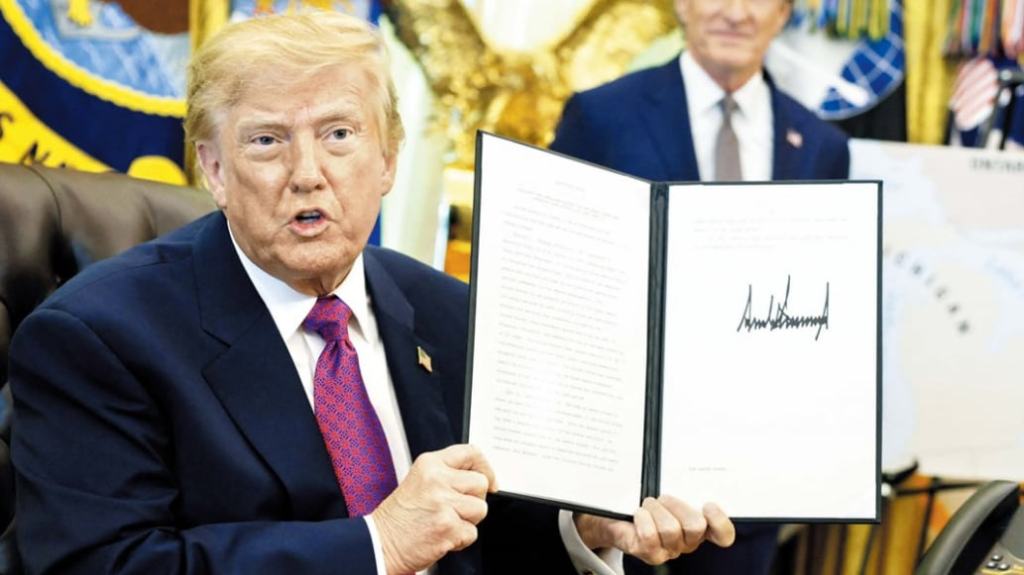
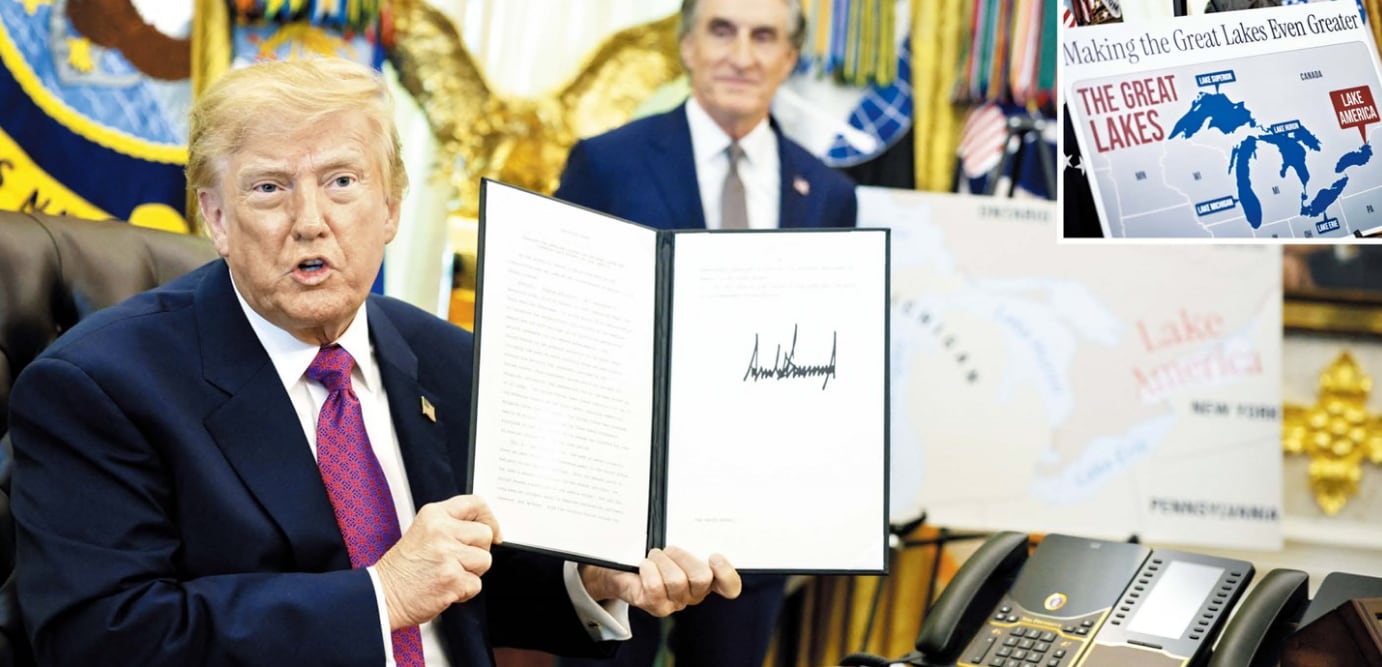
U.S. President Donald Trump signed an executive order on the 27th to rename Lake Ontario, located between New York State and Ontario Province in Canada, as “America Lake.” This move came just two days after he announced on social media the name change amid worsening relations with Canada over a trade war marked by high tariffs.
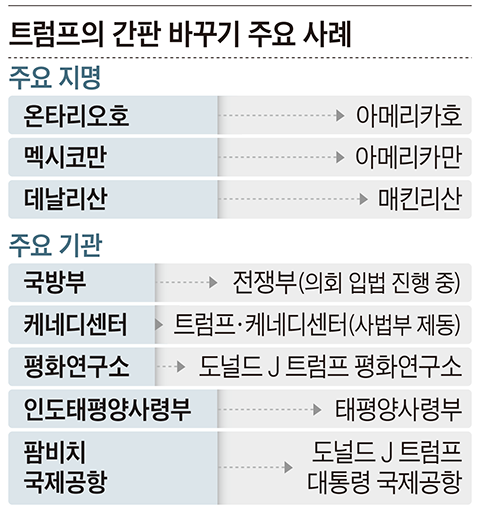
Last year, shortly after the start of his second term, Trump unilaterally renamed the Gulf of Mexico, bordering the southeastern U.S., to “America Gulf,” sparking backlash from Mexico, which shares the body of water. Now, a similar situation has unfolded with Canada. Beyond geographical names, public institutions and government agencies have also seen frequent name changes since Trump’s second term. Analysis suggests Trump, a former New York real estate developer who prioritizes “branding,” favors renaming as a straightforward way to emphasize his “America First” agenda.
At the White House that day, Trump stated, “Canadian officials treated us very badly, and they are nasty people. We need our own sea, and we might even change the names of the Atlantic or Pacific Oceans.” In response to Trump’s executive order, Canadian Prime Minister Mark Carney remarked, “‘Ontario,’ derived from the Indigenous Wendat language meaning ‘beautiful large lake,’ predates both the establishment of the Canadian Confederation and the U.S. Declaration of Independence. The U.S. is not only altering trade relations and foreign policy but also renaming national monuments and water bodies.” This directly criticized Trump’s renaming practices.
On January 20, 2025, the first day of his second term, Trump signed an executive order titled ‘Restoration of Names Honoring American Greatness,’ initiating a wave of name changes. Key measures included renaming the Gulf of Mexico to America Gulf and reverting Alaska’s Denali—the highest peak in North America (6,190 meters)—to its former name, Mount McKinley, which had been restored in 2015 under President Barack Obama following Indigenous requests. “Denali” means “the high one” in the Indigenous language, while McKinley honors William McKinley, the 25th U.S. president. Trump justified the Gulf of Mexico’s renaming by citing its rich oil, gas, and marine resources, stating, “It will play a central role in America’s future.” Regarding Denali’s reversion, he criticized Obama, saying, “Deleting McKinley’s name—who expanded U.S. territory and industrialized the nation before being tragically assassinated—is a disgrace to the deceased.” This underscored the alignment of renaming with his “America First” ideology.
Trump dismissed Mexico’s protests over the unilateral name change and even banned a Associated Press reporter who continued using “Gulf of Mexico” from the White House. In September 2025, he renamed the Department of Defense—the third most powerful federal agency alongside the State and Treasury departments—to its historical name, the “Department of War,” used from 1789 to 1947. Analysts interpreted this as Trump’s attempt to revive the glory of World War victories that propelled the U.S. to global superpower status.
Trump also pushed to attach his name to institutions. In December 2025, the Kennedy Center for the Performing Arts in Washington, D.C.—established in 1971 to honor President John F. Kennedy—was renamed the “Trump-Kennedy Center” after Trump replaced its board with allies. Around the same time, the U.S. Institute of Peace (USIP), an independent nonprofit established by Congress in 1984, became the “Donald J. Trump Peace Institute.”
In Florida, a political stronghold for Trump due to his Mar-a-Lago resort, major facilities were also renamed. In January 2026, a road near Mar-a-Lago in Palm Beach was renamed “Trump Boulevard.” In July 2026, Palm Beach International Airport was rebranded as “Donald J. Trump Presidential International Airport.” While airports in Washington, D.C. (Ronald Reagan), Houston (George H.W. Bush), and Little Rock, Arkansas (Bill and Hillary Clinton), bear former presidents’ names, they were all renamed posthumously, making Trump’s case exceptional. Local legislatures, dominated by his supporters, passed the renaming proposals.
Analysis suggests Trump’s worldview—viewing names as tools to determine a product’s value and image—fuels his obsession with renaming. However, the impulsive changes have caused significant backlash. For instance, “America Gulf” and “America Lake” lack international legal validity and remain domestic measures.
Google Maps reflected the Trump administration’s 2025 change of the Gulf of Mexico to America Gulf. However, the display varies by location: Mexico still shows “Gulf of Mexico,” while third countries list both names. Critics argue this was a temporary compromise under Trump’s pressure.
The attempt to rename the Kennedy Center sparked greater controversy. Though construction began to engrave “Trump” on its exterior, a court later halted the project, deeming it beyond the board’s authority. This led to costly removal work. The forced takeover also triggered boycotts by artists scheduled to perform, causing a sharp decline in ticket sales and donations, plunging the center into financial crisis.
The Department of Defense’s reversion to “Department of War” also faces hurdles, as it requires congressional approval. Many Republican lawmakers oppose the change, leaving its future uncertain. Consequently, most mainstream media continue using the original name in reports.



 jasdooit
Leave a comment