
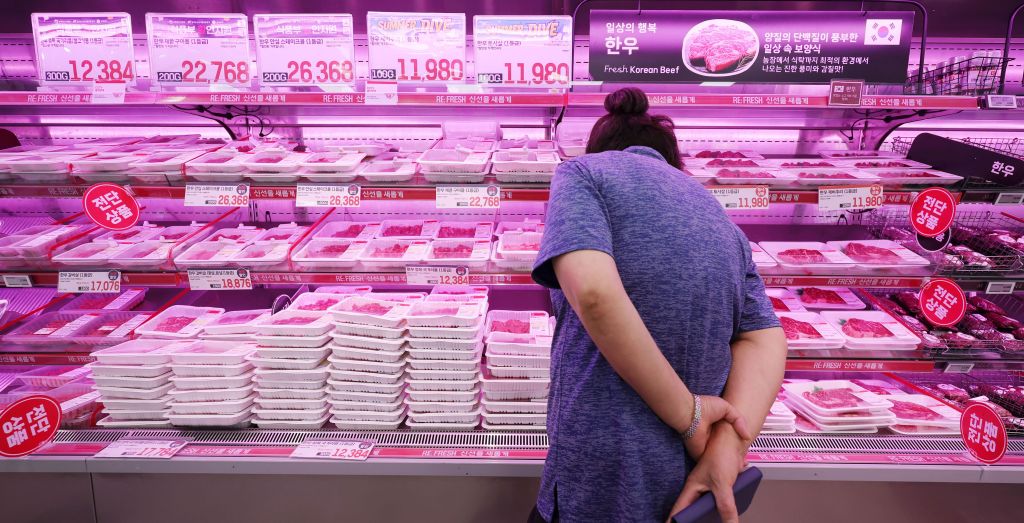
As Chuseok approaches, livestock prices continue to rise, increasing the financial burden of key Hanwoo beef cuts such as sirloin and tenderloin. This is due to a combination of reduced supply from fewer cattle being raised and increased demand during the Chuseok peak season.
According to the Livestock Products Quality Evaluation Service on September 6, as of September 4, the price of Hanwoo tenderloin reached 15,308 Korean won per 100g, a 19.9% increase from the same period last year. Sirloin prices rose by 22.6%, and flank meat, primarily used for braised dishes, increased by 17.7%.
The primary cause of the rise in Hanwoo beef prices is reduced supply. Following a significant drop in Hanwoo beef prices several years ago, the number of cattle being raised has continued to decline, leading to decreased slaughter and supply volumes. Additionally, increased feed costs due to rising international grain prices have also contributed to the price hike.
This year’s Hanwoo slaughter count is 864,000 head, an 8.8% decrease from last year and a 5.0% drop from the annual average. The fourth-quarter slaughter count is expected to be 178,000 head, 14.1% fewer than the same period last year.
As a result, wholesale prices have risen, increasing the financial burden on consumers. According to the Korea Rural Economic Institute Agricultural Outlook Center, this year’s wholesale price for Hanwoo beef is expected to reach around 22,500 Korean won per kilogram, a 14.5% increase from last year. The center also forecasts that during the Chuseok peak season, wholesale prices for Hanwoo beef will range from 24,000 to 25,000 Korean won per kilogram, representing a 14.3% to 19.0% increase compared to last year.
Imported beef prices are also on the rise. As Hanwoo beef prices increase, demand has shifted to relatively cheaper imported beef, and reduced U.S. beef exports have further driven up prices. The price of U.S.-produced chilled chuck eye roll reached 4,019 Korean won per 100g, a 20.1% increase from the same period last year.
Although egg wholesale prices have fallen due to recovering production, consumer prices remain high. As of September 4, the average consumer price for a 30-egg carton was 7,199 Korean won, 3.7% higher than the same period last year. Annual average prices show that the consumer price for a 30-egg carton rose from 6,562 Korean won in 2024 to 6,789 Korean won last year, and has reached 7,146 Korean won this year.
The government plans to stabilize prices by increasing livestock supply ahead of the Chuseok peak season. It will supply 22,000 tons of beef, a record-high 67,000 tons of pork, and 4,900 tons of eggs, 2.4 times the usual amount.




Leave a Reply