
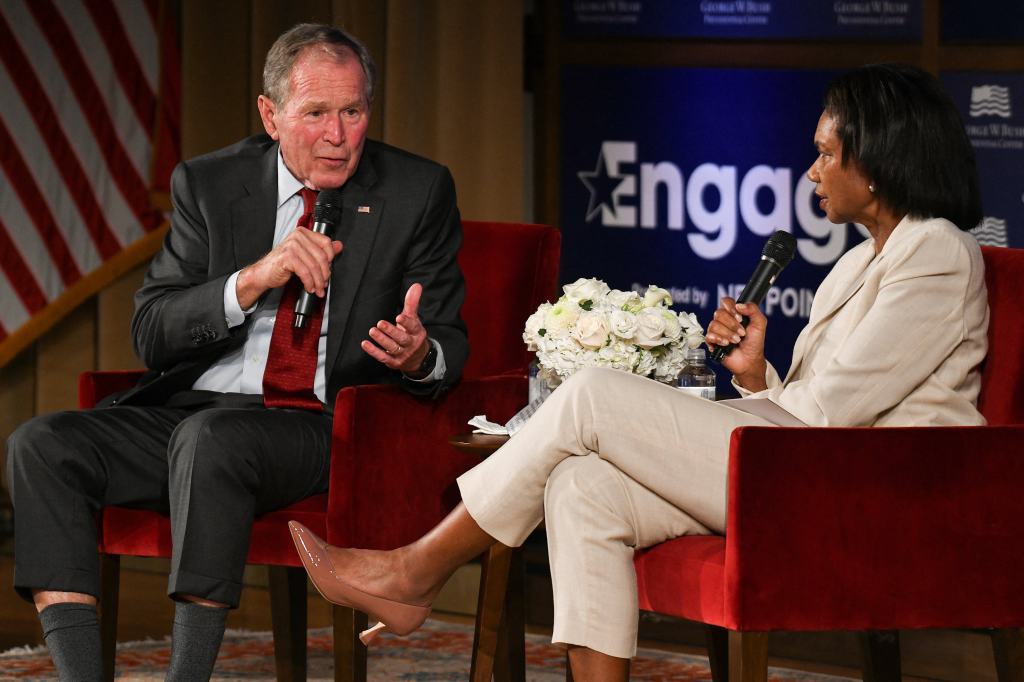
Former U.S. President George W. Bush, speaking two days before the 25th anniversary of the 9/11 attacks on September 9, said, “Starting with Japanese Prime Minister Junichiro Koizumi on the morning of the 12th, the day after the terror attacks, world leaders began calling me one after another,” adding, “Koizumi’s call gave me confidence that free societies could cooperate together.” Bush made these remarks during a discussion with former Secretary of State Condoleezza Rice at an event held at the George W. Bush Presidential Center at Southern Methodist University (SMU) in Texas on the afternoon of that day. According to records from the U.S. National Archives and Records Administration (NARA), then-South Korean President Kim Dae-jung spoke with Bush eight days after the attacks, on the 19th, to express condemnation and condolences.
Bush reflected on Koizumi’s call, saying, “It was an ironic call considering that our fathers’ generation had fought each other,” and added, “But he called and said that the two countries should protect each other’s freedom through mutual defense.” Bush’s father, former President George H. W. Bush, served as a Navy fighter pilot during World War II and was shot down near Chichijima (Father Island) in Japanese-controlled territory in 1944. Nine U.S. service members fell into the sea, and only Bush, then a Navy lieutenant junior grade, survived. The U.S.-Japan alliance is widely regarded to have deepened significantly in the early to mid-2000s, built on the personal bond between Bush and Koizumi.
The event also revealed lesser-known details about the 9/11 attacks. It was noted that upon arriving at the White House after visiting a school in Florida on the day of the attacks, Bush’s first question to Rice was, “Where is Laura [the First Lady]?” Rice remarked, “It truly felt like family.” Both Bush and Rice initially thought, “It must have been a plane accident.” Bush stated, “After the attacks, it became clear early on who the perpetrators were, and my main focus was serving as the ‘Comforter in Chief’ to the grieving families and the nation.” He recalled visiting Ground Zero in Manhattan, the site of the World Trade Center collapse, and witnessing “the sacrifice, courage, and dedication of firefighters and police officers who achieved the unbelievable.”
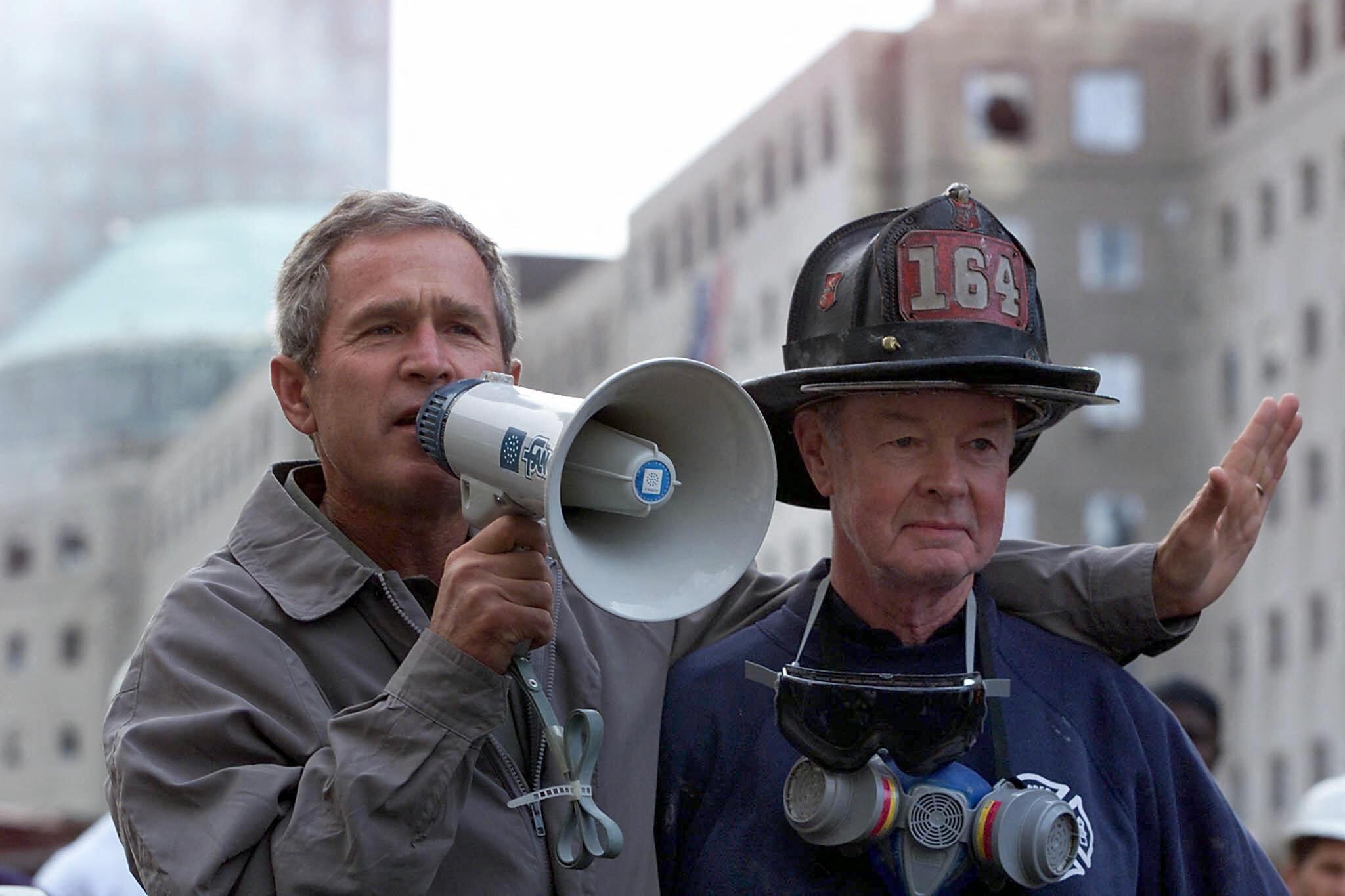
The 9/11 attacks resulted in the deaths of 2,977 people in New York’s World Trade Center, the Pentagon in Washington, D.C., and Shanksville, Pennsylvania. Bush said, “Every time I meet someone who says, ‘I lost a loved one on 9/11,’ I feel sorrow, and dealing with young children was especially tough,” adding, “The only thing I could do was hug them and say, ‘I’m thinking of you.’” Bush noted a surge in military enlistments after 9/11, stating, “When America is in crisis, Americans step up,” and emphasized, “I witnessed this firsthand—America is truly an amazing country.” On October 30 of that year, Bush’s ceremonial first pitch in a bulletproof vest at the third game of the World Series at Yankee Stadium in New York became an iconic symbol of the nation’s recovery from 9/11. Regarding conspiracy theories surrounding 9/11, Bush said, “I try not to pay attention to those nuts.”
Also in attendance was Dan Caine, then a major in the Air Force stationed at Andrews Air Force Base near Washington, D.C. Leading an F-16 fighter jet and commanding air defense operations over the capital, he recalled, “The moment I heard the ‘engagement rules’—that pilots had discretion to shoot down civilian aircraft—remains one of the most vivid memories of the past 25 years.” He added, “I will never forget the leadership of General David Wherley Jr., who said, ‘I don’t know what we’ll face, and it’ll be unbelievably hard, but I’ve got your back,’” referring to Wherley, then commander of the District of Columbia Air National Guard. Caine stated, “While 2,977 people were lost, it was also a day of endless acts of selfless courage,” and noted, “Though we clash and creak loudly, uniting in times of national hardship is the American identity.”


 jasdooit
Leave a comment