
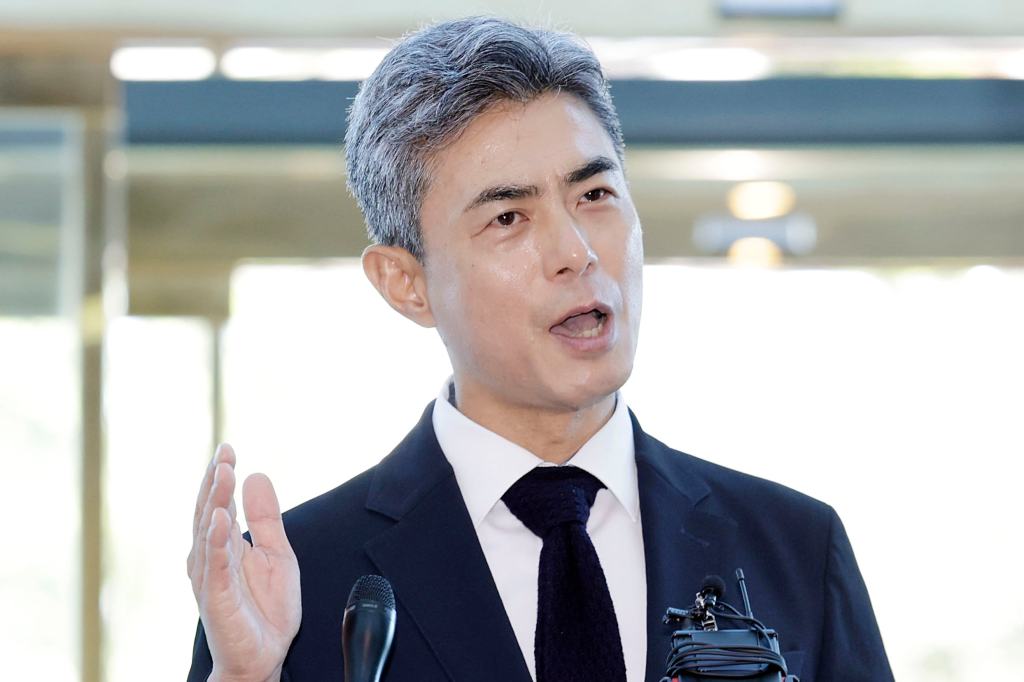
Kang Shin-chul, a nominee for Minister of National Defense, who faced suspicions of obtaining special housing allocations for demolition victims in Seoul’s Seocho District by falsely registering residency, is now under fresh allegations that his older brother and aunt also applied for similar special allocations using the same method, revealed on the 10th. At least four members of Kang’s family reportedly received demolition victim status. Additionally, Kang’s father allegedly transferred his Jeju Island home to another person for free to meet the one-homeowner requirement for special allocation eligibility, only to repurchase it two years later for 300,000 Korean won—a scheme described as a loophole.
Representative Chun Ha-ram of the Reform Party, a member of the National Assembly’s Defense Committee, held a press conference at the National Assembly on the morning of the same day, stating, “The family collectively and systematically carried out an ‘operation to secure demolition victim status,’ with four family members obtaining four demolition victim designations. Among them, Kang Shin-chul, his father, and his older brother each received a Seoul apartment through special allocation for demolition victims.”
According to an analysis of Kang’s confirmation hearing materials by Chun’s office, Kang’s older brother and aunt also applied for special allocations as demolition victims around the same period using similar methods. Kang’s older brother, Kang Mo (62), applied for special allocation in Cheonwang 2 District on April 24, 2009, and acquired a new apartment in Cheonwang Yeonji Town 1 Complex, Guro District, Seoul, on August 8, 2013. Kang’s aunt also reportedly obtained demolition victim status and applied for special allocation in Umyeon 2 District on October 23, 2008.
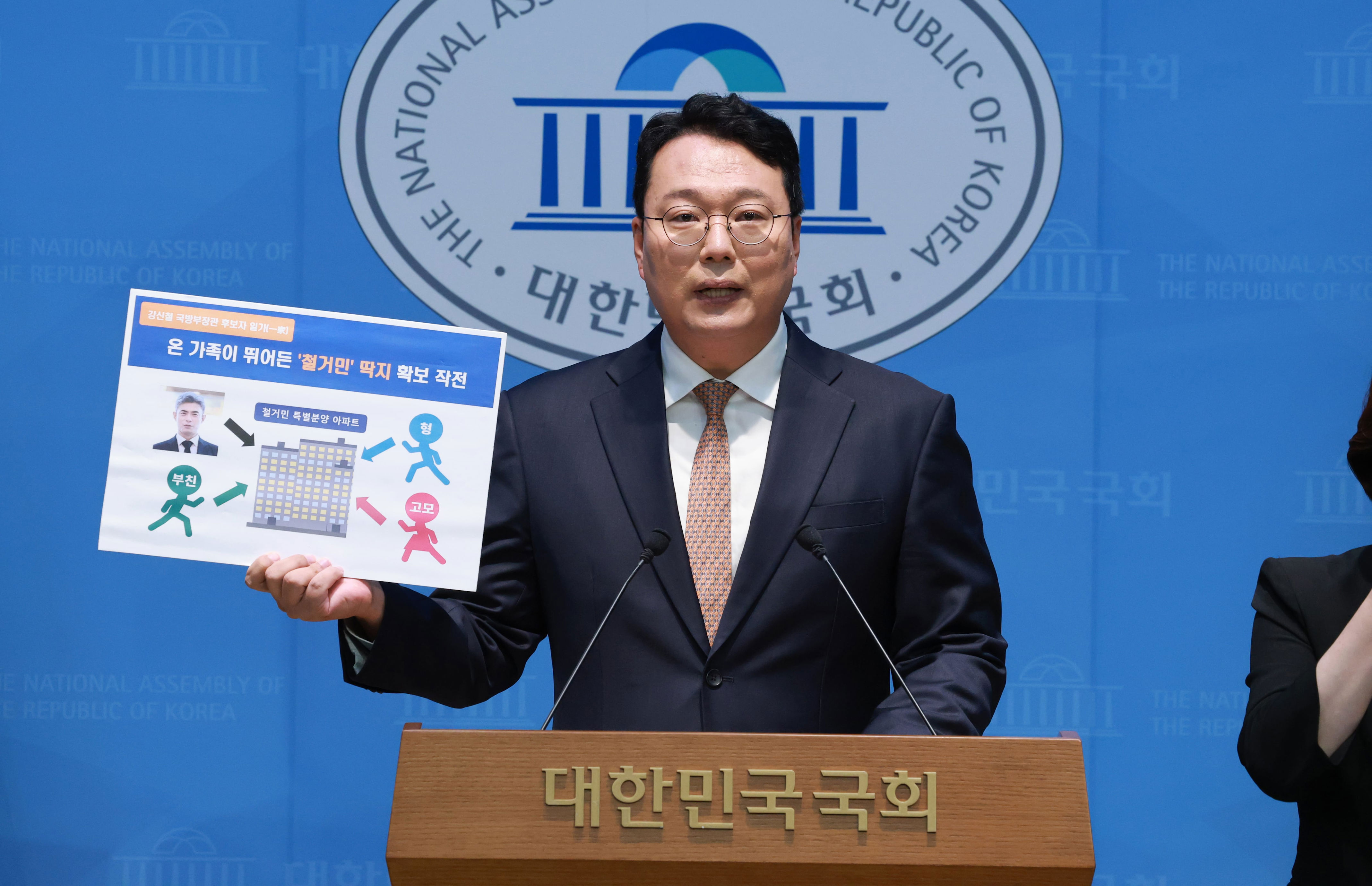
Representative Chun suggested that Kang and his father likely falsely registered residency in Guro District around the same period to obtain demolition victim status. Kang, who served as the commander of the 2nd Battalion, 8th Regiment, 7th Division in Gangwon’s Hwacheon in 2008, registered residency at his own vacant house in Cheonwang-dong, Guro District, with his spouse on March 21, 2008. On the same day, his father, Kang Mo (83), who lived in Jeju, also registered residency at the same house and became the head of the household. Three days later, on the 24th, they moved their registration to a neighboring house to separate households. Twenty days after their registration, on April 10, the implementation plan for the Yeongdeungpo Alternative Correctional Facility construction project was announced, followed six days later by a compensation plan. Kang later received one apartment in Seocho Nature Hill 3 Complex, while his father received one in Complex 2. The current market value of Kang’s apartment, originally priced at 520 million Korean won, is approximately 2.2 billion Korean won.
Chun’s office revealed that Kang’s father transferred his Jeju Island home in Seogwipo, presumed to be his actual residence, to another person as a gift, only to repurchase it two years later for 300,000 Korean won. Representative Chun questioned, “Have you ever heard of or witnessed a transaction where property is gifted and then repurchased for 300,000 Korean won?” adding, “This was to meet the one-homeowner requirement for special allocation eligibility.”
He reiterated that Kang had “maliciously and intentionally falsely registered residency in Cheonwang-dong, Seoul, only during the period when demolition victim status was needed.” This was to fulfill both ownership and residency requirements. Kang had previously explained that his family’s sole residence was in Cheonwang-dong, as their military apartment in Hwacheon was temporary. However, Representative Chun countered, “At the time, Kang’s two elementary school-aged children were living in Yangji Village, Bundang, Gyeonggi Province, with their maternal family. Therefore, Kang’s actual residence was Yangji Village, not Cheonwang-dong. Shouldn’t residency registration have been in Yangji Village if it was based on actual residence?”
According to Chun’s office, after the demolition compensation process concluded, Kang and his father moved their residency back to their original addresses: the military apartment in Hwacheon and Jeju Island, respectively.
Representative Chun stated, “I thought Kang was an elite military officer, but he turned out to be an elite speculator. The entire family, including his father, older brother, and aunt, played a central role in this operation to secure demolition victim status.” He added, “A system designed to support displaced residents became a tool for the nominee’s family to profit. We demand Kang’s resignation.”
Kang’s camp clarified that all family members were legitimate recipients of demolition compensation and denied any illegality in the special allocation process. A source from Kang’s confirmation hearing preparation team explained, “The nominee, his father, older brother, aunt, and other family members and relatives who lived in Cheonwang-dong, Guro District, were all actual homeowners in the area and legitimate recipients of demolition compensation. The special allocation applications were processed normally according to procedures.”
The source further expressed strong regret over what they called “stereotypical and derogatory expressions” used without factual verification, which they claimed tarnished the reputation of both Kang and his family.

 jasdooit
Leave a comment