
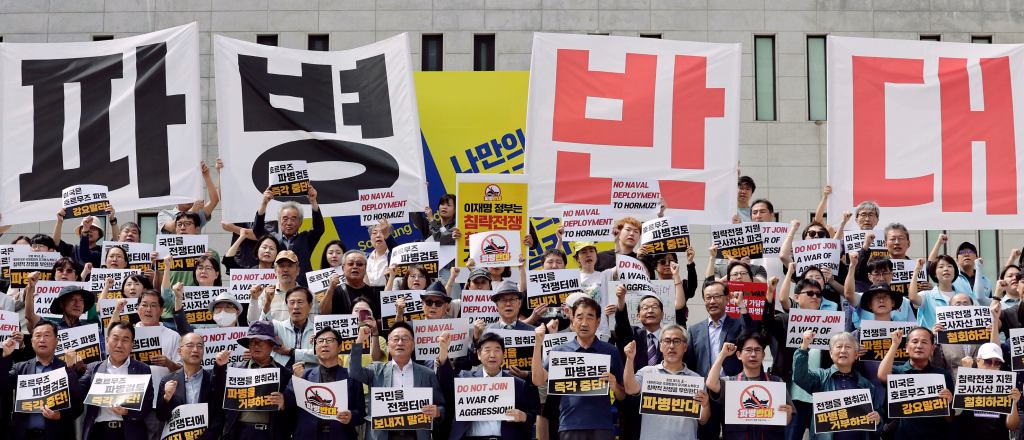
The Ministry of National Defense has dispatched a local inspection team near the Strait of Hormuz, intensifying controversy over potential troop deployment. The People Power Party stated, “We will positively review deployment for national interest,” but the Democratic Party clearly reflects opposition from its traditional supporters who oppose deployment. Cheong Wa Dae clarified, “Nothing has been decided yet.”
The U.S.-Iran conflict in the Strait of Hormuz differs from previous wars where South Korea deployed troops. The Vietnam War had the justification of preventing communist expansion, and the Iraq War saw participation from countries like the UK and Australia following the 9/11 attacks. In contrast, no country has yet sent military forces to the Strait of Hormuz. During the Iraq deployment, combat had effectively ended, and South Korea sent non-combat reconstruction units as part of a multinational force. However, the Strait of Hormuz is now witnessing an escalation of war. The U.S. military destroyed Iranian oil tankers and facilities, and Iran retaliated with missile strikes on U.S. installations. In the Red Sea, clashes between Saudi Arabia, a U.S. ally, and Iran-aligned Houthi rebels have killed hundreds. Iran has threatened to “consider South Korea an enemy” even if it sends non-combat assets.
Nonetheless, South Korea cannot ignore the U.S.’s request as a military ally. Currently, unresolved issues between South Korea and the U.S.—including investment projects in the U.S., construction of nuclear-powered submarines, permission for nuclear enrichment and reprocessing, transition of wartime operational control, and promotion of U.S.-North Korea dialogue—are intertwined, affecting the future of security and the economy. Trump singled out South Korea, expressing dissatisfaction by saying, “No thank you” to President Lee Jae Myung’s probe for support in the Iran conflict. Given Trump’s personality, some form of “aftermath” is likely. The White House is also pressuring, stating, “We are waiting for South Korea’s support.”
Within the Democratic Party, voices argue, “There is less justification than the Iraq War” and “We should not be dragged by the U.S.” Some civic groups have already begun protests. However, Representative Park Ji-won, a former NIS director, mentioned “non-combat troops” and said, “Considering relations with the U.S. and national interest, it is unavoidable.” It is reported that figures who handled security issues during the Roh Moo-hyun and Moon Jae-in administrations within the ruling party are refraining from debate or expressing that “it is unavoidable.” Political statements made with supporters in mind only provide excuses for dividing national opinion.
President Lee recently said, “The topic of deployment is really difficult.” It certainly is. However, deployment ultimately requires the president, as the commander-in-chief, to make a decision and persuade the public and the National Assembly. Excessive debate and strategic offensives will only deepen divisions. It is necessary to quietly observe and ensure the decision is made solely based on national interest.




 jasdooit
Leave a comment