
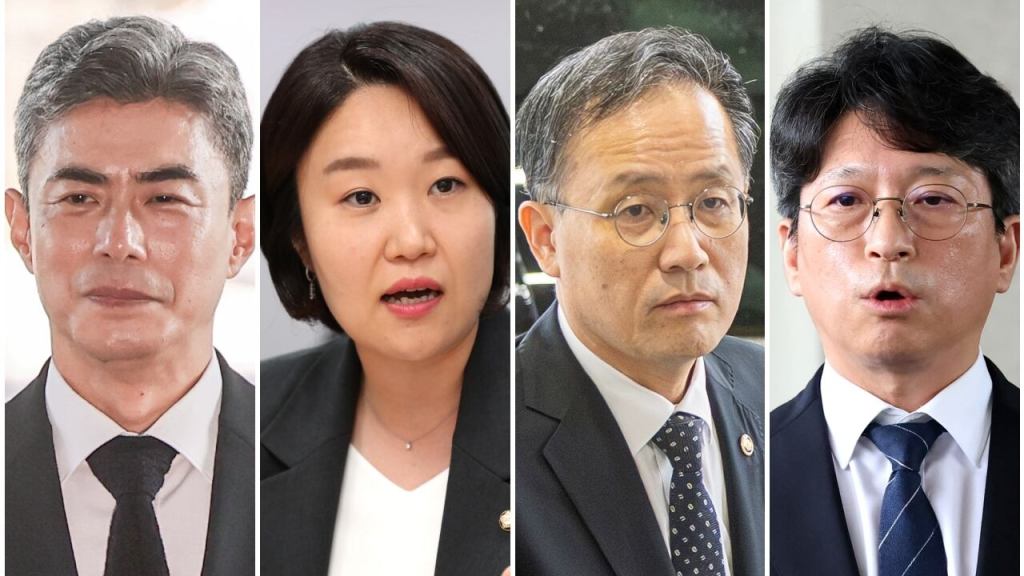
Five out of six nominees for ministerial positions in the Lee Jae Myung government’s second-term cabinet have been found to have increased their assets through real estate investments, including “non-resident single-home ownership” and “all-out borrowing and debt-fueled investment.” While some cases date back over a decade, the government has been tightening real estate regulations—such as reducing loans and raising taxes—with the stance that “long-term ownership of non-resident single homes is speculative.” This is expected to spark controversy during confirmation hearings. Opposition parties criticized, “This is the current administration’s self-inflicted wound, having touched the public’s nerves on real estate.”
◇ Kang Shin-chul faces allegations of real estate speculation via fake residency
New allegations emerged on the 9th that Kang Shin-chul, the defense minister nominee, who had faced suspicions of obtaining a special allocation for an apartment in Seoul’s Seocho District by falsely registering residency to qualify as a displaced person, also received a special allocation through the same method via his father. Kang has also drawn criticism for his son borrowing approximately 700 million Korean won from his aunt and uncle just one year after employment to purchase a commercial property in Yangji Village, Bundang, Seongnam, Gyeonggi Province.
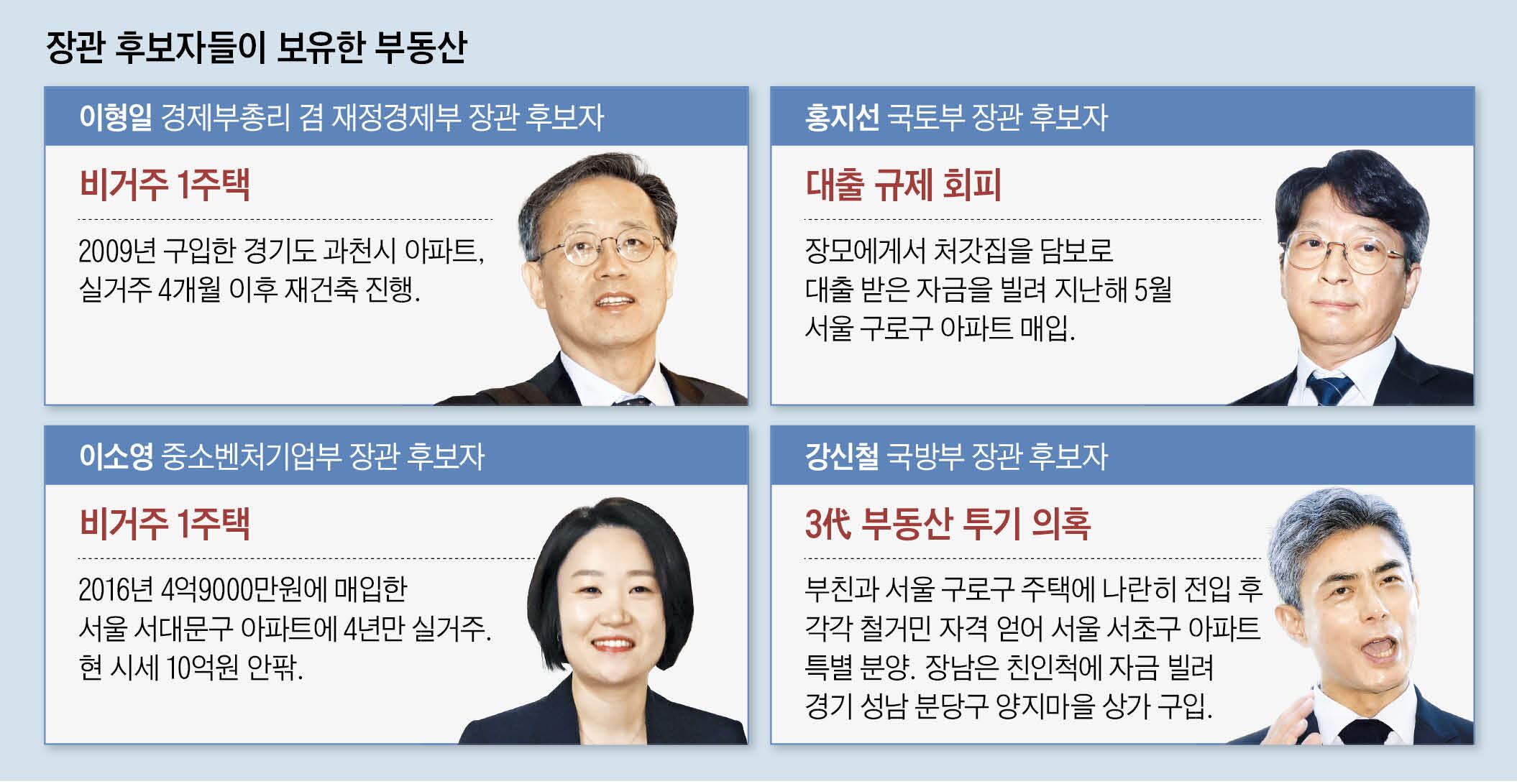
Kang, while stationed in Hongcheon, Gangwon Province, moved his residence to a house in Cheonwang-dong, Guro-gu, Seoul, in March 2008. However, according to personnel hearing materials obtained by this newspaper, his father, Mr. Kang (83), also moved to a house in Cheonwang-dong near Kang’s property in March 2008. Mr. Kang had operated a citrus farm in Seogwipo, Jeju, since the late 1980s and, as of April this year, owned approximately 15,000 square meters of orchard land in Seogwipo. Despite this, he changed his address to a house he owned in Seoul during this period.
The housing sites in Cheonwang-dong, where Kang and his father moved, were designated as the site for Seoul Southern Prison in October of the same year. As Guro-gu Office compensated and purchased their houses, Kang and his father each qualified as “displaced persons” and received a special allocation for one apartment each in Seocho District, Seoul.
Regarding the fake residency allegations involving Kang and his father, a source from Kang’s side stated on the day, “We understand that the special supply subscription was carried out normally according to procedures.” They claimed it was not illegal. However, real estate industry insiders noted, “Unlike reconstruction projects, special allocations for displaced persons require both ownership and actual residency. If residency was registered solely to qualify for the special allocation, isn’t that speculation?”
◇ Non-resident single-home ownership and all-out borrowing ahead of loan regulations
Two of the six ministerial nominees fall under the category of “non-resident single-homeowners,” which the Lee Jae Myung government and the Democratic Party of Korea have deemed “effectively speculative gap investments.” According to Rep. Choi Soo-jin of the People Power Party, Lee So-young, the nominee for Minister of SMEs and Startups, purchased an 84-square-meter apartment in Hongje-dong, Seodaemun-gu, Seoul, for 490 million Korean won in February 2016 and lived there for only the initial four years. While Lee resided in a jeonse (lease) house in Uiwang, Gyeonggi Province—the constituency of her National Assembly seat—from February 2020, the apartment’s transaction price rose to around 1 billion Korean won.
According to Rep. Kim Sang-hoon of the People Power Party, Lee Hyoung-il, the nominee for Deputy Prime Minister and Minister of Economy and Finance, purchased an apartment in Gwacheon, Gyeonggi Province, for 420 million Korean won in February 2009 and held it for 17 years, residing there for only a total of four months across two periods. This has raised questions about whether the purchase was for investment rather than residential purposes. The apartment is currently undergoing reconstruction. As a former first vice minister of the Ministry of Economy and Finance under this administration, Lee had announced a real estate tax reform plan last month, stating, “We will normalize taxation on non-resident and multiple-homeowners to enhance fairness.”
Hong Jee-sun, the nominee for Minister of Land, Infrastructure and Transport, faces suspicions of purchasing a house in Sindorim, Guro-gu, Seoul, for 1.005 billion Korean won in May last year—just before the government’s June 27 mortgage regulations tightened loan restrictions—through “all-out borrowing.” Of the total, 367 million Korean won was covered by a mortgage loan under her name, and 170 million Korean won was borrowed from her mother-in-law, Ms. Kim. Around this time, a mortgage of the same amount was established on an apartment in Suwon, Gyeonggi Province, owned by Ms. Kim. It is presumed that Ms. Kim took out a loan using her in-laws’ house as collateral to help Hong and her spouse purchase the property.
Earlier, Yong Hye-in, the nominee for Minister of Gender Equality and Family, sparked controversy over “short-term trading” after reportedly buying a house in Ansan, Gyeonggi Province, in April 2021 and reselling it in March 2022 for a profit of 20 million Korean won.

 jasdooit
Leave a comment