
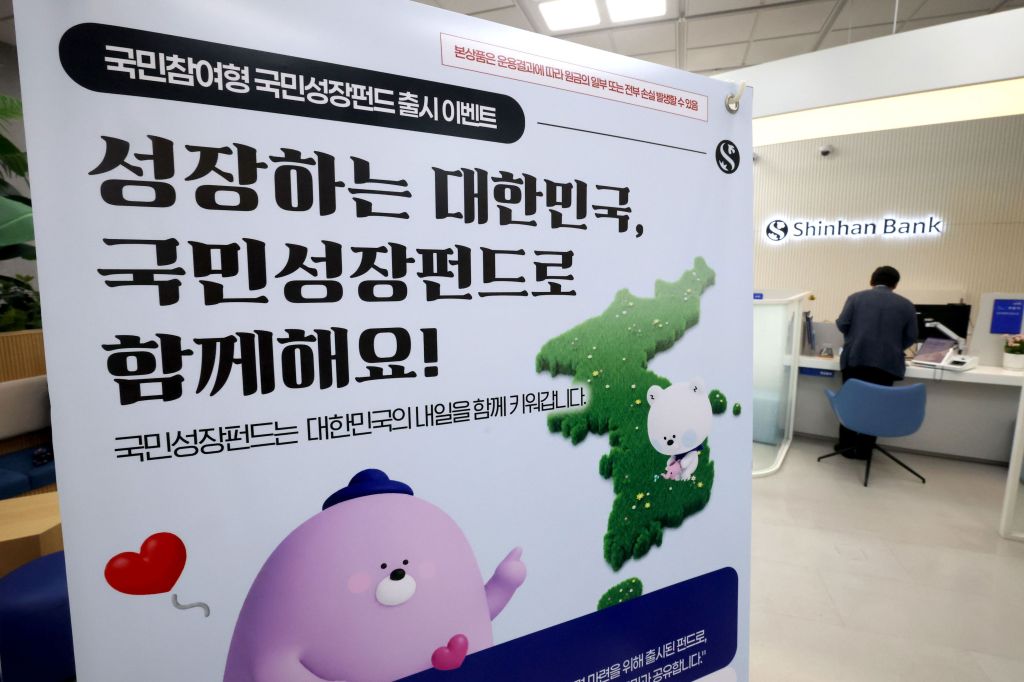
The government’s core policy fund, the “National Participation Growth Fund,” which allows ordinary citizens to invest, will go on its second sale from the 30th of this month to the 15th of next month. This fund invests in companies across 12 high-tech strategic industries, including semiconductors, artificial intelligence (AI), biotechnology, defense, and robotics. The sale size is the same as the first round in May—600 billion Korean won—with half (300 billion Korean won) prioritized for low-income subscribers whose wage income is 50 million Korean won or less (or comprehensive income of 38 million Korean won or less).
On the 8th, the Financial Services Commission announced, “The second National Participation Growth Fund will be sold on a first-come, first-served basis for two weeks from the 30th of this month to the 15th of next month.”
The sale size for this round is 600 billion Korean won. Of this, 300 billion Korean won is prioritized for subscribers with wage income of 50 million Korean won or less. For those with additional income beyond wages, the threshold is comprehensive income of 38 million Korean won or less. However, if the prioritized quota is not fully sold during the first week (September 30 to October 7), the remaining quota will be sold without income restrictions from October 8 to 15.
The fund can be subscribed to at 10 banks—KB Kookmin, Shinhan, Hana, Woori, NH Nonghyup, and others—and 14 securities firms, including Mirae Asset, Korea Investment, Kiwoom, NH Investment, and Samsung. Subscriptions are available either by visiting branches or online. During the first week, up to 40% of bank quotas and 60% of securities firm quotas will be sold online, with these restrictions lifted in the second week.
Subscribers from the first round in May cannot rejoin the second round. However, those who opened accounts for the first round but did not invest can subscribe this time.
When subscribing, income verification documents—such as an ISA (Individual Comprehensive Asset Management Account) income confirmation certificate or certificate issuance number—must be submitted. During the first sale, subscribers had to obtain and submit these documents themselves, but this time, the National Tax Service will automatically send the documents to sellers if subscribers agree.
Subscribers can choose one of three public funds managed by Mirae Asset, Samsung, and KB Asset Management. These funds share returns from 10 sub-funds, so the investment yield is the same regardless of the chosen fund.
◇ Must Open Dedicated Account to Receive Tax Benefits
This fund offers income tax deductions: 40% for investments up to 30 million Korean won, 20% for amounts exceeding 30 million to 50 million Korean won, and 10% for amounts exceeding 50 million to 70 million Korean won, with a maximum deduction of 18 million Korean won. Dividend income is subject to a 9.9% separate tax if held for five years.
To receive tax benefits, subscribers must be 19 years old or older (or wage earners aged 15 or older) and open a dedicated account exclusively for the National Participation Growth Fund. Those who were subject to comprehensive financial income taxation between 2023 and 2025 cannot open a dedicated account.
The subscription limit for dedicated accounts is 100 million Korean won per person annually, with a maximum of 200 million Korean won over five years. The minimum subscription amount, set autonomously by sellers, ranges from 0 to 1 million Korean won. Investments can also be made through general accounts without tax benefits, with an annual limit of 30 million Korean won per person.
The fund has a five-year maturity, and redemptions are not allowed during this period. It is unsuitable for funds needed in the near future.
◇ Negative Returns Since Launch
The fund gained significant popularity during its first sale in May, with the online quota (300 billion Korean won) selling out in about 20 minutes.
However, initial returns fell short of investor expectations. According to FnGuide, the 12 National Participation Growth Funds recorded a 0.65% loss over the past month (as of the 7th). This underperformed the average return of 6.71% for 1,105 domestic equity funds during the same period.
Since its launch on June 12, the fund’s average return has been -1.28%. This figure reflects the government’s financial support, which covers up to 20% of losses. Without this support, losses would have exceeded 20%.
As a closed-end fund, the final profit or loss will only be determined at maturity in five years. A source from the Financial Services Commission stated, “Given the long-term investment nature of high-tech strategic industries and the diversified investment across sectors, visible results will take considerable time.”




 jasdooit
Leave a comment