
On the 9th, the area in front of the control room at the acid-washing factory of the Jeonnam-Gwangju Gwangyang Steelworks was crowded with employees dispatched by the company throughout the day. The acid-washing factory treats the surface of hot-rolled steel sheets produced at the steelworks before they are transferred to the cold-rolling process. The control room monitors and controls the operation of the entire factory’s equipment. Dozens of people stood guard in front of it all day.
This scene followed the POSCO labor union’s partial strike, the first in the company’s history, which began at 7 a.m. that day. As wage negotiations stalled, the union launched its first strike in 58 years. The company reportedly kept watch in front of the control room all day, fearing that striking workers might attempt unauthorized entry and disrupt factory operations. The first strike involved 120 union members: 20 from Pohang and 100 from Gwangyang. These workers operate all lines at the Gwangyang acid-washing factory and parts of the electrical steel sheet factory’s second line in Pohang.
No production disruptions occurred as the company deployed available personnel. Both labor and management remain cautious, given that this is the company’s first-ever strike. However, analysts predict that the wide gap in their positions will make it difficult to reach a compromise in the near term. Some view the strike as a result of POSCO hitting structural limits. While attempting business diversification by expanding overseas production bases amid sluggish performance in its mainstay steel sector, the company has yet to achieve notable results. This has reportedly fueled employee dissatisfaction, especially when compared to other companies offering so-called “N% performance bonuses.”
◇Demand of 1.4 trillion Korean won… Company calls it “excessive”
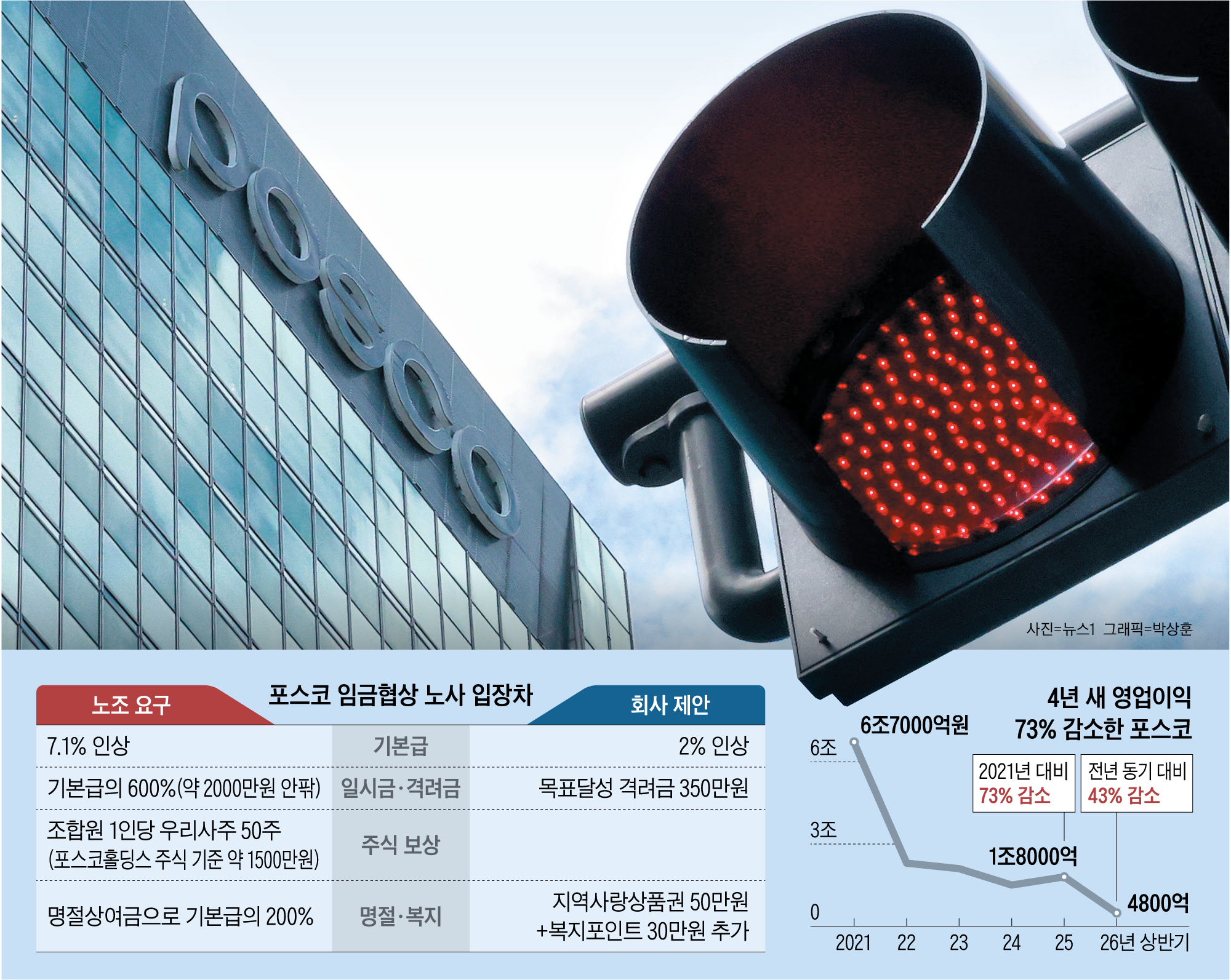
The most direct issue that broke POSCO’s 58-year no-strike tradition is the scale of compensation. The union demanded a 7.1% base pay increase, a 600% bonus based on base pay, 50 shares of company stock per member, and 200% holiday bonuses. The company offered a 2% base pay increase, a 3.5 million Korean won performance-based bonus, and 500,000 Korean won in local gift certificates.
However, the company estimates that one-time compensation demands alone would exceed 40 million Korean won per person annually if applied to current stock prices and base wages. This is roughly three times the initial demand of around 10 million Korean won in the mid-range last year and about six times the actual one-time payment of 7 million Korean won that was agreed upon. The company argues that this is excessively burdensome given its performance. If all union demands are accepted, the additional cost would amount to approximately 1.4 trillion Korean won, about 80% of last year’s operating profit of 1.78 trillion Korean won. The union counters that management is focusing on the total cost burden based on initial demands rather than seeking a compromise at the negotiation table.
◇Steel profits down 73%… Both sides “cannot retreat”
POSCO management insists the steel industry is in dire straits. The steel division’s operating profit fell from 6.7 trillion Korean won in 2021 to 1.8 trillion Korean won last year—a 73% drop over four years. The first half of this year also saw a 43% decrease compared to the same period last year. Rising raw material costs and intense competition from low-cost Chinese steel have continued to erode profitability. A turnaround is unlikely. The OECD forecasts that global excess steel production capacity will increase by 16% from 640 million tons in 2023 to 745 million tons in 2028, prolonging oversupply.
POSCO Group is currently expanding into new businesses such as secondary battery materials and LNG (liquefied natural gas). However, while steel remains its mainstay, efforts to secure overseas production bases in the U.S., India, and Indonesia have yet to yield results significant enough to offset declining performance.
Employees, meanwhile, express anxiety as the company’s performance has plummeted in recent years. There are growing concerns that management’s focus on investment and growth in new businesses and overseas markets will lead to neglect of domestic operations. A sense of deprivation has also grown as they observe other industries.




 jasdooit
Leave a comment