

Kwon Hyuk-bin, 52, the founder and Chief Vision Officer (CVO) of Smilegate, was ordered by a lower court on the 9th to pay his spouse, Lee Mo-shi, 2.55 trillion Korean won worth of stocks and cash in divorce asset division. This is the highest amount in South Korea’s divorce litigation history. Smilegate is one of the country’s top five game companies.
The Third Family Division of Seoul Family Court (Presiding Judge Jeong Dong-hyuk) accepted the divorce petition filed by Lee Mo-shi, the spouse, against Kwon on the same day, setting the asset division ratio between Kwon and Lee at 65% and 35%, respectively. Accordingly, the court ordered Kwon to transfer 35% of Smilegate’s total shares (7.1049 trillion Korean won), amounting to 2.4867 trillion Korean won, and 65 billion Korean won in cash to Lee. The court also dismissed Lee’s claim for consolation money, stating, “The marital relationship has irretrievably broken down, and both parties bear equal responsibility.”
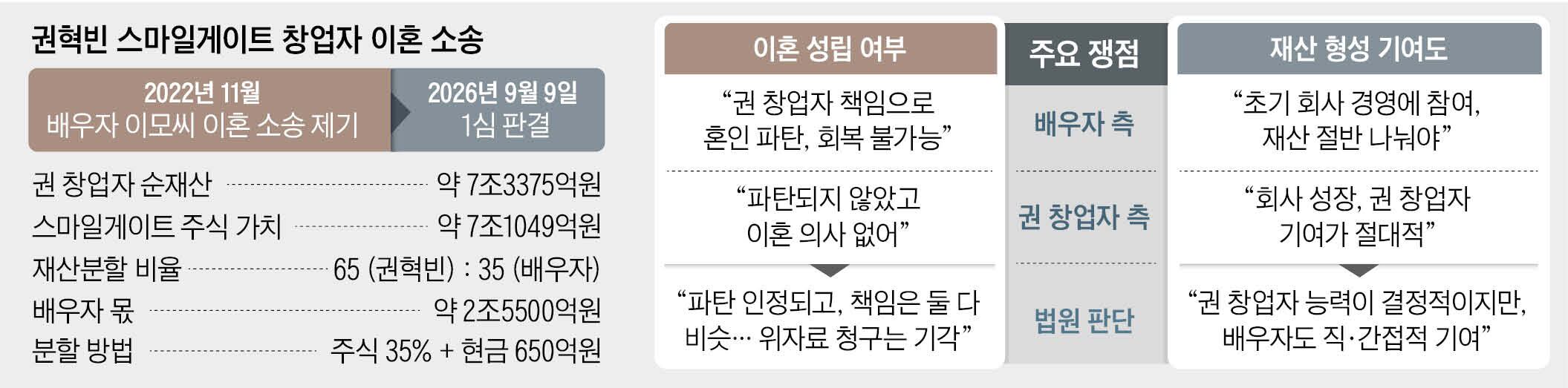
◇Court: “Wife Contributed Directly and Indirectly to Company While Handling Household and Childcare”
The Seoul Family Court’s ruling on the 9th, which ordered Smilegate founder Kwon Hyuk-bin to pay 2.55 trillion Korean won in divorce asset division to his spouse Lee Mo-shi, is approximately three times the 944 billion Korean won set in July by the retrial of SK Group Chairman Chey Tae-won and Art Center Nabi Director Roh Soh-yeong’s divorce lawsuit. It also exceeds by over 1 trillion Korean won the previous record for South Korea’s highest divorce asset division (1.3808 trillion Korean won), which was ruled in 2024 during the appellate trial of the divorce case between Chairman Chey and Director Roh before the Supreme Court overturned it.
◇Similar Division Ratios, Yet a 1 Trillion Korean Won Difference?
Director Roh’s asset division ratio was 33.3% in the retrial and 35% in the appellate trial, showing little difference from the 35% share of Kwon’s spouse. However, the asset division amount for Kwon is significantly higher than Chairman Chey’s because the court recognized the divisible assets as reaching 7.3375 trillion Korean won. In contrast, the retrial of Chairman Chey’s divorce lawsuit reduced the divisible assets from 4.0115 trillion Korean won in the second trial to 2.8999 trillion Korean won, following the Supreme Court’s ruling that Director Roh’s father, former President Roh Tae-woo’s “30 billion Korean won slush fund,” could not be considered as Director Roh’s contribution to SK Group’s growth. Additionally, Director Roh did not participate in SK Group’s management.
◇“Shares Are Joint Property” vs. “Nominal CEO”
During the divorce proceedings, Lee’s side argued, “The company shares are the couple’s joint property.” In response, Kwon’s side countered, “Lee did not contribute any capital and was only a nominal CEO on paper, without ever actually attending work at the company.”
The court responded, “Considering that Lee held a portion of the company shares and was solely responsible for household and childcare for a long period, she should be recognized as having contributed directly and indirectly to the company.” The court viewed Smilegate’s total shares (7.1049 trillion Korean won) as the couple’s joint property. It stated, “Kwon’s shares are non-listed and difficult to dispose of,” and ordered the division of 35% of the shares in kind, with the remaining 65 billion Korean won paid in cash. The court also designated Lee as the guardian of the minor child and ordered Kwon to pay 20 million Korean won in child support monthly.
◇Anticipated Changes in Smilegate’s Governance Structure
Kwon, classified as a 1.5-generation game entrepreneur following the late Kim Jung-ju, founder of Nexon, and Kim Taek-jin, founder of NCSoft, graduated from Sogang University’s Department of Electronic Engineering and founded Smilegate in 2002 with 50 million Korean won in capital. However, the company failed to produce hit titles for years. Even the first-person shooter game “CrossFire,” launched ambitiously in 2007, did not succeed domestically.
The Chinese market revived him. In 2008, distributing “CrossFire” through Chinese tech giant Tencent led to a massive hit in China. This propelled Smilegate to become a new powerhouse in South Korea’s gaming industry and provided Tencent with a foothold to grow into a big tech company. The game recorded 1.1 billion cumulative members across over 80 countries worldwide, writing a success story for “K-games.” According to Forbes’ “Korea’s Rich List” in April, Kwon’s assets were valued at 3.1 billion dollars, ranking 16th. In 2023, he reached as high as 4th place. Kwon is known to have deemed a non-listed structure without external interference suitable for developing the games he desires.
The industry is focusing on the impact this ruling will have on Smilegate, one of South Korea’s top five game companies. If the divorce is finalized as per this ruling, changes in the governance structure become inevitable. This is because Lee will become the second-largest shareholder with 35% stake. The couple, who went through a divorce lawsuit, are likely to become adversaries. A high-ranking industry official stated, “While Kwon’s management rights with 65% stake are unlikely to be shaken, Lee could pressure the company by requesting the dismissal of directors or auditors or making direct shareholder proposals.” A Smilegate representative said, “The company will continue to faithfully perform its core duties as before.”



 jasdooit
Leave a comment