
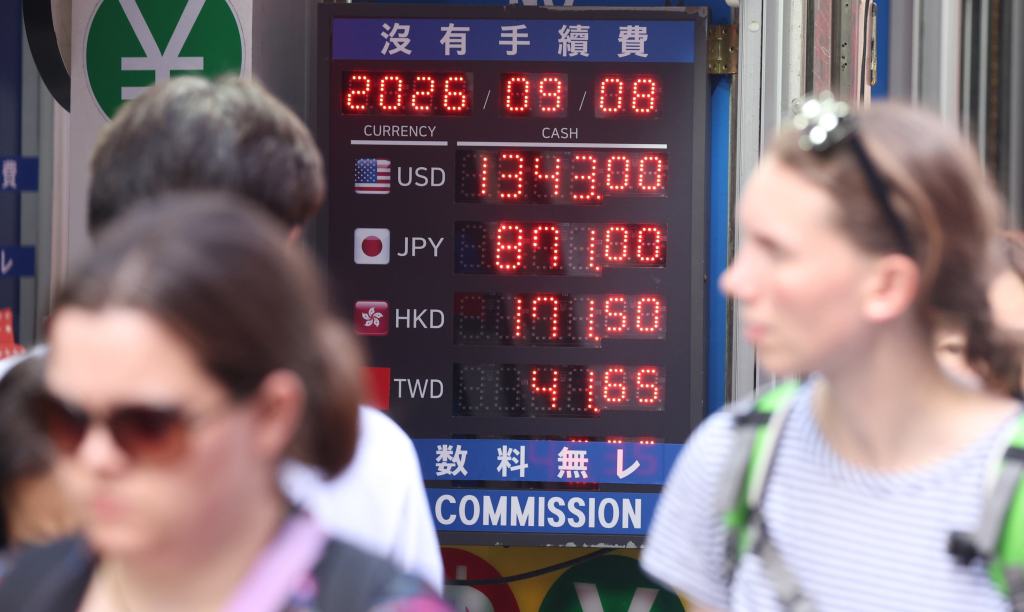
The South Korean won’s value against the U.S. dollar has risen by over 200 Korean won in about two months, increasing financial pressure on companies’ earnings and fund management. Export firms see reduced won-denominated revenue when converting dollar earnings, while importers who secured dollars in advance missed cost-saving opportunities amid further declines. Although the won’s strength lowers import prices, analysts note the rapid pace complicates companies’ pricing and currency conversion strategies.
On the 9th, the dollar-won exchange rate closed at 1,336.1 Korean won in Seoul’s foreign exchange market, down 9.5 Korean won from the previous trading day. This marked the first weekly close near 1,330 Korean won since October 4, 2024 (1,333.7 Korean won), approximately 1 year and 11 months ago.
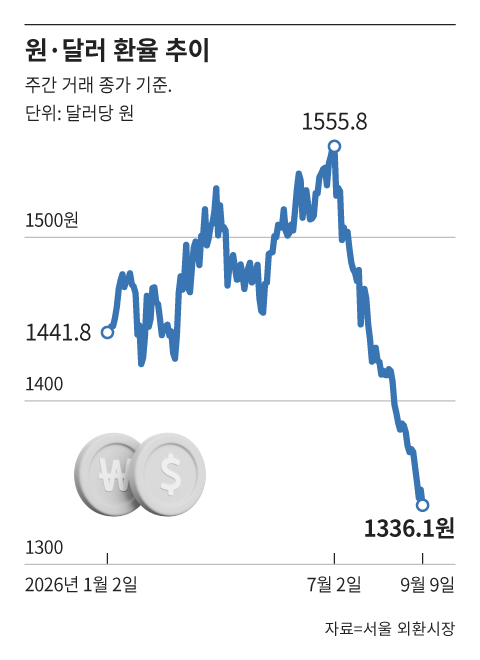
According to the Bank of Korea, the exchange rate fell 11.67% between July and August compared to the end of June—the fourth-largest two-month decline since the market-average exchange rate system was implemented in March 1990. Compared to the recent peak of 1,555.8 Korean won on July 2, the rate dropped 219.7 Korean won in about two months, surpassing the 210 Korean won decline that took roughly ten months during the COVID-19 shock.
The drop was driven by dollar inflows from semiconductor exports, SK Hynix’s American Depositary Receipt (ADR) issuance, and expectations of dollar selling due to expanded shareholder returns. Export firms’ “chasing sales” to offload dollars before further declines also accelerated the fall.
Exporters face reduced won-denominated revenue and profits even if product prices remain unchanged. Daol Investment & Securities estimated that a 100 Korean won annual average exchange rate decline could cut Hyundai Motor and Kia’s annual operating profits by approximately 1.9 trillion Korean won and 1.4 trillion Korean won, respectively.
Corporate currency conversions further drive the exchange rate downward. LS Securities analysis showed that a 1 billion dollars increase in ADR issuance or shareholder return-related conversions lowers the rate by about 3.6 Korean won. Market observers note that despite the completion of mid-year corporate tax prepayments, remaining dollar deposits could fuel continued selling for domestic investments and dividends. Importers delaying dollar purchases in anticipation of further declines also add downward pressure. However, deferred import settlements and dollar purchases for overseas investments could trigger a rebound.




 jasdooit
Leave a comment