
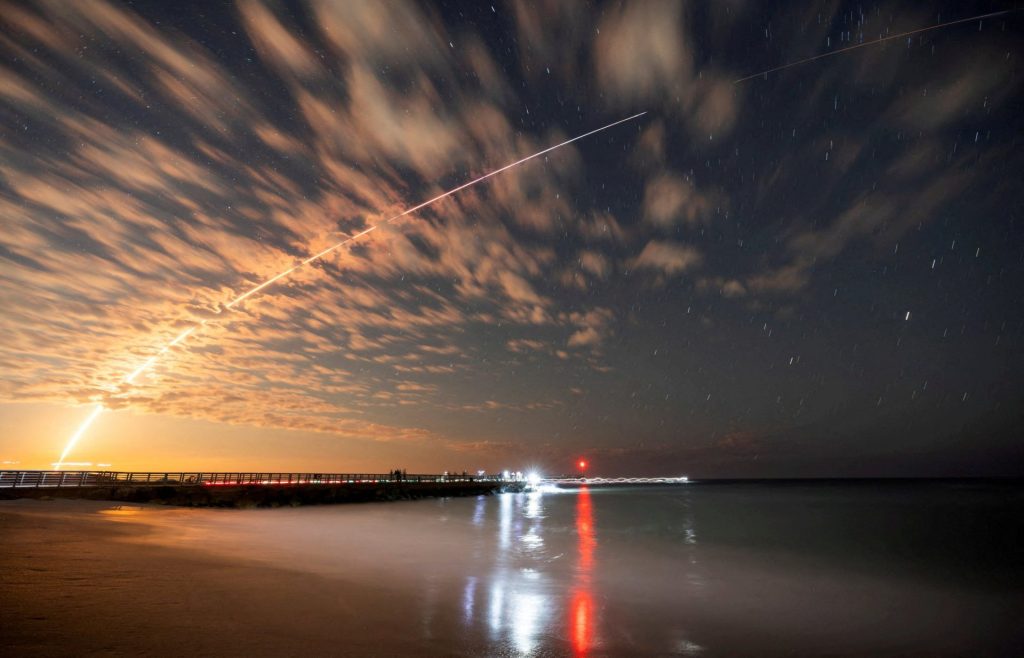
Since the launch of Sputnik almost seventy years ago, governments around the world have been careful about admitting that they have developed – let alone deployed – weapons into orbit. But at the start of this week, that changed.
On 14 September, US Air Force Secretary Troy Meink announced that the United States now has “on-orbit space control weapons capable of defending the joint force” – Pentagon terminology for the US armed forces. It’s the first time the US military has openly acknowledged deploying weapons in space.
Meink gave no information about what the nature of this weapons system might be. Nor do we know anything about how many have been deployed, what orbits they occupy or precisely what they can do. Indeed, even the word “weapon” covers a formidable range of possibilities.
James Bond fans might immediately picture a giant space laser capable of incinerating targets on Earth. It’s unlikely that Meink was referring to anything so dramatic. The more likely target for the weapon is not something on the ground at all, but other satellites – as one US official told The Washington Post.
In practice, that could mean a satellite capable of destroying another satellite, interfering with it electronically, jamming its communications or disabling its sensors. One possibility being discussed by experts is that the newly acknowledged system involves non-kinetic weapons such as orbital jammers, rather than devices designed to blow satellites apart, which would create clouds of dangerous debris.
Space has become extraordinarily important in the past decade. Modern societies depend upon satellites for communications, navigation and weather forecasting, but also for financial transactions, precision agriculture, disaster response, aviation and the synchronisation of everything from electricity grids to mobile-phone networks.
Starlink alone now has more than 11,000 satellites in orbit, while its Direct-to-Cell network connects millions of ordinary mobile phones. SpaceX describes the satellites rather neatly as “cell towers in space”.
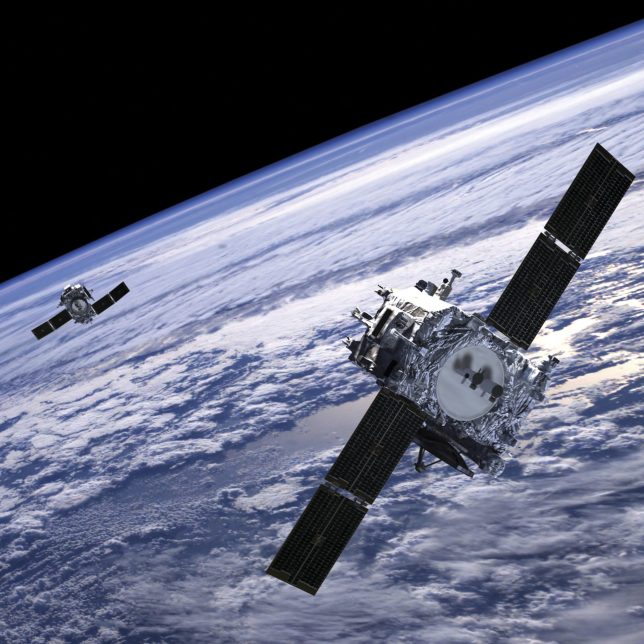
Satellites also allow us to measure changes in oceans, ice, forests and the atmosphere, and so better understand the changing climate. They are vital in helping scientists track the health and status of the planet, gathering vast amounts of real-time data that have transformed the way we understand everything from rising sea levels and retreating ice sheets to deforestation, drought and changes in atmospheric temperature.
Then there is our view outwards. The James Webb Space Telescope, launched in 2021, is observing everything from the earliest galaxies to the atmospheres of distant worlds.
Yet, as so often in human history, extraordinary technological advances go hand in hand with defence funding and military applications. The same satellite systems that guide aircraft, monitor hurricanes or provide internet access can guide missiles, transmit battlefield intelligence and allow armies to communicate. Ukraine has demonstrated how strategically important commercial satellite communications can be during a war. Russia has, as a result, described commercial satellites used for military purposes as potential legitimate targets.
There are international rules governing all this, although they are considerably less comprehensive than is sometimes assumed.
The Outer Space Treaty of 1967 grew out of mounting concern that the Cold War arms race might spread beyond our orbit, at a time when the US and the Soviet Union had developed rockets that were capable of carrying nuclear warheads into space. The treaty prohibits countries from placing nuclear weapons or other weapons of mass destruction into orbit – and requires the Moon and other celestial bodies to be used for peaceful purposes only.
But attempts to strengthen those rules have repeatedly run into problems. In April 2024, Russia vetoed a joint US-Japanese proposal, submitted to the UN Security Council, that was intended to reaffirm the prohibition on nuclear weapons in space and called for measures to prevent an arms race from developing.

Linda Thomas-Greenfield, the US ambassador to the UN at the time, warned that putting a nuclear weapon into orbit would be “unprecedented, unacceptable and deeply dangerous”.
That episode followed an extraordinary flurry of activity and anxiety in Washington. A few weeks earlier, Mike Turner, the House Intelligence Committee chairman, had issued a cryptic warning about a “serious national security threat”. It soon emerged that he was referring to US intelligence that Russia was developing a nuclear anti-satellite weapon – a device that could potentially be detonated in orbit, producing an electromagnetic pulse that was capable of disabling large numbers of satellites simultaneously.
Russia strenuously denied that it was developing any such weapon.
Turner’s comments led to speculation about Cosmos 2553, a Russian satellite launched in February 2022, just weeks before its invasion of Ukraine. US officials later said the satellite was connected to Moscow’s nuclear anti-satellite programme and was being used to test components of a potential weapon, but was not itself believed to be carrying a nuclear warhead.
Meink’s announcement this week will not have been clumsy or coincidental. And the timing is certainly striking, coming after a weekend dominated by warnings about another technological arms race: AI. Much of that discussion focused on America’s lead over China, and on Donald Trump’s characteristically stark assertion that “whoever wins AI, wins”.
Space and AI are very different, but the underlying logic is becoming strikingly similar. Technological supremacy is increasingly being presented not simply as an economic advantage, but as a matter of national power and security – a contest in which coming second means coming last.
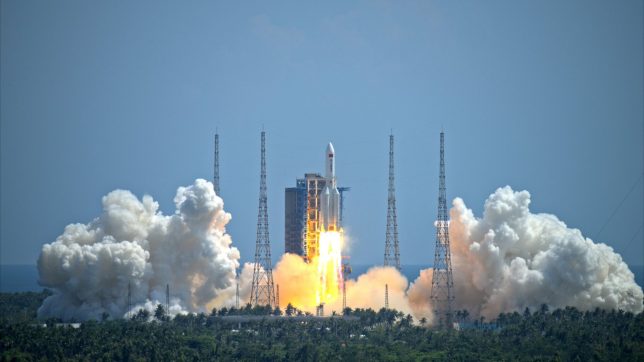
Deterrence, of course, partly depends on letting your opponents know that you possess capabilities that provide a key advantage. But comments like Meink’s also bring consequences: once Washington announces weapons in orbit, Beijing and Moscow acquire an obvious justification for accelerating – or publicly acknowledging – their own programmes.
For now, China has called for restraint, warning that the announcement risks triggering a new arms race. “We urge the US side to stop expanding its military capabilities and preparing for war in outer space,” said foreign ministry spokesperson Guo Jiakun.
Alongside discussions about AI and the end of civilisation as we know it, September 2026 is providing an uncomfortable glimpse of the future. Technologies that promise extraordinary benefits are simultaneously becoming instruments of strategic and military competition. Historians will tell you that it was ever thus, from the invention of stirrups to the adoption of gunpowder.
But for the first time in history, man-made threats now extend beyond the limits of the Earth itself. And make no mistake: this is just the start.
Peter Frankopan is a professor of Global History at Oxford University



 jasdooit
Leave a comment