
Kathmandu, Sept. 19 — More than 4,400 people applied for Nepal’s vacant ambassadorial positions when the Ministry of Foreign Affairs opened the selection process to the public in May. After screening out duplicate and incomplete applications, officials narrowed the pool to around 2,700 candidates.
Five months later, the government on Friday recommended 13 of them as Nepal’s next ambassadors, including to India, China and the United States.
The remaining nine ambassadorial recommendations will be made after Foreign Minister Shisir Khanal returns from New York, where he is attending the 81st session of the United Nations General Assembly.
The recommendations followed several days of consultations after the Foreign Ministry prepared a list of probable candidates last week. According to officials familiar with the process, Prime Minister Balendra Shah and Rastriya Swatantra Party chair Rabi Lamichhane held discussions on the proposed names before a final list was presented to the Cabinet.
“A proposal was taken to the Cabinet only after building a consensus,” said a senior government official familiar with the development.
The government was also working against a deadline, with both Shah and Khanal preparing to leave for New York for the UN General Assembly. Friday was effectively the last opportunity to endorse the names before their departure.
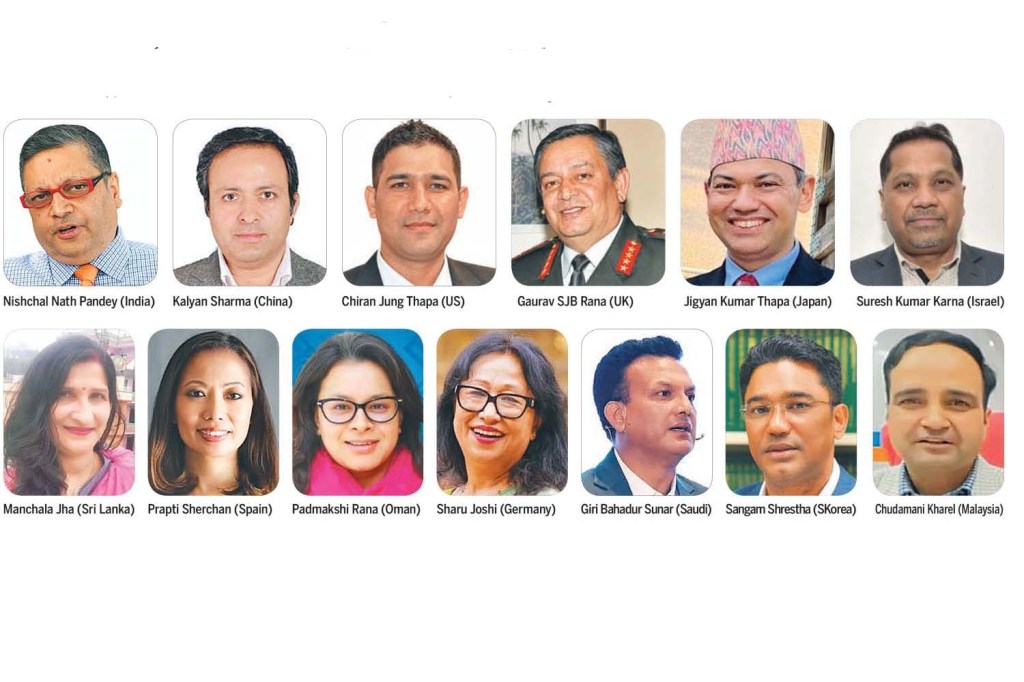
Under Friday’s Cabinet decision, Nishchal Nath Pandey, Kalyan Raj Sharma and Chiran Jung Thapa have been recommended as ambassadors to India, China and the United States, respectively. The Cabinet also cleared retired chief of Nepal Army Gaurav Shumsher Jung Bahadur Rana for the United Kingdom, Jigyan Kumar Thapa for Japan, Suresh Kumar Karna for Israel, Prapti Sherchan for Spain, Sharu Joshi for Germany, Dr Padmakshi Rana for Oman, Chudamani Kharel for Malaysia, Sangam Shrestha for South Korea, Manchala Jha for Sri Lanka, and Giri Bahadur Sunar for Saudi Arabia.
The list brings together diplomats and foreign-policy specialists as well as people with backgrounds in academia, banking, the military, development and international organisations.
Foreign affairs expert Pramod Jaiswal said the professional backgrounds of several nominees stood out.
“It is encouraging to see experts, scholars, and subject-matter specialists with strong educational and professional backgrounds being selected for these important diplomatic positions,” Jaiswal said.
He said ambassadorial appointments in the past have often been viewed as being influenced by political connections or proximity to political parties, while the current selections appeared to put greater emphasis on expertise and professional qualifications.
Foreign affairs expert Indra Adhikari also said the selection process appeared to have improved, particularly in terms of defining the qualifications expected of diplomatic representatives.
“The terms of reference for diplomats and heads of missions were not clearly known or defined before. That has now been improved,” Adhikari said. “People who are known and recognised in their respective fields have been selected, and we had said that the candidates should have experience working in the relevant area.”
She, however, pointed to a potential conflict of interest involving some nominees with backgrounds in the development sector, saying similar appointments had drawn questions in the past.
“There are quite a few people from the development sector among those selected this time,” she said. “There could be a potential conflict of interest.”
After reviewing some of the nominees, their backgrounds and past affiliations, one former diplomat raised a broader question: “Did we preserve strategic autonomy, or did we compromise on strategic autonomy?”
Pandey, nominated for India, has directed the Centre for South Asian Studies and previously led the Institute of Foreign Affairs under the Ministry of Foreign Affairs from 1998 to 2006. He also advised the National Planning Commission on tourism and civil aviation in the mid-1990s and served on Nepal’s Truth and Reconciliation Commission and a high-level foreign policy task force.
Sharma, nominated for China, is a Sinologist and economist who holds a PhD in economics from Fudan University. He chairs the Fudan University Alumni Association of Nepal and the Nepal-China Friendship Forum, and teaches a course on doing business in China at Kathmandu University.
Thapa, headed for Washington, brings two decades of experience in security policy and crisis management, including years as Oxfam’s regional security adviser for Asia and earlier postings advising Nepal’s Ministry of Defence and security agencies. He is the first non-uniformed Nepali to complete Harvard Kennedy School’s homeland security leadership programme.
General Rana, nominated for the UK, served four decades in the Nepali Army and oversaw the integration of former Maoist combatants under the Comprehensive Peace Agreement. He later commanded Nepal’s UNIFIL peacekeeping battalion in Lebanon and now chairs the Conservation Alliance Nepal.
Thapa, nominated for Japan, has spent more than 20 years cultivating Nepal-Japan ties, including work at the Kanagawa International Foundation and coordination of high-level bilateral visits between the two countries’ leaders.
A minister told the Post that the government had taken the Supreme Court’s verdict into account in preparing the list, with an effort to ensure representation across gender, Janajati and Madhesi communities.
Karna, nominated for Israel, brings three decades in IT, banking and economic policy, including a stint as chief operating officer of Nepal Bank Limited. Sherchan, nominated for Spain, has led IFC’s gender and inclusive-finance programmes across Asia and Africa. Joshi, nominated for Germany, has more than 25 years in labour migration governance and gender policy, including work at UN Women. Rana, nominated for Oman, co-founded Impact Hub Kathmandu and has built partnerships with the EU, UNDP and UNICEF. Kharel, nominated for Malaysia, currently serves as general secretary of the Nepal Yoga Sports Association.
Shrestha, nominated for South Korea, is a former dean at the Asian Institute of Technology with a long record in climate and water-security diplomacy. Jha, nominated for Sri Lanka, served as a commissioner on Nepal’s Truth and Reconciliation Commission and teaches governance at Tribhuvan University. Sunar, nominated for Saudi Arabia, has more than 25 years of experience in social safeguards and community-based climate adaptation across World Bank and ADB programmes.
The ambassadorial vacancies followed two rounds of recalls. The Sushila Karki government recalled Nepal’s ambassadors to China, Germany, Israel, Malaysia, Qatar, Russia, Saudi Arabia, Spain, the US, the UK and Japan on October 16. The Balendra Shah government followed on April 7 by recalling six more envoys-from India, Australia, Sri Lanka, South Korea, Denmark and South Africa-without immediately naming replacements, leaving 17 missions without a Nepali envoy for months.
With Friday’s Cabinet endorsement, the names will now go to Parliament for hearings. Once the Parliamentary Hearing Special Committee clears them, the Ministry of Foreign Affairs will seek agrment from the respective host countries. The president will formally appoint the ambassadors only after that process is completed.



 jasdooit
Leave a comment