
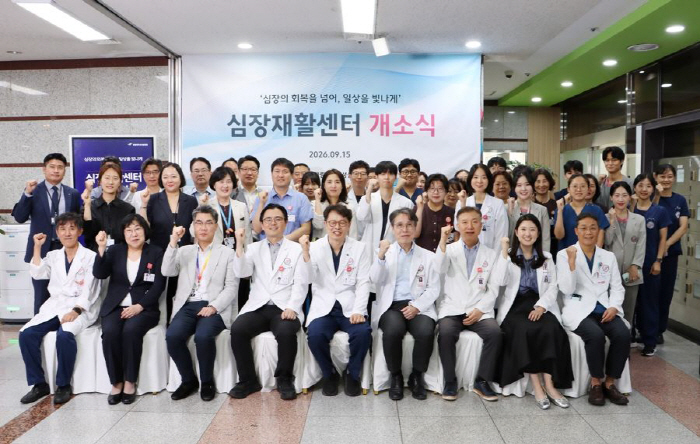
[reporter Jang Jong-ho] Hallym University Sacred Heart Hospital, led by Director Kim Hyung-soo, opened its Cardiac Rehabilitation Center on the 15th to provide structured cardiac rehabilitation care aimed at helping cardiovascular disease patients recover after treatment and prevent recurrence. About 30 people attended the opening ceremony, including Kim Hyung-soo, director of Hallym University Sacred Heart Hospital, key hospital officials, medical staff from the departments of Rehabilitation Medicine, Cardiology, and Thoracic and Cardiovascular Surgery, and hospital employees.
Cardiac rehabilitation helps patients who have received acute treatment for cardiovascular disease, including medication, procedures, or surgery, safely recover their physical function and exercise capacity while reducing the risk of recurrence. The main beneficiaries are patients who have experienced cardiovascular conditions such as angina, myocardial infarction, or heart failure, as well as those whose physical function and exercise capacity have declined after undergoing procedures or surgeries such as percutaneous coronary intervention, coronary artery bypass grafting, or heart valve surgery. After assessing each patient’s disease status, cardiac function, exercise capacity, comorbidities, and risk factors, medical staff determine an individualized exercise program and intensity.
At the Cardiac Rehabilitation Center of Hallym University Sacred Heart Hospital, patients undergo everything from detailed pre-exercise evaluations to actual rehabilitation treatment in a single space.
Patients first receive medical consultations and education before undergoing a cardiopulmonary exercise test (CPET) using an exercise stress electrocardiography system, blood pressure monitor, respiratory gas analyzer, and oxygen saturation monitor. During exercise, medical staff check changes in the patient’s electrocardiogram, blood pressure, and heart rate, while analyzing breathing to assess exercise capacity and cardiopulmonary function.
Based on these results, medical staff comprehensively assess each patient’s condition according to underlying diseases, cardiopulmonary function, and physical function before prescribing an individualized exercise intensity and method. Patients then undergo exercise therapy in stages using specialized equipment, including treadmills and cycle ergometers at the center. For patients who have difficulty walking or face a risk of falls, the exercise methods and assessment procedures are adjusted to reflect their physical condition.
Cardiovascular disease patients may experience significant disease-related changes in their heart rate, blood pressure, or electrocardiogram during exercise. Therefore, not only “how much they exercise” but also “how safely they exercise” is important. The center has established a monitoring system to closely and continuously track changes during exercise according to each patient’s condition. It has also equipped the facility with emergency medical equipment and response protocols so that staff can respond immediately if abnormal signs or emergencies occur.
A dedicated nurse and physical therapist are stationed at the Cardiac Rehabilitation Center to oversee the entire process, from patient testing to exercise therapy. They continuously monitor patients’ conditions and responses to exercise, gradually adjusting the intensity in accordance with the medical team’s prescriptions.
In particular, the hospital has established a multidisciplinary care system involving close cooperation among the departments of Rehabilitation Medicine, Cardiology, and Thoracic and Cardiovascular Surgery. The departments share patients’ treatment progress and medical conditions and coordinate referrals so that those requiring care can receive cardiac rehabilitation.
Through this initiative, Hallym University Sacred Heart Hospital has strengthened a cardiovascular disease care system covering the entire continuum—from conservative management, procedures, and surgery to treatment, recovery, recurrence prevention, and a return to daily life—rather than ending care once the initial treatment is complete.
Kim Hyung-soo, director of Hallym University Sacred Heart Hospital, said, “For cardiovascular disease, it is just as important to continue managing patients after treatment so they can safely return to daily life and prevent recurrence as it is to treat them during a medical emergency.” He added, “Centered on the Cardiac Rehabilitation Center, we will closely integrate the expertise of Rehabilitation Medicine, Cardiology, and Thoracic and Cardiovascular Surgery and provide safe, structured, personalized cardiac rehabilitation treatment to patients who come to our hospital.”
Reporter Jang Jong-ho bellho@
This article has been translated by GripLabs Mingo AI.
- Mir, Whose Girlfriend Is a Pilates Instructor, Reveals His Newlywed Home… “Some People Still Don’t Know I’m Married”
- Five Years After Leaving “Superman Is Back,” Gary Still Draws Fans’ Cameras at Thai Airports and on the Street… Son Ha O Also Gains Popularity
- Lee Hee-jin, 47, Recounts Painful Past Romance After Fortune Teller Says She Has No Marriage Luck: “My Ex Cheated and Even Spent My Money”
- Shownu of Kkingkkingkking Will Strip Down Again This Year… Teases Bold WATERBOMB Reveal: “I’ll Go with a Minimal Outfit” (Thursday Night)
- Park Mi-sun Endured Seven Hours by the Hangang River While Battling Cancer: “A Woman Crazy About Fireworks”



 jasdooit
Leave a comment