
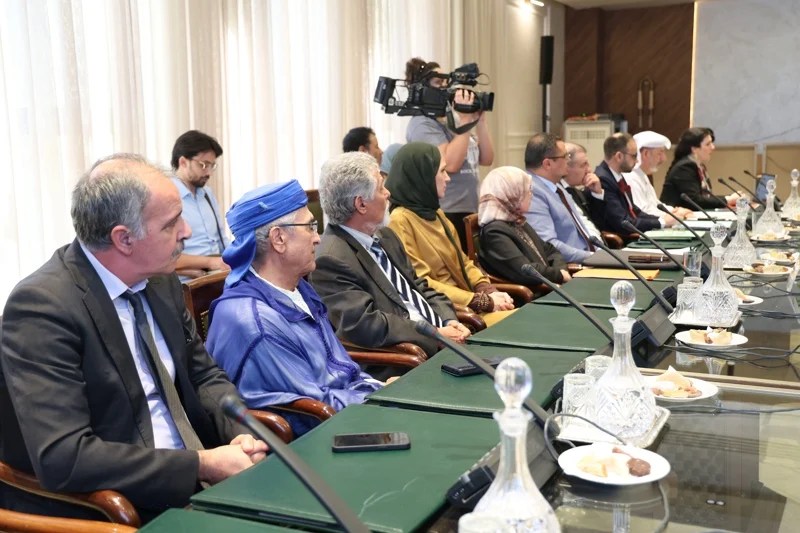
Morocco’s Royal Academy on Friday launched a research and studies chair dedicated to Maghrebi calligraphy, bringing together specialists to discuss its future research, documentation and training programs and potential cooperation with institutions, museums and experts around the world.
The chair was inaugurated at the academy’s headquarters in Rabat as part of an effort to document and study the history, development and distinctive characteristics of Morocco’s calligraphic traditions.
Abdeljalil Lahjomri, permanent secretary of the Royal Academy, said the new chair aims to give Maghrebi calligraphy the research and documentation it deserves while highlighting its national and civilizational dimensions and enriching academic research into Morocco’s written heritage.
“Maghrebi calligraphy was not formed in a fleeting moment, nor was it merely an aesthetic variation of Arabic writing,” Lahjomri said, describing it as the product of centuries of cultural development.
He traced its evolution from the early Islamic period through major historical centers including Kairouan, Fez and al-Andalus, where it developed distinctive characteristics in the form of letters, visual rhythm and aesthetic balance.
The script was used in Quranic schools, scientific institutions, scholarly works, legal documents, manuscripts and Quranic copies, as well as in traditions of observation and imitation that helped preserve calligraphic knowledge in Morocco for centuries, Lahjomri said.
He contrasted that history with the Ottoman calligraphic tradition, which developed a more formalized system based on the relationship between teacher and student, correction and gradual training, eventually leading to an ijazah, or certification authorizing the student to practice the craft.
The Moroccan and Andalusian experience, by comparison, relied more heavily on community and professional transmission, Lahjomri said. While that helped preserve the substance of the tradition, it left less documented evidence tracing how knowledge was transmitted from one generation to another.
The new chair is expected to serve as a research space examining Maghrebi calligraphy through its history, forms, aesthetics and spiritual and artistic dimensions.
It will also seek to document the living transmission of calligraphic knowledge, including systems of certification and chains of transmission, creating an academic record that researchers and historians can use to trace the development of the tradition.
Lahjomri said the goal goes beyond preserving historical artifacts.
The academy wants to help ensure that Maghrebi calligraphy continues to generate knowledge, engage younger generations and enter into artistic and academic dialogue with other Arabic calligraphic schools while maintaining its distinctive identity and historical roots.
“This is an important stage,” Lahjomri said, because it could help transform Maghrebi calligraphy from a tradition closely associated with its local historical environment into a form of artistic and scholarly heritage that can be taught and circulated internationally.
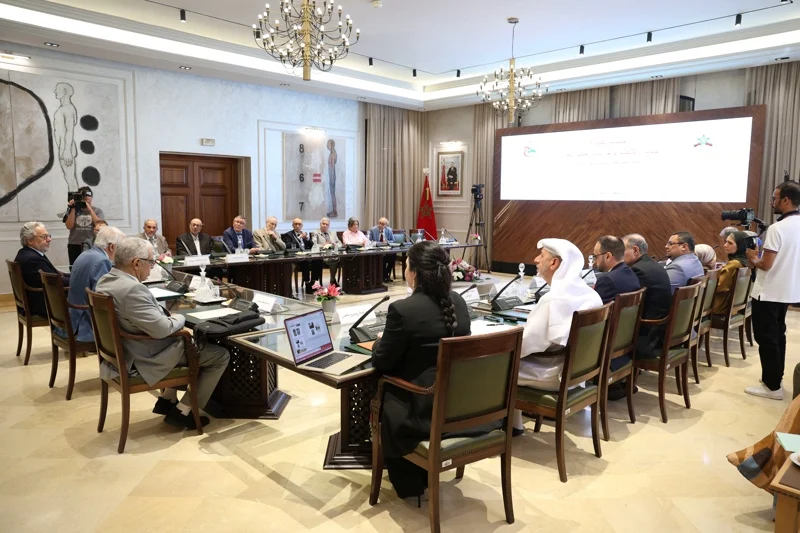
Belaid Hamidi, who oversees the research chair, said the initiative could establish a documented system of ijazah and continuous chains of transmission between master calligraphers and students, supported by training notebooks.
Maghrebi calligraphy was historically transmitted largely through oral and practical teaching in Quranic schools, scholarly institutions and the judiciary, Hamidi said, making it difficult for historians to reconstruct complete chains of transmission between Morocco and al-Andalus.
The chair aims to build such a record so that future calligraphers and researchers will have an authoritative reference, he said.
Mahmoud Roul Kilic, director-general of the Research Centre for Islamic History, Art and Culture in Turkey, described the establishment of the chair as an important initiative for strengthening the position of Maghrebi calligraphy both within its traditional geographical context and internationally.
Arabic calligraphy, also known as Islamic calligraphy, has become one of the world’s major art forms, with numerous regional styles and traditions, he said.
Adiba Romero Sánchez, vice president of the Granada-based Thaqara Cultural Foundation, described the chair as an opportunity to study and promote a shared Moroccan-Andalusian heritage.
Romero Sánchez cited historian Ibn Khaldun’s treatment of writing as part of civilization, knowledge and collective memory. She argued that the history of calligraphy is also a history of the environments and routes through which knowledge traveled.
Her research into Islamic manuscripts, she said, has shown that the history of calligraphy cannot be understood solely through later classifications. Multiple calligraphic traditions coexisted in al-Andalus, which she described as part of a wider Mediterranean network rather than an isolated cultural space.
Citing the work of Moroccan historians Mohamed El Manouni and Ahmed Chouqui Binebine, Romero Sánchez said calligraphic traditions traveled with scribes, copyists and the scholarly practices they carried with them.
She pointed to the Almoravid period as an example of intensified connections between the two shores of the Mediterranean, with manuscripts, libraries, scribes and books moving between al-Andalus and Morocco.
Those exchanges allowed writing traditions to interact and develop new characteristics within different environments, contributing to distinctive forms of writing in Morocco, she said.
Romero Sánchez called for the new chair to provide a scientific forum where researchers can work directly from historical evidence and manuscripts to examine questions surrounding the terminology used for Maghrebi calligraphy, the chronology of its development and the evolution of calligraphic traditions across the western Islamic world.
The Rabat meeting also featured presentations of initiatives from other institutions, including the Kuwait Center for Islamic Arts. Its director, Farid Al Ali, presented the center’s experience from its initial concept and planning stages through the development of institutional relationships and the accumulation of expertise.
The Royal Academy said the chair will continue developing research, training and institutional partnerships aimed at documenting Maghrebi calligraphy and expanding its presence in academic and cultural institutions beyond Morocco.
The post Morocco’s Royal Academy launches research chair dedicated to Maghrebi calligraphy appeared first on English – Morocco News.



 jasdooit
Leave a comment