
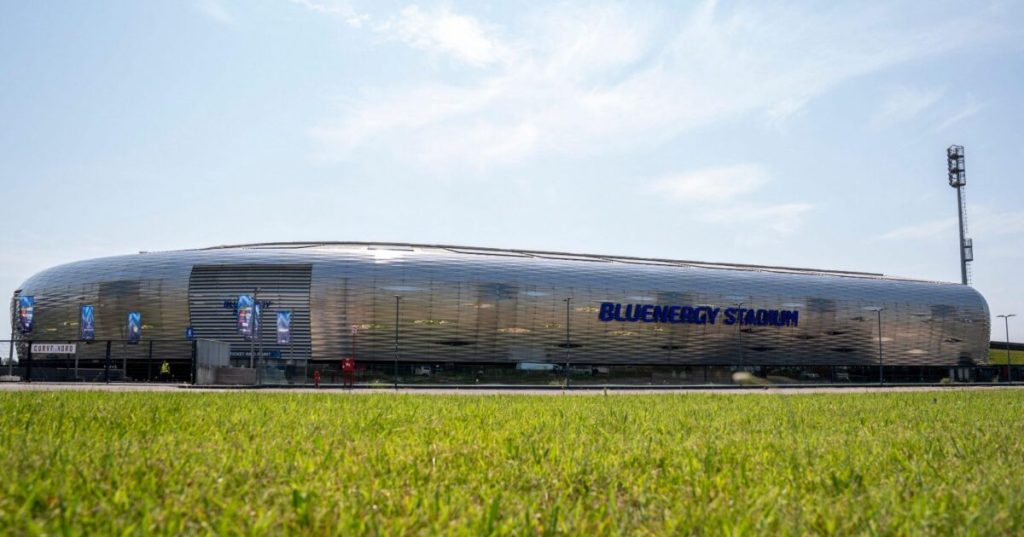
There will be nothing especially remarkable about Udinese hosting Cagliari on Saturday afternoon. Two Serie A teams will turn up at the Bluenergy Stadium, thousands of supporters will make their way through the turnstiles and, at 3pm local time, somebody will kick a football.
Everything around the game is where it gets interesting.
Udinese v Cagliari on September 19 will be the first league fixture organised using UEFA’s new Football Event Sustainability Manual as the framework for a dedicated matchday. Under the banner Play for Sustainability, Udinese are effectively turning a fairly ordinary Serie A game into a test site for what a greener football match might look like.
Find out how you can help you team rise up the Pledgeball League table
This is not a promise that one afternoon in Udine will save the planet. The idea is more practical: change a series of smaller things, collect data on what happens and establish a benchmark against which future editions can be measured.
Some of those changes begin before supporters reach the stadium.
Local transport operators TPL FVG and Arriva Udine are increasing services to the Bluenergy Stadium. Supporters with a season ticket or match ticket can use designated buses free of charge, including additional services between Udine railway station and the ground. A dedicated bus will also connect Tolmezzo with the stadium.
Then there are the bikes. A 5km group ride will leave Udine’s Piazza I Maggio at 1.30pm and finish at the stadium, where supervised bicycle parking will be provided. Participants get a free match ticket and merchandise. A local bike-sharing promotion also offers two 20-minute rides for €2.
It is an unusually practical answer to football’s transport problem. Telling supporters they should drive less is easy; giving them a bus timed around the final whistle or somewhere safe to leave a bicycle requires somebody to organise it.
Once inside, the experiment continues. Food outlets will offer vegan, vegetarian and gluten-free choices, with uneaten food donated to Banco Alimentare rather than discarded. After the match, supporters can join Plastic Free volunteers in cleaning the stands. Accessibility volunteers will be present and an audio-description service will allow visually impaired supporters to follow the game.
None of those things sounds revolutionary on its own. But that’s the point.
Football’s environmental footprint isn’t produced by one spectacularly wasteful act repeated every Saturday. It comes from thousands of journeys, food being prepared, rubbish being generated and stadiums being heated, cooled, watered and powered. Udinese want to know what happens when those mundane processes are treated as part of organising the football match rather than a sustainability project bolted on afterwards.
UEFA launched their Football Event Sustainability Manual alongside European Leagues in June. It covers the full lifecycle of an event and uses what UEFA call a “pick-and-drop” approach, allowing clubs to select measures appropriate to their resources and circumstances rather than following one universal blueprint.
Udinese are the first club to take that framework and apply it to a dedicated domestic league fixture.
Did you know, 100,000 tonnes of sportswear ends up in landfill every year in the UK alone?
There is an obvious advantage to trying this with something as gloriously routine as Udinese-Cagliari rather than a Champions League final. European finals have increasingly incorporated measures around waste, transport, accessibility and the circular economy, but they are unusual events with huge budgets.
READ: Arsenal, Liverpool and Man City among greenest Champions League clubs
If sustainable practices are going to matter across football, they also have to work on normal league weekends.
Udinese already have a decent head start. The roof of the Bluenergy Stadium carries 2,409 photovoltaic panels, which the club say generate around 3,000kWh of electricity per day on average. The project also supports Energia in Campo, a renewable-energy community through which surplus electricity generated at the stadium can be shared with supporters and local businesses.
The club also measure their emissions using UEFA’s Carbon Footprint Calculator. Its analysis found that indirect Scope 3 emissions associated with areas including goods, services and mobility represented around 78% of the measured footprint. Direct emissions accounted for roughly 12% and purchased-energy emissions around nine per cent.
Suddenly the free bus and 5km bike ride look rather less like nice matchday gimmicks.
A club can cover their stadium roof in solar panels and still have thousands of supporters arriving individually in cars. They can run on renewable electricity while throwing away uneaten food. Sustainability becomes more complicated once the obvious jobs are done.
Supporter travel is particularly difficult because clubs cannot simply order thousands of people onto trains. What they can do is make alternatives more convenient. Udinese aren’t merely asking supporters to cycle; they’re providing parking, organising a group ride and giving participants a ticket. They’re not simply recommending public transport; they’re increasing services and making specified buses free.
Saturday should begin to show whether supporters take up those alternatives.
Udinese will collect data covering mobility, energy consumption, waste, catering and participation, with preliminary findings due after the match. Play for Sustainability will then return annually, allowing this first edition to become a baseline against which future matchdays can be measured.
That might be the most important part. Football has become extremely good at announcing sustainability initiatives. Finding out whether anybody used the special bus, how much waste was avoided and whether next year’s numbers improve is less glamorous but considerably more useful.
Italian football already has some experience of this. Lega Serie A’s Road to Zero programme has used the Coppa Italia final as a sustainability test bed since 2024, trialling measures around transport, energy, waste, food redistribution and accessibility. Udinese are now taking similar thinking into the much more ordinary environment of a regular league fixture.
That matters because this has to become ordinary. A bicycle scheme that works in Udine will not necessarily work in Manchester, Madrid or Istanbul. Geography, public transport and supporter habits differ too much for a single template.
What can be copied is the process: work out where the impact comes from, try something practical, measure it, publish what happened and come back next year to see whether anything improved.
Football does plenty of talking about sustainability. On Saturday, Udinese are attempting the considerably less glamorous business of finding out what actually works.
Watch Route ’26: Losing Sight of Goal, by following Pledgeball on Instagram and YouTube


 jasdooit
Leave a comment